

Nowadays, army children are taught in proper schools, by proper teachers, and sit proper exams that, if passed, will give them recognised qualifications that will help them to progress in the world. Yet during the eighteenth century, the only schooling that the sons and daughters of non-commissioned officers would have received was in cursing and fending for themselves and, if they were girls, making themselves useful by washing and sewing for their father's soldier comrades. Although regimental schools were increasingly being established, with senior non-commissioned officers initially doing the teaching, these were originally intended to teach illiterate recruits how to read, write and calculate. But then because many of those illiterate recruits were army children, the realisation dawned that the regimental schools might as well start teaching these soldiers-in-the-making, and their future wives (for many army daughters later 'married into' the regiment) while they were still young. And occupying army children with schoolwork and needlework also had the advantage of keeping them out of trouble!
By the nineteenth century, regimental schools catering for army children and teaching a wide range of subjects (practical, as well as academic) were relatively commonplace, and in this respect, the army was ahead of its time. The regimental schools were replaced by garrison schools in 1887, and administrative changes have continued to be made in response to changing times, with the British Families Education Service (BFES) being set up to educate army children in Germany in the aftermath of World War II, for instance. Today, the schooling of army children abroad is provided by Service Children's Education (SCE), and when in Britain, army children attend local schools, that is, unless they are at boarding school.
Officers' children may always have received an education appropriate to their perceived status, but at the price of separation from their parents (often for years on end), for they were generally sent to a boarding establishment, be it a public school, a ladies' academy or a finishing school, in Britain. In addition, there were military boarding schools: the Royal Hibernian Military School (RHMS), established in 1769 in Dublin, Ireland, and the Royal Military Asylum (RMA), founded in 1801 in Chelsea, London, and today known as the Duke of York's Royal Military School in Dover, Kent. It has now been decades since all army children have been able to enjoy the (dubious) privilege of a boarding-school education, thanks to a continuity of education allowance (CEA), or boarding-school allowance (BSA), and subsidised flights to join their parents during the holidays. Indeed, the agonising decision as to whether to sacrifice family togetherness in favour of the undoubted benefits of stability and continuity of curricula during crucial pre-GCSE and A' level years is one that all peripatetic army families must continue to take.
IN MEMORIAM: ART COCKERILL (1929–2016)
We were saddened to learn of the death, on 27 June 2016, of Art Cockerill, and thank his family for permission to reproduce Chris Crowcroft’s obituary of Art below.
'Soldier, hydro-electric pioneer, engineer, author, librettist, publisher and freelance contributor to Guardian Weekly, Arthur (Art) Cockerill has died at the age of eighty-seven in Cobourg, Ontario.
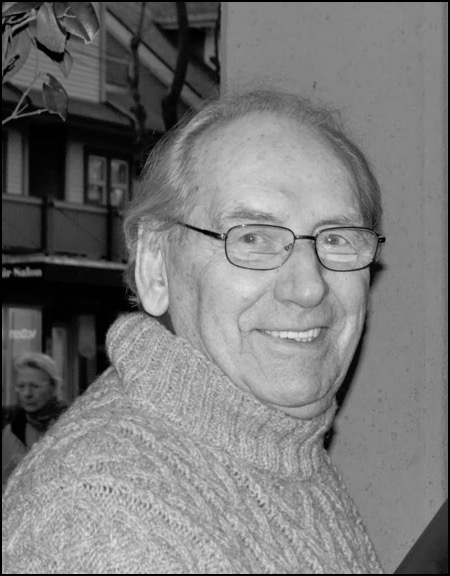
Born in Blidworth, Northamptonshire, Art was the fourth of ten children, all of whom feature in his novel Lay Gently on the Coals (Aesop Modern, 2011). As the son of a World War I regular soldier, Art entered the Duke of York’s Royal Military School in 1939. A proud “Dukie”, he went on to write the school’s bicentenary history, The Charity of Mars (Black Cat Press, 2002) and was a founder-member of its Clocktower Society. The school’s motto was the title of his history of boy soldiers, Sons of the Brave (Secker & Warburg, 1984). His fascination with military history led to the authorised biography of MI5 chief Sir Percy Sillitoe (W H Allen, 1975) and Winning the Radar War (with Jack Nissen, Robert Hale, 1989). A children’s book, Emma on Albert Street (Black Cat Press, 1997), was illustrated by Bill Slavin.
Commissioned into the Royal Engineers, he served post-war in Egypt. In 1957, he emigrated with his wife, Beryl, to Canada, where he worked as a hydro-electric engineer. His largest project was in Labrador, with lead investor Edmund de Rothschild. He also wrote the book for a musical, taking advice from George S Kaufman and Tyrone Guthrie – Art was never shy.
Leaving Quebec in the 1960s, he moved with his second wife, Charlotte, to Cobourg, Ontario, where he raised his family and pursued a successful engineering career that took him to Africa, the Caribbean and the Middle East. While working on airport installations in Libya, he had the opportunity to interview Gaddafi. He also spent time in custody. He established Delta Tech Systems, a technical publishing company that was “more lucrative”, he joked, “than any other publishing I undertook”. He championed social causes, ran for political office and played the clarinet in the Cobourg Kiltie Band, a skill learned at military school. Active to the end, he contributed and collaborated on many articles on military history and education to specialist historical reviews.
Art is survived by Charlotte, his wife of more than fifty years, and his children, John, Kate and Emma, as well as seven grandchildren and three great-grandchildren. His daughter Sarah predeceased him in 2001.
His energy, joie de vivre and uninhibited generosity to others means that he will not be forgotten.’
TACA echoes Chris’s closing words. A pioneering researcher, often with Peter Goble, into the history of army education, the Royal Hibernian Military School and, above all, the Duke of York’s Royal Military School – and more – Art was an enthusiastic and generous supporter of TACA ever since its establishment in 2007. Indeed, you will find evidence of Art’s erudition, and of his willingness to share his expertise, throughout the TACA website (see, for example, ‘PERSONAL STORY: KILLED IN ACTION’, ‘PICTURE: A REGIMENTAL SCHOOL IN INDIA’, ‘BACKGROUND INFORMATION: A SINGULAR AND MOST UNUSUAL SUB-POST OFFICE’, ‘TACA CORRESPONDENCE: BOY SOLDIERS AND EIGHTEENTH-CENTURY REGIMENTAL MUSTER ROLLS’, ‘TACA CORRESPONDENCE: MEMORIAL AT ALL SAINTS' CHURCH, HUTTON, BRENTWOOD, ESSEX’, ‘BOOK: A NEW HISTORY OF THE ROYAL HIBERNIAN MILITARY SCHOOL’ and ‘REVIEW: LAY GENTLY ON THE COALS’). As well as providing a window into his work, Art’s website, http://www.achart.ca, is a rich and important historical resource that will remain accessible to all for the foreseeable future. TACA is immensely indebted to Art, and sends sincere condolences to his family and friends.
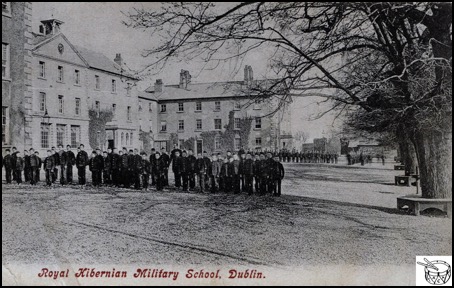
PICTURE: THE ROYAL HIBERNIAN MILITARY SCHOOL, DUBLIN, IRELAND
As the caption states, the photograph below shows the Royal Hibernian Military School in Dublin, Ireland, with its pupils lined up in front of it. Mounted on a postcard back, it was mailed in 1911 from Dublin to a recipient in Nottingham. In existence between 1769 and 1924, the Royal Hibernian School educated the orphaned sons of soldiers or those whose soldier–fathers’ absence overseas had left their families destitute. You can read more about the history of the school on the late Art Cockerill’s website: http://www.achart.ca.
TACA CORRESPONDENCE: WERE TRADES TAUGHT TO ARMY CHILDREN IN THE EARLY NINETEENTH CENTURY?
TACA has received the following message from Gay Fielding (née Campbell):
'My ancestor John Campbell enlisted in the 42nd Regiment in Glasgow in 1825, age 18 years, and his occupation was carpenter (WO 97). John was reportedly born and raised in army camps, according to his lawyer in his court case while he was still serving in 1845 in Nova Scotia. I have not yet been able to identify John's parents to determine whether his father was a soldier/officer of the British Army.
How would John have learned his trade if he and his mother and siblings (?) had been camp followers? Or would he have needed to have remained "at home" while his father was relocated to various theatres of duty? Any help you can give me would be appreciated.'
If you have any information that you think will help Gay, she can be contacted at the following e-mail address: gayze@tpg.com.au.
ARMY SCHOOLMISTRESSES IN THE NINETEENTH AND TWENTIETH CENTURIES
Howard R Clarke is the author of A New History of the Royal Hibernian Military School, 2011. In this illuminating article, Howard traces the history of the army schoolmistresses, an intrepid band of women who taught soldiers’ children wherever they were posted in the world. TACA is grateful to Howard, and to Art Cockerill, for permission to publish this piece, which appears on the Delta Tech Systems website, as do the memoirs of Dorothy Bottle, who is mentioned at the end.
‘The first schoolmistresses who were publicly funded to teach soldiers’ daughters were those employed at the Hibernian School and the Royal Military Asylum, but the origins of army schoolmistresses must be traced back to the system of regimental schools. Although a number of commanding officers (COs) had established schools supported from regimental funds, and had received encouragement from the Duke of York following the policy of enlisting boy soldiers in 1796, it was not until 1812 that the order was given that all battalions and corps should establish regimental schools under the direction of sergeant schoolmasters. The various circulars and orders made it clear that the aim was both to educate young soldiers and attested boys and also soldiers’ children – so that their fathers would know that the state was concerned about their welfare. Hence, from 1812, the regimental schools were open to both the sons and daughters of soldiers, and all were taught to read and write and were given some basic arithmetic tuition by the sergeant schoolmasters. Commanding officers were also encouraged to employ the “best qualified and best behaved women of each Regiment” to instruct the girls in “Plain Work and Knitting”. This was the regime that continued until 1840, and king’s regulations continued to encourage commanding officers to employ soldiers’ wives of good character to instruct the girls in useful domestic skills.
In 1840, there were about 10,000 girls accompanying battalions and corps, or at their depots (this number does not include the artillery or the sappers), and a return compiled by the War Office for the year to 1 January 1837 recorded that there were, on average, 46 boys, 47 girls and 14 adults at each of the schools of the cavalry regiments, and an average 47 boys, 41 girls and 44 adults at the regimental schools of the infantry. In 1840, at the suggestion of Lieutenant-Colonel Somerset, the CO of the Cape Mounted Rifles, the War Office agreed to the appointment of a paid schoolmistress to each infantry battalion and cavalry regiment, and at each infantry depot. Following parliamentary approval, this was effected in a Royal Warrant issued on 29 October 1840, which specified that the schoolmistress should be qualified “to instruct the Female Children of Our Soldiers as well as in reading, writing and the rudiments of arithmetic, as in needlework and other parts of housewifery, and to train them in habits of diligence, honesty and piety”. A circular in November 1840 advised COs to give “careful attention to the morals and habits of the incumbents” and suggested that there were likely to be qualified persons amongst the wives of non-commissioned officers (NCOs). It was left to COs to select suitable persons and make the appointments, and it would be necessary to consult the muster rolls of the units on the Army List to establish how many army schoolmistresses were appointed during the 1840s and 1850s.
In 1850, a Royal Warrant established infant schools, “of which the Schoolmistress shall have the sole charge”, at which both sexes were instructed in reading and writing until they were sufficiently advanced to receive instruction from the trained army schoolmaster in the children’s school. The army schools were therefore co-educational, with the exception of the Royal Artillery schools at Woolwich (and subsequently at the garrison schools at Chatham and in Gibraltar), which had separate boys’ and girls’ schools. The warrant also established industrial schools under the schoolmistress to teach the girls knitting, needlework and household occupations. These were not separate establishments, but merely the name given to the afternoon activities at the children’s schools. (Boys could also attend an industrial school.)
CERTIFICATES OF MORAL CHARACTER REQUIRED
From 1858, female candidates for appointment as army schoolmistresses who did not possess qualified-teacher status were sent at public expense to one of a designated list of teacher-training establishments in Great Britain or Ireland. They had to be between eighteen and thirty-three years of age and to have a certificate of moral character from a clergyman of their religious denomination. There was an expectation that an army schoolmistress would be qualified to teach reading, writing and arithmetic, geography and religious studies, and that she should be a good needlewoman, competent in dressmaking and knitting. She was also expected to possess a taste and ear for music, especially singing. All for around £20 per annum!
It was hardly surprising that Army Inspector Lefroy, in his 1859 inspection, reported that it was difficult to obtain a supply of trained schoolmistresses for regiments. There were plenty of wives and daughters of NCOs who applied for training, but despite having the requisite personal qualities, they had had a poor education. If the schoolmistresses were married, they moved with their husbands, and not to where there were vacancies, and, if they were unmarried, “their employment is restricted by considerations of prudence”. Successive reports dwelt on the difficulties of accommodating single women teachers in barracks.
In 1863, regulations improved the pay and system of appointing schoolmistresses. Pupil-teachers (monitresses) could be appointed, and a new class of assistant schoolmistress was established, with selections being made from NCOs’ wives to assist on the same pay and conditions as pupil-teachers. In 1865, there were 443 female teachers, including 209 trained army schoolmistresses, and the Council of Military Education reported that these were well-qualified and committed to their work. The 1872–73 Inspector’s Report listed 238 trained and qualified schoolmistresses in charge of the infant and industrial schools, 55 acting schoolmistresses (who had passed the army’s entrance examination), 66 pupil-teachers and 336 monitresses.
It was difficult to recruit sufficient trained teachers as army schoolmistresses, partly because the pay was not sufficiently attractive and promotion prospects were better in civilian schools. Army schoolmistresses were also required to serve away from home for frequent long periods of foreign service in India and the colonies. Mothers were also concerned for their daughters’ morals if they wished to join a regiment as a schoolmistress.
TWENTIETH-CENTURY ARMY SCHOOLMISTRESSES
By 1914, candidates for the position of army schoolmistress had to be between twenty and twenty-two years of age; to satisfy appropriate physical and educational standards; and to undergo a course of twelve months’ training at Aldershot. They were not permitted to marry a soldier below the rank of sergeant, and became liable for retirement on marriage, but this was not always enforced. Although schoolmistresses were administered with the Corps of Army Schoolmasters, they had an independent existence as far as pay and conditions of service were concerned. They were neither civilians nor military, and suffered the disadvantages of both. They were governed by War Office regulations, and could be directed to serve at any army school at home or abroad. Yet they were not a recognised army unit, had no uniform, and their pay was not raised in line with army pay; in 1919, they were paid about the same as a lance corporal.
The Royal Warrant establishing the Army Educational Corps in June 1920 stated that, “Army Schoolmistresses shall bear the same relationship to our Army Educational Corps as they bore to our Corps of Army Schoolmasters”. Their rates of pay and conditions of service were to be laid down in warrants and issued in army orders. This 1920 warrant for the pay and conditions of army schoolmistresses paid them less than civilian teachers, which was a cause of grievance among the 289 serving schoolmistresses, and adversely affected recruitment.
The army schoolmistresses were designated Queen’s Army Schoolmistresses (QAS) from 1927, but none were recruited during World War II, and their numbers had halved to 154 in March 1946. The army children’s schools in the UK were handed over to the local education authorities (LEAs) in 1946, and thereafter male and female qualified teachers were invited to apply for three-year secondments from the LEAs to serve as civilians in army children’s schools overseas. In consequence, the number of serving QAS declined to thirty in 1957, and by 1970, only one remained.
MISS DOROTHY MABEL BOTTLE: A QUEEN’S ARMY SCHOOLMISTRESS
Little is known of the life of Miss Dorothy Mabel Bottle (c.1886–1973), the author of a memoir entitled Reminiscences of a Queen’s Army Schoolmistress, beyond her experience as an army schoolteacher. It is known from John Bottle, Dorothy Bottle’s nephew, that his aunt was born in Yorkshire and retired there after a full life of teaching from 1904 until 1935. She taught in military schools in Ireland, Jamaica, Egypt and the garrisons of home command, and travelled extensively in the Middle East. A keen observer and articulate reporter of army life and the communities in which she spent her teaching career, be it in home service or foreign stations, she maintained a lively awareness of the world in which she lived and worked. She was a non-judgmental reporter of the politics of her day, whether mixing with supporters of Sinn Féin during her time in Ireland at the turn of the twentieth century, or discussing the customs of her native England or the Arab–Jewish conflict. Her narrative makes most interesting reading [click here to read it].’
© Howard R Clarke, September 2010.
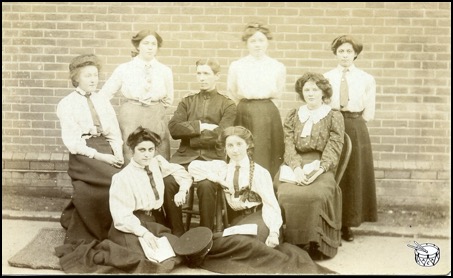
PICTURE: AN ARMY SCHOOLMASTER AND ARMY SCHOOLMISTRESSES, DEEPCUT BARRACKS, SURREY, C.1910
Scribbled on the back of the photographic postcard shown below are the words, ‘Wives/Instructors Deepcut Barracks c.1910’. The man at the centre of the group wears an army schoolmaster’s uniform, while the books with which many of the women are pictured suggest that they are army schoolmistresses. Howard R Clarke’s brief history of the women who taught army children, ‘ARMY SCHOOLMISTRESSES IN THE NINETEENTH AND TWENTIETH CENTURIES’, appears above.
THE CALEY: THE ROYAL CALEDONIAN SCHOOLS AND THE ROYAL CALEDONIAN SCHOOLS TRUST

TACA CORRESPONDENCE: DID YOUR ARMY-CHILD ANCESTOR ATTEND THE GARRISON SCHOOL AT RICHMOND BARRACKS, DUBLIN, IRELAND?
When contributing a photograph of army-child Martha Tuckwell’s gravestone to TACA (see below), Catherine Neville, of the Richmond Barracks Exhibition Centre in Dublin, Ireland, explained that Richmond Barracks was a former British Army barracks. She continued:
‘We would like to enhance our school tours to provide visiting children with an insight into school life for garrison children. I am therefore currently researching the garrison school, and would be grateful if anyone could provide any information on family members who may have attended the school between 1857 and 1922.’
If you have any information for Catherine, please contact TACA, and we’ll pass it on. And for more on Richmond Barracks and its history, visit its website: http://www.richmondbarracks.ie.
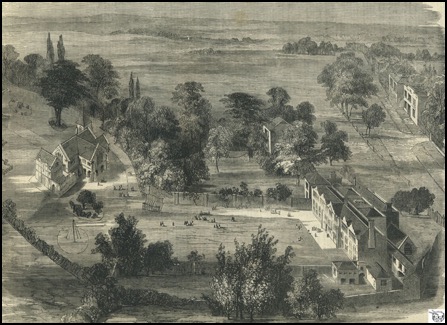
PICTURE: THE SOLDIERS’ DAUGHTERS’ HOME, HAMPSTEAD, 1858
The print reproduced below, which has been slightly cropped, shows the Soldiers’ Daughters’ Home in Hampstead, and was published on 19 June 1858 in The Illustrated London News to mark the opening of the institution’s new buildings (‘most pleasantly situated in their own grounds’) the previous day by Prince Albert.
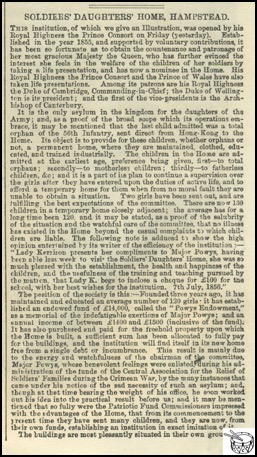
‘It is the only asylum in the kingdom for the daughters of the Army; and, as a proof of the broad scope which its operations embrace, it may be mentioned that the last child admitted was a total orphan of the 56th Infantry, sent direct from Hong-Kong to the Home. Its object is to provide for these children, whether orphans or not, a permanent home, where they are maintained, clothed, educated, and trained industrially. The children in the Home are admitted at the earliest age, preference being given, first––to total orphans; secondly––to motherless children; thirdly––to fatherless children, &c; and it is a part of its plan to continue a supervision over the girls after they have entered upon the duties of active life, and to afford a temporary home for them when from no moral fault they are unable to obtain a situation. Two girls have been sent out, and are fulfilling the best expectations of the committee. There are now 130 children in a temporary home closely adjacent; the average has for a long time been 120, and it may be stated, as a proof of the salubrity of the situation and the watchful care of the committee, that no illness has existed in the Home beyond the casual complaints to which children are liable.’
(For another picture, and a little information about the history of the school, later known as the Royal Soldiers’ Daughters’ Home and then the Royal School, see below, ‘PICTURE: THE ROYAL SOLDIERS' DAUGHTERS' HOME, HAMPSTEAD’. In 2012, the Royal School was integrated into North Bridge House School.
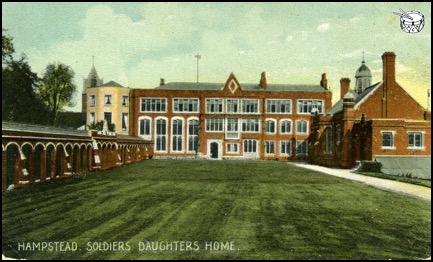
PICTURE: THE ROYAL SOLDIERS' DAUGHTERS' HOME, HAMPSTEAD
The Royal Soldiers' Daughters' Home, pictured below in an old postcard, was established at Rosslyn House, Hampstead, London, in 1855, 'to nurse, board, clothe and educate the female children, orphans or not, of soldiers in Her Majesty's Army killed in the Crimean War', the original aim being to equip them to earn a living either in domestic service or as regimental schoolmistresses. Situated at Vane House from 1858 (see above, ‘PICTURE: THE SOLDIERS’ DAUGHTERS’ HOME, HAMPSTEAD, 1858’), the school subsequently accommodated up to two hundred of the daughters of serving and retired soldiers, and not just the destitute, the girls being aged from infancy to sixteen. Later an independent school renamed the Royal School, Hampstead, this was integrated into North Bridge House School in 2012.
PICTURES: THE ROYAL SCHOOL, BATH, SOMERSET
The text along the bottom of the black-and-white postcard below tells us that the building pictured is in Bath: ‘The School for Officers’ Daughters’. The postcard below that shows a view of the ‘Courtyard Steps, Memorial Wing’.
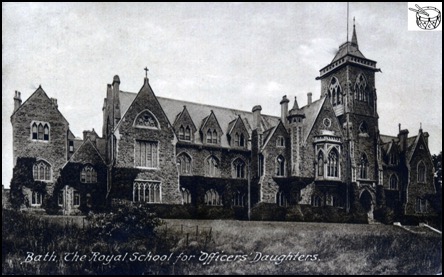
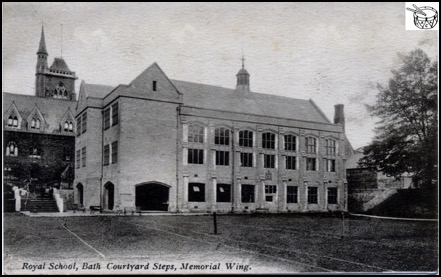
The Royal School opened in Bath, Somerset, in 1865, its proposed objective being ‘to bestow upon the Daughters of necessitous Officers of the Army, at the lowest possible cost, a good virtuous and religious Education, in conformity with the principles and doctrines of the Church of England’. Having merged with Bath High School in 1998, it is today known as the Royal High School. Click here to visit its website.
PICTURE: A REGIMENTAL SCHOOL IN INDIA
The photograph below, which was kindly contributed by A W (Art) Cockerill, shows the regimental school of the 1st Battalion of the Northamptonshire Regiment (previously the 48th Foot) in India, probably in Secunderabad, in around 1889–90. As Art writes, 'Well before the end of the nineteenth century, every unit serving overseas – and some in the home and Irish commands – was well served with one or more teachers that might include a schoolmaster sergeant, a schoolmistress and an assistant. Some units, such as the 48th Foot in an Indian station shown here, were exceptionally well provided for. In this instance, a total of seven teachers, assistant teachers and helpers, including a munshi ('teacher' in Urdu, believed to be a linguist who taught the children and adults Urdu), attended to a class of 37 children. This was an exceptionally high teacher–pupil ratio.' Art also points out the 'uniformed boy third from the right, back row, who I am convinced is a boy soldier of the regiment. He might be 14 at a stretch'. The school's munshi is standing next to this older boy, while the schoolmaster and schoolmistress are seated in chairs flanking their young charges. Perhaps unusually, everyone in this photograph, including each child, is named, from which it appears that a number of the children are siblings.

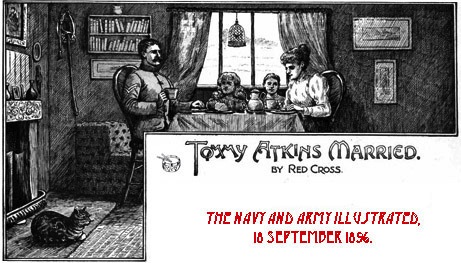
'A CONCERT BY SOLDIERS' CHILDREN IS FREQUENTLY A TREAT': CHILDREN OF THE REGIMENT IN 1896
As 'Red Cross', the author of 'Tommy Atkins Married' – an article that first appeared in the 18 September 1896 issue of The Navy and Army Illustrated – indicates in the extract reproduced below, the curriculum taught at army schools during the late nineteenth century reflected contemporary British values. Music, it seems, was particularly thoroughly and effectively covered. (For the cheerful picture painted by Red Cross of the 'children of the regiment', click here; here for an indication of how they were fed; and here for a description of their accommodation.)
'Soldiers' children, amongst their other advantages, have the benefit of excellent schools. Here they are given a thoroughly sound English education, the girls in addition being well grounded in needlework, darning, etc. Music, both theory and practice, is taught and well taught, and a concert by soldiers' children is frequently a treat worth going some distance to enjoy.
I had the pleasure about two years ago of being present at a concert given in the Royal Opera House in Malta, by the combined schools of the Garrison. Upwards of three hundred children took part, and no prettier sight have I ever witnessed than the appearance on the stage of these little ones. The programme consisted of solos, part songs, and glees, interspersed with fan drill and other beautiful movements, the whole of which was admirably executed.'
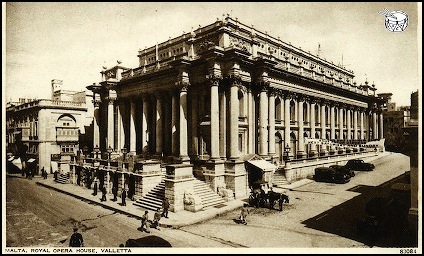
Above: The grand Royal Opera House in Valletta, Malta, where the children of the garrison performed before 'Red Cross', was constructed in 1866.
TACA CORRESPONDENCE: INFORMATION SOUGHT ABOUT GREEN HILL SCHOOLS, WOOLWICH, SOUTH-EAST LONDON
TACA has received the following request for information:
‘Researchers in the Royal Borough of Greenwich are keen to find out about the local army school at Woolwich known as Green Hill Schools. It is believed that the school taught local army children up until the 1960s, but there is a lack of information about it, so we would love to hear from anyone with memories of being taught (or teaching) there.’
If you can help, please contact Carolyn Ayres, Heritage Project Officer of the Royal Greenwich Heritage Trust; her e-mail address is: Carolyn@rght.org.uk.
English Heritage's Survey of London, 2012, includes some information about Green Hill Schools’ history. To read it, click here and scroll down to pages 62–64.
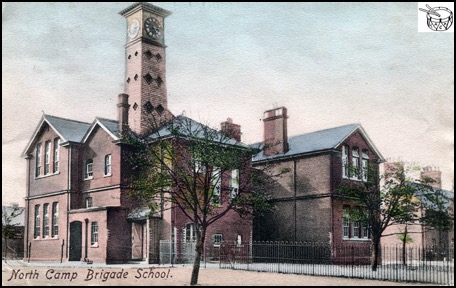
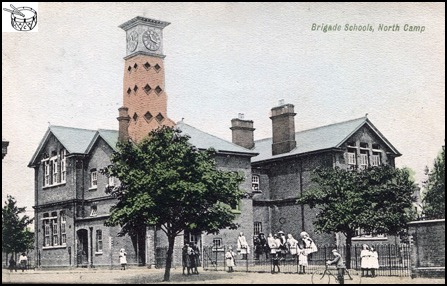
PICTURES: NORTH CAMP BRIGADE SCHOOL, FARNBOROUGH, HAMPSHIRE, 1905
This colour postcard, which was first published by Francis Frith & Co in 1905, presents a view of the North Camp Brigade School in Farnborough, Hampshire, named as such because it was part of Aldershot’s Northern Camp (the school was also known as the 1st Brigade Garrison School). Mailed on 31 May 1906, addressed to a Mr Fairley in West Bromwich, and signed ‘Percy’, the message concludes with the words, ‘This is a picture of my school’.
The partially tinted black-and-white postcard below was posted in 1904, and shows the ‘Brigade Schools, North Camp’ in Farnborough, Hampshire. A number of children, including a boy on a bike, can be seen on either side of the school’s railings.
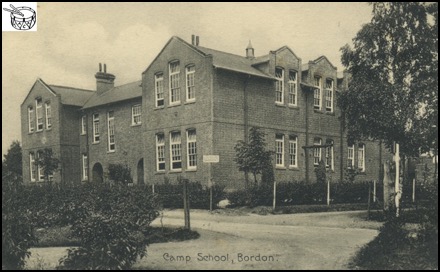
PICTURE: THE CAMP SCHOOL, BORDON, HAMPSHIRE
The building shown in the black-and-white postcard below, which dates from the early twentieth century, is the Camp School in Bordon, Hampshire. The words on the sign at the front of the building, in the centre of the postcard, are just discernible and read ‘LOUISBURG BARRACKS’. Constructed in Station Road in 1906 as a junior school, the school catered for infants from the late 1960s. Today, it houses Bordon’s Phoenix Theatre and Arts Centre.
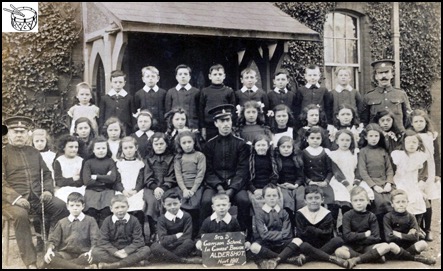
PICTURE: 'STD 3, GARRISON SCHOOL, 1ST GUARDS’ BRIGADE, ALDERSHOT', HAMPSHIRE, NOVEMBER 1911
The sign held by the boy sitting cross-legged at the centre of the photograph below reads ‘Std 3 / Garrison School / 1st Guards’ Brigade / Aldershot / November 1911.’. He and his classmates were photographed with three adults: a sergeant standing on the right (whose cap badge might be that of the Coldstream Guards, which were stationed in Aldershot in 1911), and two seated army schoolmasters, on the left and behind the sign-holding boy. The postcard was franked at Aldershot in November 1911. It was addressed in black ink to ‘Mrs King. / 137 Stewart Road / Bournemouth E / Hampshire.’. The message reads, ‘Guards / Aldershot / 27.11.11 / Dear M / This is one of the photos, I promised you. The other was a failure. I shall behaving [sic] one of the Company soon and will send that. Love to all, from / Yours Sincerely / Will’.
CONTRIBUTION: AN ARMY-SCHOOL COPYBOOK, 1914
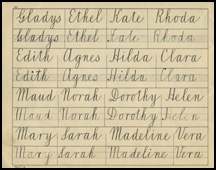
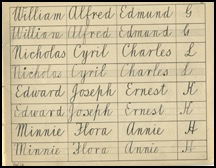
We are most grateful to Brian Gillard, who generously contributed a boot-sale find to TACA, this treasure being an army-schools copybook dating from 1914. Copybooks were once used to teach children to write legibly, the idea being that they copied letters and words written by their teacher, or in a specimen book, into the book’s blank spaces. The information supplied, in pen and ink on the front and back of the book, tells us that it was completed by Harry Jones (who, as Brian observes, had ‘beautiful writing for an eight-year-old’), of the Line Wall Garrison Station army school in Gibraltar, as part of the Army Schools Annual Writing Competition, on 25 October 1914. As Brian says, it is ‘a great bit of army school history’, and TACA is delighted to have received it.

Above: The front cover of Harry Jones’ army-schools copybook shows the Horse Guards Building in London. The inclusion of Edward VII’s cypher indicates that the book was printed before the king’s death in 1910.
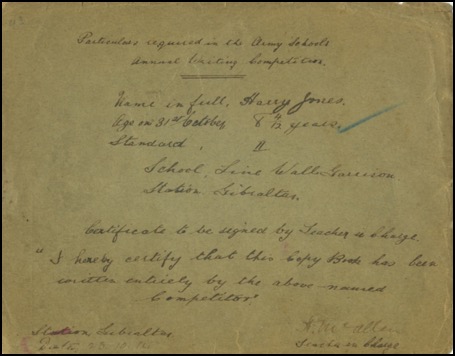
Above: The handwritten information given on the back cover reads as follows:
‘Particulars required in the Army Schools Annual Writing Competition.
Name in full, Harry Jones.
Age on 31st October, 8 4/12 years.
Standard, II.
School, Line Wall Garrison Station, Gibraltar.
Certificate to be signed by Teacher in Charge.
“I hereby certify that the Copy Book has been written entirely by the above-named Competitor.”
Station, Gibraltar – H.M. Allen
Date, 25.10.14 – Teacher in Charge.’
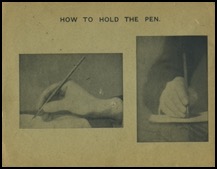
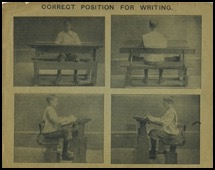
Above, left and right: Photographs printed on the inside covers demonstrate how to hold a pen (left) and how to sit correctly (right) when writing.
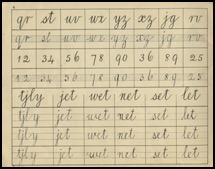
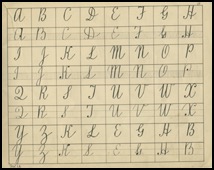
Above and below: Young Harry filled twenty-four pages with his penmanship: with letters, numerals, words and names; here are four pages from his copybook.
PICTURE: GARRISON SCHOOL, VERDALA, MALTA, 1921
The photograph that appears below, showing staff and pupils at the 'Garrison School, Verdala' in 1921, was generously contributed to TACA by Liz Mardel, who, in her accompanying message, explains how it came into her possession.
'I acquired the attached photo of the school for the children of soldiers in Verdala Army Barracks, Malta, dated as you see, 1921, in a strange way. As Miss McMeeking, I was a teacher at the Royal Naval School Verdala, situated nearby, from 1957 to 1961. When we were about to have our second reunion in 2005, I put a letter about it in the local Portsmouth News. A phone call then came from a woman in Gosport who had rescued a glass photographic plate from items sent to a Scout jumble sale and had been wondering who could find a good home for it! There is also a plate of the woman teacher in the fourth row from the top in the picture, so I suspect that the plates could have come from her family. The school was, I believe, in Cospicua, one of the two dual-purpose "chapel schools" on the island, but destroyed in World War II.'
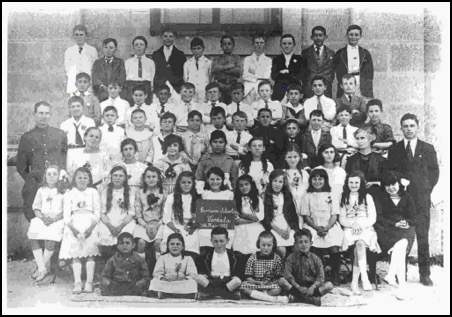
For more on this photograph, see ‘TACA CORRESPONDENCE: AN AMAZING COINCIDENCE DISCOVERED IN ARMY CHILDHOOD’.
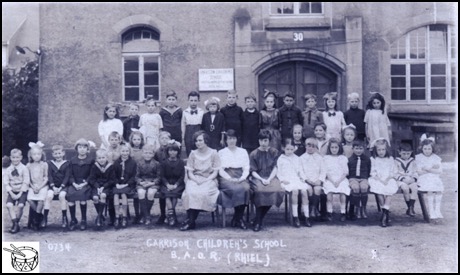
PICTURES: THE GARRISON CHILDREN’S SCHOOL, RIEHL, GERMANY, 1920S
The British Army occupied the Rhineland region of Germany during the 1920s, with the families of many of the soldiers posted there accompanying them on their tours of duty. (TACA’s ‘ON THE MOVE’ page carries a photograph of families arriving in Riehl, a suburb of Cologne/Köln in 1922, see ‘PICTURE: MILITARY FAMILIES ARRIVING IN RIEHL, GERMANY, 1922’.) Pictured below are some of the children and teachers of the Garrison Children’s School, British Army of the Rhine (BAOR), Riehl Area (the annotation has misspelled the German name, which is correctly given as ‘Riehl’ on the sign on the wall behind the children).
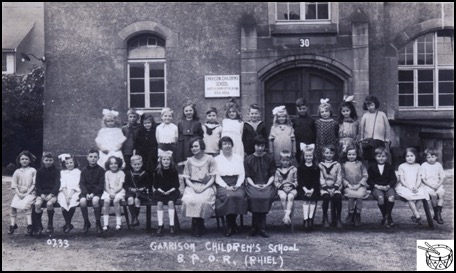
Reproduced below is a second, similar photograph (and ‘Riehl’ has again been misspelled on its label); it is striking how many of the girls are sporting oversized ribbons in their hair, while a number of the boys are wearing sailor suits.
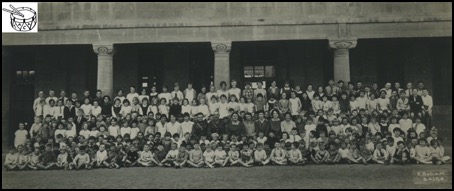
PICTURE: THE GARRISON SCHOOL, ABBASSIA, CAIRO, EGYPT, IN 1928
The black-and-white photograph below was taken by K Bolam, of Cairo, and was printed as a postcard. A handwritten note on the back tells us that this is ‘a group of the whole school, infants and elder children’, the school in question being the ‘Garrison School, Abbassia, Cairo’, in Egypt, photographed in April 1928. Staff can also be spotted at the centre of the group of children.
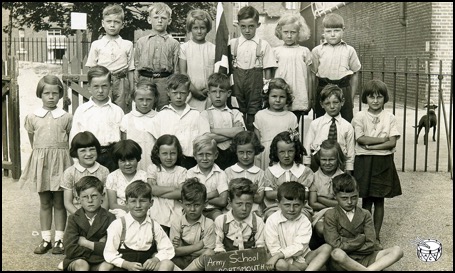
PICTURE: THE ARMY SCHOOL, PORTSMOUTH, HAMPSHIRE
Judging by their clothing and hairstyles, this class of young army children attended the Army School in Portsmouth, Hampshire, some time between World War I and World War II.
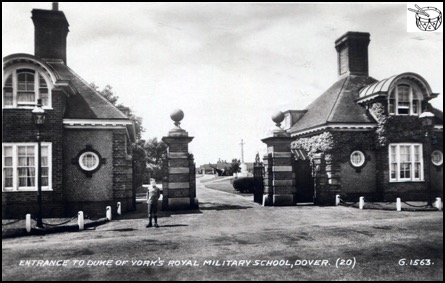
PICTURE: ENTRANCE TO THE DUKE OF YORK’S ROYAL MILITARY SCHOOL, DOVER, KENT, 1930S
As the caption makes clear, this black-and-white postcard published by Valentine’s, which dates from the 1930s, shows the entrance to the Duke of York’s Royal Military School in Dover, Kent. A pupil (a ‘Dukie’) can be seen in the foreground. Founded in 1801 for the orphaned children of soldiers, the school was originally situated in Chelsea, but moved to Dover in 1909.
For more about the history of the Duke of York’s Royal Military School, visit the late Art Cockerill’s website: http://www.achart.ca. And click here to visit the school’s website.
BACKGROUND INFORMATION: A SINGULAR AND MOST UNUSUAL SUB-POST OFFICE
‘At the height of its activities, before modern communications - e-mail, social networking and courier services - came into existence and greatly reduced mail services, the General Post Office (GPO), as the Post Office was called before 1969, had a post office in every town, village and hamlet throughout Great Britain. The sole exception among sub-post offices issued with identifying stamps to frank letters was the Duke of York’s Royal Military School.
The year in which the school received permission from the GPO to open a sub-post office is not known. (From the viewpoint of philatelic history, it would be useful to know this.) However, it is certain that a sub-post office was in existence at the school during the 1920s, and probably before that. It may even have been opened in 1909, the year in which the school moved from its old premises in Chelsea, London, to its spacious grounds on the white cliffs of Dover, in Kent, where freshening breezes from the English Channel provided the children with a healthy environment in which to grow.
The Duke of York’s School’s franking stamp made a distinctive impression, as can be seen on Peter Goble’s Military series postcard below, by coincidence one of the last items of mail to be franked before the sub-post office closed in 2007. This postcard would be a rare and coveted stamp-collector’s item were it to be offered for sale on eBay or at a philately fair.
The photograph from the British Postal Museum & Archive (BPMA), reproduced here with the permission of the BPMA, was taken in 1938. The identities of the postmaster, a retired ex-soldier on the school staff who was required to wear his army uniform, and the young ‘Dukie’ at the wicket are both unknown.’
Art Cockerill.
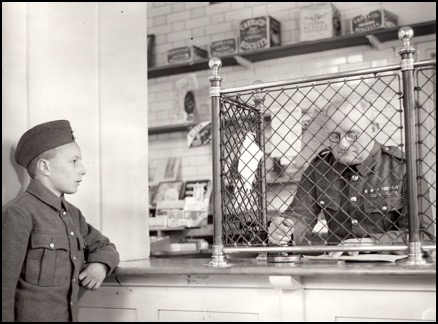
Above: Sub-post office at the Duke of York’s Royal Military School, Dover, 1938. (© Royal Mail Group Ltd 2010, courtesy of The British Postal Museum & Archive.)
Below: A postcard franked with the postmark ‘Duke of York’s School Dover Kent 29 Au 07’. This is possibly the last franked piece of mail sent from the sub-post office at the Duke of York’s Royal Military School. The postmaster retired in August 2007.
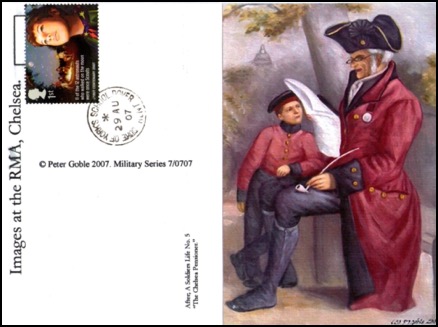
Art Cockerill’s website, http://www.achart.ca, includes a comprehensive history of the Duke of York’s Royal Military School. Many thanks to Art for having contributed the above text to TACA; to Peter Goble, for permission to reproduce the postcard above; and to the British Postal Museum & Archive (BPMA), http://postalheritage.org.uk, for permission to reproduce the photograph above.
TACA CORRESPONDENCE: IDENTIFYING AN ARMY RESIDENTIAL CO-EDUCATIONAL SCHOOL, 1930S
Family-history researcher Carole Temple has contacted TACA in her attempt to identify the army school that her grandfather’s children attended. Carole writes:
‘My grandfather, Albert Edwin Gould (1881–1929), served in the British Army for twenty years. He served in the East Surrey Regiment and the 15th Battalion (Scottish) Division, among other units. He was a private throughout his army service and was, I think, a garrison labourer.
After my grandfather died, his five youngest children were put into an army residential co-ed school in about 1931, until they reached, I think, sixteen years of age. I'm seeking the name of the school that they attended and any information about the school. Their names were Edward, James, Louie, and Gladys and Winifred (twins); their last name was Gould.’
We have suggested to Carole the Duke of York’s Royal Military School and the Royal Caledonian Schools as possible starting points, and if you think that you can help Carole further, please contact TACA and we’ll pass on your message.
TACA CORRESPONDENCE: SEEKING PUPILS AT THE LAWRENCE MILITARY SCHOOL, MOUNT ABU, INDIA, 1940S
Richard Cordeux has contacted TACA regarding the Lawrence military schools in India:
‘Founded, by Major General Sir Henry Montgomery Lawrence, to provide education to the children of serving and deceased soldiers and officers of the then British Army in India, history has it that there were four Lawrence schools at the time of India’s Independence. The two oldest were started during Sir Henry’s lifetime. The oldest, at Sanawar, was founded in 1847; the second, at Mount Abu, was established in 1856. While the school at Sanawar is still going strong, the one at Mount Abu is no longer there: it became the Indian National Police Academy and now houses the Internal Security Academy.’
Richard attended the Lawrence school at Lovedale (the fourth was at Ghora Gali) in 1938, and that at Mount Abu from 1940 to 1945, and would like to make contact with old ALS (Abu Lawrence School) Mount Abu-ites. He can be contacted by e-mail at r.cordeux@btinternet.com.
TACA CORRESPONDENCE: ‘DO YOU HAVE MEMORIES OF ATTENDING SCHOOLS IN LOVEDALE (INDIA), LAGOS (NIGERIA) AND CATTERICK CAMP (NORTH YORKSHIRE) WHEN MY FATHER AND I DID?’
TACA has received the following message from Margaret Charlton (née Richardson):
‘I am the daughter of Terence (Terry) Richardson, who was born and raised in Lovedale, southern India, the son of Major Albert Victor Richardson, schoolmaster at the Lawrence Memorial Royal Military School, Lovedale, Nilgiri. My late father had two brothers, Desmond and Brian. All three boys attended the Lawrence Memorial School, Lovedale, probably from 1934 until 1947/1948, when my father returned to the UK and was posted to Lisburn, Northern Ireland.
In 1954, we travelled from Lisburn to Lagos, Nigeria, where I attended a small school run by nuns. In 1957, we returned to the UK, to Catterick Camp, in North Yorkshire, where I attended the local army primary/junior school, which was sited on the crossroads with Hipswell village/Hipswell Road West and Richmond Road. The school was not far from Marne Barracks. Not far from the school was the local GP’s practice; at that time, the doctor was a Dr Connor. St Oswald’s Church was close by, as was the Brownie hut. I later left the garrison primary school and attended Hipswell Church of England Primary/Junior School, in Hipswell village, where the headmistress was a Mrs Slack. There were two other teachers, a Ms or Mrs Aitken, and a Miss Leftley (who later became Mrs Brown).
My quest is twofold. Does anyone recall my late father, or grandfather in Lovedale? Does anyone recall attending the small school in Lagos, or, indeed, the other that schools I have mentioned? If so, I would very much like to hear from you. Thank you.’
If you think that you can help Margaret, please contact TACA, and we’ll pass on your message.
TACA CORRESPONDENCE: INFORMATION SOUGHT ABOUT THE BRITISH ARMY CHILDREN’S SCHOOL, MINGALADON, BURMA
Christopher Taylor has contacted TACA to ask if anyone has any photographs or information about a school for army children in Burma [now Myanmar] that he attended as an RAF child. Christopher writes:
‘Ours was the first family to join a serving officer in Burma; we arrived in 1946 aboard the SS Highland Princess. To begin with, I was taught by an English Buddhist monk. I started attending the British Army Children’s School at Mingaladon, in Burma, in 1947. The command education officer was S R Williams. Our badge was a red-blue-red square, with the Roman numerals XII under a chinthe, the mythical Burmese lion–dog.’
If you can help Christopher, please e-mail him at christophertaylor132@btinternet.com; TACA would also be interested to learn more about this school.
PERSONAL STORY: MY ARMY CHILDHOOD IN JERUSALEM AND CYPRUS
Robert Henderson’s father was serving in the Royal Signals when Robert was born at the start of of World War II. Here, Robert gives us an insight into his experiences of growing up in Jerusalem, Egypt and Cyprus during some exceptionally turbulent times.
‘Having been born in Jerusalem, Palestine, where my father was stationed, we moved to Egypt in 1941, when my father was posted there, and in 1942, when the German Army neared Egypt, we were evacuated back to Palestine. I stayed with my grandparents there, as my grandfather was on the high commissioner’s staff, having come there with General Allenby in 1918. My father was later wounded (and decorated) in North Africa. He was eventually moved to the BMH (British Military Hospital) in Palestine, and was sometimes brought to visit us by ambulance.
LIFE IN JERUSALEM
I went to school at the BCS (British Community School) in Jerusalem. The war was an inseparable part of our lives. No sweets, chocolate, or anything made in Britain or anywhere else. The Italian planes bombed ineffectually now and again. A blackout curfew was imposed, and shutters went on the windows. The Free French came in, and the officers’ families joined married quarters. A good friend was a French boy, Totty, and I picked up some French, which I still have. Later, the Polish Army came in, but I never met a Polish boy.
On the king’s birthday there was always a parade at the high commissioner’s place: the Black Watch marched with a massive pig mascot and bagpipes, and Spitfires flew above. We knew the British Army was unbeatable – none to compare with it – and after midday, and cod-liver oil at school, one was allowed to slide down two stories of banisters roaring out “Some talk of Alexander, and some of Hercules Of Hector and Lysander, and such great names as these. But of all the world’s great heroes, there’s none that can compare. With a tow, row, row, row, row, row, to the British Grenadiers”. At all other times, sliding on the banisters was a punishable offence.
We children were spoiled by the army men, who would do all they could for us. Also, being taken by my grandfather for lime juice at the officers’ club was a great treat. I can still almost smell the Player’s Navy Cut smoke, the whisky and the beer aroma, and there was often singing around the piano. Chips and lime juice on the bar among the uniformed heroes – happy days.
There were memorial services for the fallen at Sunday church parades, when the padre would read out names of relatives. Every evening at six o’clock, we would wait near the radio to hear: “London calling, London calling. This is London calling, and here is the news . . . “. My grandfather would take notes, and afterwards we would move the pins on the large world map fixed to the wall: silver-headed pins for the British, green for the Americans, red for the Russians, black for the Germans, yellow for the Japanese. I learned a lot of geography this way. My grandfather told me we would win the war, and he was right. Of course, I knew we would. The sun never set on the British Empire and the map of the world was largely pink. QED.
We were British, the best of the best, and pity those who were not. We lived in a sort of bubble, and though I saw local children, I never spoke to one. Unthinkable in present-day terms.
Winston Churchill and King George were our heroes. By strange chance, King George markedly resembled my father (or should it be the other way around?) and this was particularly endearing.
We were all Beano and Dandy fans, and long discussions and arguments went on at school about the contents of these comics. Desperate Dan, Keyhole Kate and so on were real people to us, as were the brave British soldiers and the evil Huns in the comics. The comic books themselves were rare, and whoever had one was courted. We also read non-war subjects, and the Just William books were my all-time favourites. Dinky Toys were highly prized, especially the military models.
And then, finally, one glorious spring day in 1945, V-day [Victory-day]. We had won (naturally). Now there were unshuttered lighted windows at night, and no more rationing. Australian cheese and butter, Marmite, Worcestershire sauce, HP sauce, ketchup, relish, chocolate etc, etc – all the things we spoke about and had rarely had before.
Everyone talked about going “home”. Fabled Trafalgar Square and the legendary delights of Brighton and Blackpool beckoned, but we stayed on, as my grandmother went into missionary work for the LSCJ (The London Society for the Conversion of the Jews).
EVACUATION TO CYPRUS
Then the troubles started with the Arabs and the Israelis, and in November 1947 we were warned for Operation Polly, whereupon we packed and were evacuated to Cyprus. This was my second evacuation.
We were told we would return when the troubles were over, but this never happened. Instead, my father went into the BMH in Cyprus and I was enrolled at the army children’s school in Nicosia, first in the junior class and then in the intermediate class, until 1951, at which time we finally went “home”.
Here are a few of the names I can recall from my schooldays in Cyprus: Jack (Jackie) Dean, Elizabeth (Lizzy) Dean, Alexandra (Sandra) Marshall and Caroline White. I would be glad to hear from them and any other army children who were at the BCS Jerusalem or the army children’s school in Nicosia when I was. I can be contacted at bob10@012.net.il.'
Robert Henderson (b.1939)
TACA CORRESPONDENCE: INFORMATION SOUGHT ON ARMY SCHOOLS IN AUSTRIA
William Dickins attended British army schools in Graz, Vienna, Klagenfurt and Villach (all in Austria) after World War II, and has contacted TACA for advice on finding out more about them. If you can help him, or can recommend a useful source of information on British service schools in general in Austria during the post-war period, please e-mail TACA.
GUIDE TO FAMILIES PROCEEDING TO B.A.O.R., AUGUST 1946: EDUCATION
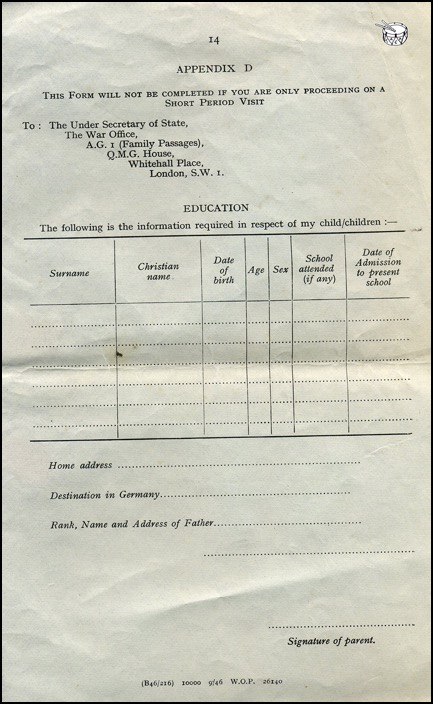
Just over a year after the end of World War II, many army families were preparing to join their soldier husbands and fathers on accompanied postings to the British Army on the Rhine (BAOR). Before they set off, the War Office provided them with a briefing booklet entitled Guide to Families Proceeding to B.A.O.R. (publication date: August 1946), covering such issues as travel arrangements and medical matters. Army children’s education was also addressed, as follows.
‘Education in B.A.O.R.
22. In order to assist the Director of Education, B.A.O.R., to arrange for the provision of educational facilities on the continent, you are asked to complete the form at Appendix D and to send it to the War Office as soon as possible. You need NOT send in the form if you are only going on a short term visit.’
BACKGROUND INFORMATION: BAOR SECONDARY SCHOOLS AND SPECIAL TRAINS
Peter Watson, a former army child who attended King Alfred School, in the northern German town of Plön, in Schleswig-Holstein, between 1953 and 1957, outlines the history of the secondary schools that were set up for the children of service personnel who were posted to British Army of the Rhine (BAOR) locations after 1945, as well as the special trains that transported them there. See 'Links', below, for more about these schools.
'It was a Cabinet-level decision by the 1945 British Labour government that before their families could join the entitled servicemen and certain military-sponsored civilians in the British Zone of Germany (OP UNION), plans for an education system equivalent to the standards available to all in Britain, irrespective of service, rank or status, had to be in place. Questions were subsequently raised by MPs in the House of Commons seeking confirmation that the schools would be open to all, irrespective of rank or service, and that no special privileges would be given to officers' children.
The provision of primary education was relatively easily solved by the establishment of small schools in all of the large garrisons and individual, more isolated, major units. The problem of secondary education (for children above the age of 11) was more complex, with 1,000 potential pupils being scattered over an area the size of Wales. A co-educational, comprehensive boarding system was the only sensible solution, although this was totally alien to the majority of the parents and children, as well as the staff.
Prince Rupert School (PRS), Wilhelmshaven [in Lower Saxony, north-western Germany], opened with 70 pupils for a one-month trial in July 1947, in the naval barracks attached to the former Kriegsmarine dockyard. The experiment was judged a success, and 250 pupils joined for the autumn term. King Alfred School (KAS), Plön, was to follow in the summer of 1948, initially with 500 pupils, and subsequently with 600. There were also small secondary day schools in Hamburg and Berlin for a time, but these were not viable and closed in the early 1950s, the pupils being transferred to KAS and PRS. The provision of boarding-school places peaked in 1953, with the opening of Windsor School, Hamm [in North Rhine-Westphalia, north-western Germany].
However, the subsequent restructuring of BAOR and RAF (Germany) into the British elements of the new NATO force based in West Germany, the reduction of troop numbers and increasing infrastructural costs meant that the existing system had to be radically revised. King Alfred School, Plön, closed in the autumn of 1959, and Windsor School, Hamm, was divided into two separate schools. Queen's School, Rheindahlen [in North-Rhine Westphalia], had opened in 1955 to provide day secondary-school facilities for the children living in the new NATO headquarters and adjacent British garrisons and RAF stations in the lower Rhineland. Day secondary schools were opened in other major garrisons where there was sufficient demand, although the more academic pupils (with the exception of those living in the Rheindahlen area) were required to board at PRS or the Windsor schools.
PRS in Wilhelmshaven closed in 1972, but its name and traditions were transferred to a new day school adjacent to the then British military hospital (BMH) in Rinteln [also in Lower Saxony]. The Windsor schools in Hamm closed in 1983, but a small, replacement, boarding facility for the more academic pupils was created at Kent School, Hostert. There was a further rationalisation in the Rheindahlen area in 1987, following which both Kent School, Hostert, and Queen's School, Rheindahlen, closed and a new Windsor School opened on the latter site with enhanced facilities, including a small boarding annexe.
SUMMARY OF BRITISH FAMILIES EDUCATION SERVICE (BFES) SECONDARY SCHOOLS IN BAOR
The boarding schools were:
- Prince Rupert School, Wilhelmshaven, 1947-72;
- King Alfred School, Plön, 1948-59;
- Windsor schools, Hamm, 1953-83.
The day schools included (details are incomplete):
- (?) in Berlin, 1947-50, and early 1970s to 1992; [see 'TACA CORRESPONDENCE: THE HAVEL SCHOOL, BERLIN, (WEST) GERMANY', below]
- (?) in Hamburg, 1947-52 (?); [see 'TACA CORRESPONDENCE: THE BRITISH SCHOOL HAMBURG, (WEST) GERMANY', below]
- Queen's School, Rheindahlen, 1955-87;
- Cornwall School, Dortmund, mid-1960s;
- Heide School, Hohne, 1960s onwards;
- Kent School, Hostert, 1960s to 1987;
- King's School, Sundern, 1960s onwards;
- (?) in Münster, mid-1960s; [see 'TACA CORRESPONDENCE: EDINBURGH SCHOOL, MÜNSTER, GERMANY’, below]
- Lancaster School (?), Osnabrück, mid-1960s to 2008;
- Prince Rupert School, Rinteln, 1972 onwards;
- Windsor School, Rheindahlen, 1987 onwards.
THE SCHOOL TRAINS
Rail was the preferred method of long-distance travel within the British Zone, and as part of this policy, special trains to and from Wilhelmshaven, where Prince Rupert School (PRS) was located, and Plön, the home of King Alfred School (KAS), ran at the beginning and end of each term. One train for each school was initially sufficient, but by 1950, following an increase in pupil numbers, two trains were required for each school.
For PRS, Wilhelmshaven, the basic routes from 1947 to 1972 were as follows.
- A Train: Krefeld-the Ruhr-Münster-Osnabrück-Bremen-Wilhelmshaven;
- B Train: Bielefeld-Wunsdorf (where the through section from Hannover/Celle was coupled on)-Bremen-Wilhelmshaven.
For KAS, Plön, the basic routes were as follows. [See 'ON THE MOVE'/'PICTURES: KING ALFRED SCHOOL (KAS) TRAINS'.]
- A Train: Köln-the Ruhr-Hamm-Münster-Osnabrück-Bremen-Hamburg-Lübeck-Plön;
- B Train: Gütersloh-Bielefeld-Hannover-Hamburg-Lübeck-Plön.
The trains stopped in all of the major British garrisons en route to pick up or set down passengers, some of whom would have to travel by road to their final destinations. Pupils travelling to and from Berlin would change at Hannover (Hanover) to join the overnight "Berliner", the British military train.
It is believed that no special trains were provided for pupils from the Windsor schools at Hamm. They would use the existing troop trains (which stopped in Hamm), travel by civilian train or be bussed to and from their home garrisons, which were generally in the south of the British Zone. Those pupils living in Berlin used the "Berliner" for that part of their journey between Berlin and Braunschweig (Brunswick).'
Peter Watson.
TACA CORRESPONDENCE: THE HAVEL SCHOOL, BERLIN, (WEST) GERMANY
Thanks to Jens Dunne, who has been in touch concerning the missing name of the day school in Berlin attended by army children from the early 1970s to 1992 that is listed in the item headed 'BACKGROUND INFORMATION: BAOR SECONDARY SCHOOLS AND SPECIAL TRAINS', above. According to Jens (who was a student there), this was the Havel School, and its premises are now an RAF base.
TACA CORRESPONDENCE: THE BRITISH SCHOOL HAMBURG, (WEST) GERMANY
On New Year's Day in 1947, Jeanne Dawson (or Brookwick, as she was then) set sail with her mother and brothers from Halifax, Nova Scotia, Canada, for (West) Germany, to join her Canadian father, who was working with the Control Commission Germany (CCG) in Hamburg. In 2010, a visit to TACA's 'SCHOOLING' page prompted Jeanne to send the following message. If anyone who went to the British School Hamburg during the late 1940s remembers Jeanne, 'the Canadian girl', she would love to hear from them, and can be contacted through TACA.
'Just for nostalgia's sake, I looked up my old school in Hamburg, Germany, which I attended from 1947 to 1949, and couldn't believe that it wasn't recorded [in the "BACKGROUND INFORMATION: BAOR SECONDARY SCHOOLS AND SPECIAL TRAINS" item, above] except as "(?) in Hamburg". It was situated just outside Hamburg in Altona, and I still remember the names of the headmaster and some teachers. The pupils' ages ranged from infants to sixth form.
The picture below, of the whole school's children and staff on the steps of the building, was taken in 1949, I believe. I don't see any infants in the photograph, the youngest appearing to be eight or nine. Whether their picture was taken on another day, or they were schooled elsewhere, I can't think. The two statues on either side of the group were of Martin Luther and Copernicus ("copper knickers" to the younger boys!) I am in the back row, fourth from the left in a white top. The staff as pictured from left to right are: a language teacher, I believe; Mrs Walker (who taught religious education, or RE); Miss Paterson (sport): Mr Uhren (sport); Miss Murray (French); P J T Morrill (the headmaster); Bob Christie (English and, I think, history); Miss Buchan (maths); Mr Woolley (languages); unknown; Mr Preece (geography); and Mr Conway (art). Another teacher whose name I remember, but who is not shown here, was Miss Cooper (science).
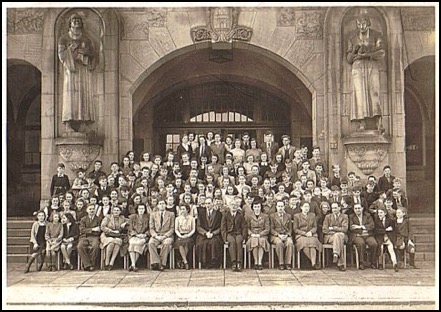
At some point early on in the period that I was there, we were told – in assembly – the new name of the school, which was to be christened "British School Hamburg". I can still remember the collective groan that went up at such an unimaginative name, compared to the ones at Wilhelmshaven and Plön. I'm a bit of a hoarder, paperwise, but apart from my original passport (from which I see that we came to England from Germany in December 1949), I have no documentation from my schooldays. I can't help wondering whether, had the school had been named something historic like "Prince Rupert" or "King Alfred", as with the schools in Wilhelmshaven and Plön, its identity would have survived rather better in the records. I only hope that someone somewhere who attended the school and looks up TACA will get some pleasure from the photograph.'
Jeanne Dawson (née Brookwick, b.1932).
TACA CORRESPONDENCE: EDINBURGH SCHOOL, MÜNSTER, GERMANY
Thanks to both Ann Lucas-Nemer and Amanda Sedgwick for supplying the missing name of the secondary day school in Münster – Edinburgh School – listed in Peter Watson's outline of the BAOR secondary schools and special trains in Germany after 1945, above. Amanda adds that the school has since closed, and that she believes that the premises are being used by the Dutch military.
TACA CORRESPONDENCE: BFES PRIMARY SCHOOL AT STADE, (WEST) GERMANY
TACA has received the following message from Elaine Hart, prompted by the missing name of the secondary day school in Hamburg that Peter Watson touched on in his piece above (see 'BACKGROUND INFORMATION: BAOR SECONDARY SCHOOLS AND SPECIAL TRAINS').
'I see that the information listed on this website is incomplete for the BFES day school in this area. There was a school at Stade and I attended it between c.1949 and 1951 (between the ages of 7 and 9). It was for children aged up to 11 – after that, children boarded at Wilhelmshaven. There were two classes – one for infants and the other for the junior age group. I think the whole school roll numbered fewer than a dozen children. I seem to remember the number 15 being mentioned, but I can't remember all of them. We lived first in Stade, but then moved into married quarters at Hesedorf and travelled an hour each way to school, in all weathers, even the tiny children. Service children have to be tough! I hope this information will be useful to you. My purpose in accessing this site was because I am trying to find the name of our teacher there. She was marvellous. Scottish, I think – perhaps from Inverness, and she gave us such a good grounding in the 3Rs despite having such a wide range of ages and abilities to deal with. The infants were taught by a German teacher, I think. If you can suggest any other sources of information to enable me to find her name, I would be grateful. Perhaps there are lists published of those who served in the BFES in those days in BAOR?'
Elaine (whose father was in the RAF, based at RAF Hesedorf, near Bremervörde, when she attended this school) also writes that she and her sister Margaret managed to locate their old school in Stade on a visit to Germany in 2005. If you can help Elaine in her quest to learn her teacher's name, please contact TACA.
TACA CORRESPONDENCE: ‘WE WERE PRIMARY-SCHOOL PUPILS IN STADE, (WEST) GERMANY, C.1950’
On reading Elaine Hart’s above message about the BFES primary school at Stade that she attended in (West) Germany between around 1949 and 1951, David and Valerie Wells contacted TACA with the following message and photographs. David wrote:
‘I and my wife, Valerie, were in Hesedorf between about 1949 and 1951. I have attached a photo of the children and teacher from when we were at Stade School [below]. Valerie has her arms around the teacher, and I am second from the right, at the front. We have a memory that the teacher’s name was Mrs McGregor, but can’t be 100% sure.
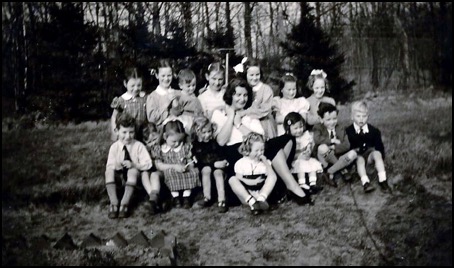
I have attached another picture of the school’s Nativity play [below]. Unfortunately neither of the photographs have names or dates on them; they were taken by my mother, Lilian, who is no longer with us.

We went to school in a service vehicle, with an armed guard at the front and one in the back with us. In the winter, we had hot-water bottles, which were filled at home to go to school with, then filled at school to come home with – yes, we were very tough. All the desks were in a big circle in the room, not in rows, as is usual. At times, we walked in the woods singing a cuckoo song in German. Mrs McGregor had a Scottie dog that got run over in front of the school, which brought most of the school to tears.
We hope that Elaine can see herself in the photos. We would love to know if she can.’
Many thanks to David and Valerie for having shared their childhood photographs and memories of the school at Stade with us.
PRINCE RUPERT SCHOOL (PRS), WILHELMSHAVEN, GERMANY: THEN AND NOW
Prince Rupert School (PRS) Wilhelmshaven, which was situated in north-western Germany, educated the children of British military and civilian personnel stationed in West Germany between 1947 and 1972. A number of video clips taken from a three-hour-long DVD about PRS Wilhelmshaven, scripted by Barbara Steels and produced by John Leggett for The Willhelmshaven Association (TWA, see http://www.prs-wilhelmshaven. co.uk), can now be viewed on YouTube. Click on these links:
- to learn more about the background and opening of PRS Wilhelmshaven (http://uk.youtube.com/watch?v=3GNejo6aKdc);
- to watch a family's home movie featuring Wilhelmshaven's Sportsplatz, aquarium and quayside, as well as a school sports day (http://uk.youtube.com/watch?v=3p94KKRp38A);
- to see archive images of Collingwood House (http://uk. youtube.com/watch?v=XdrlVt-KXHI), Drake House (http://uk. youtube.com/watch?v=JGgRiU8DJlE), Rodney House (http://uk. youtube.com/watch?v=jVekYsLHwO8) and Howe House (http://uk. youtube.com/watch?v=r2x1tFlLC8);
- to watch footage filmed on the last day, in June 1972, of PRS at Wilhelmshaven (http://www.youtube.com/watch?v=mVYr03SGhCE);
- and to view recently filmed footage showing what the school's site and buildings look like today (http://uk.youtube.com/watch?v=aX06P_ugYNs and http://uk.youtube.com/watch?v=JPqwiukDPLg).
BACKGROUND INFORMATION: PLÖN AM SEE, GERMANY
The postcard below, which is captioned in German Das 700-jährige Plön a. See ('The 700-year-old Plön am See'), presents a view of Plön (or Ploen), a city on the northern shores of the Großer Plöner See (the larger of two lakes named for Plön), in the northern German Land of Schleswig-Holstein; click on this link to see a map of its location: http://ploen.alpha-kart.com/.
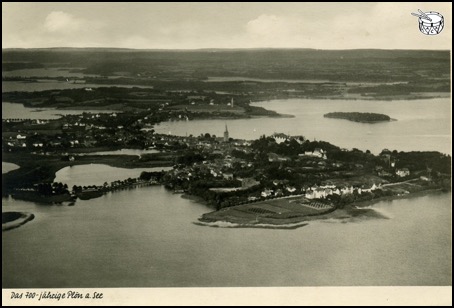
Plön was the home of the BFES' King Alfred School (KAS) between 1948 and 1959, and in the 'Links' section below, you’ll find further basic information on the school and a link to the associated Wyvern Club website. On this website, an interesting article, entitled 'Swords into Ploughshares' (http://www.kas-ploen.org.uk/HardStuff.htm), gives a potted history of the school's origins in Plön. In addition, the following link will take you to the city of Plön's official tourist-information website, which offers German-, English- and Danish-language options: http://www.touristinfo-ploen.de/tiploen/en/home/en_home_main.php; this website also provides more details of the city's history (see: http://www.touristinfo-ploen.de/tiploen/en/die_stadt_ploen/en_die_stadt_ploen_geschichte.php).
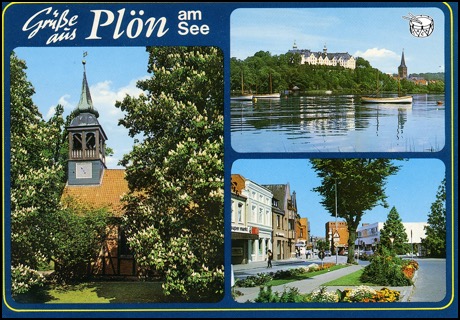
As is clearly stated, the colour postcard below combines greetings with various views of Plön am See. Although this postcard postdates the school, having been mailed during the late 1980s, the views that it presents would hardly have changed. It shows, moving clockwise from top right, the Schloß, or castle; a shopping street; and the Johanniskirche, or Johannis Church.
See also ‘KING ALFRED SCHOOL – THE STORY’, below, for details of Peter Dent’s film history of the school, which can be viewed on YouTube: https://youtu.be/OsmFbM9DA3M.
‘KING ALFRED SCHOOL – THE STORY’
Peter Dent, who was a pupil at King Alfred School (KAS) in Plön, (west) Germany, between 1952 and 1957, has produced a three-part film history of the school. As well as sending copies of it on DVD to former pupils around the world, he has made it available for all to watch on YouTube: https://youtu.be/OsmFbM9DA3M. Peter describes it as ‘a time capsule from the 1950s’, including as it does ‘a host of photographs and cine film showing the full range of activities at the school’. The film lasts for one hour and thirty minutes, and includes footage of Wyvern Club members (former KAS pupils) returning to the school – which is now the German navy’s Marineunteroffizierschule (MUS), or school for non-commissioned officers – on various anniversaries of its founding. For more on KAS, see 'BACKGROUND INFORMATION: PLÖN AM SEE, GERMANY', above.
TACA CORRESPONDENCE: WIKIPEDIA ENTRY FOR KING ALFRED SCHOOL (KAS), PLÖN, (WEST) GERMANY
BOOK: CONCORDIA: THE WINDSOR SCHOOLS, HAMM, 1953–1983
In the introduction to his recently published e-book Concordia, Stephen Green writes, ‘This is a history of the Windsor Schools in Hamm, West Germany, run by the British Families Education Service. The school started in 1953 as a mixed secondary boarding school; in 1959 the school divided into boys’ and girls’ schools. In 1981 they remerged and closed in 1983. They were schools of the Cold War.’. The first part of the book, he explains, is a ‘narrative history of the schools’, while the second comprises a ‘series of self-contained thematic chapters’ and ‘the final chapter offers some reflections’. Concordia: The Windsor Schools, Hamm, 1953–1983 will not only be of interest to those who attended the schools, but also to those who are curious about the education of service children in Germany during the Cold War period. The e-book is available free of charge, and can be requested via https://prasino.eu/concordia-the-book/; by visiting the virtual Windsor School website: https://www.cicadastudio.com/wbshamm; and via the BFES/SCEA website: https://www.bfposchools.co.uk/archivepart3.
PERSONAL STORY: MY EDUCATION AS A MARRIED-QUARTERS' CHILD
Unless they are sent to a boarding school, most army children change schools as often as their parents are posted, which can be very often indeed. Chris Fussell has already contributed many illuminating memories of his childhood to TACA (see 'PERSONAL STORY: 'EVER HEARD A SHOT FIRED IN ANGER?'', 'PERSONAL STORY: BULLFROGS, CICADAS AND MACHINE-GUN FIRE IN EGYPT, 1951', 'PERSONAL STORY: WARTIME IN THE UK; PEACETIME IN MALTA, EGYPT AND OXFORDSHIRE', 'PERSONAL STORY: EXPERT FIRST AID IN MALTA', 'PERSONAL STORY: MAYHEM IN A MALTESE MARRIED QUARTER' and 'PERSONAL STORY: A MARRIED-QUARTER CRISIS IN EGYPT'). Here, he sums up his schooling.
'AGED THREE (1942, CARRICKFERGUS, NORTHERN IRELAND): in Northern Ireland in those days, school (Presbyterian) started earlier in Ulster than in England. (By then, Dad had been medically downgraded due to a head injury and had been seconded from the Royal Warwicks [the Royal Warwickshire Regiment] to the MPSC [Military Provost Staff Corps] in NI [Northern Ireland] Command.) I learned to read and write here, with a slate and pencil! I threw stones at kids from the neighbouring RC [Roman Catholic] school – it was just what us "Prod" [Protestant] kids did – we never really knew why.
AGED FOUR TO SEVEN (1944 TO 1946, ALDERSHOT, HAMPSHIRE, ENGLAND): following a move back "home" – a posting to Aldershot – there was no school for me as I was too young in England! My eight-year-old sister helped me to keep up with my reading. I started at school again at the age of five, and was ahead of my class due to that year in the Ulster school. I got into fights with other kids because of it! One fight resulted in a nose/sinus injury. The MO [medical officer] got Dad a posting to Malta in 1947 so that I could recover in a "nicer" climate!
AGED EIGHT TO TEN (1947 TO 1949, MALTA): in Malta, I went to an army children's school (but my big sister went to the joint-service, grammar-school-standard Royal Navy Dockyard school). School was from 0900–1300, six days a week, after which it was down to the beach in the summer. This gave me a great head start as a swimmer.
AGED TEN TO TWELVE (1949 TO 1951, HULL, YORKSHIRE, ENGLAND): having returned to England, Dad left the army in Hull. I went to a normal primary school and played left half at football.
AGED TWELVE TO FIFTEEN (1951 TO 1954, EGYPT): Dad having re-enlisted, we joined him in the Egyptian Canal Zone for four years, just after I had passed (in England) my Eleven Plus exam. I went to a really excellent, small (there were 200 pupils) secondary school in Moascar Garrison. I did well here, especially in English, and had three GCE [General Certificate of Education] London University external O' levels (including one in English literature) at the age of thirteen and a half! I went to the beach every afternoon, swam competitively and did RLSS [Royal Life Saving Society] Bronze Medallion lifesaving during school PE [physical education] time.
AGED FIFTEEN (1954, BICESTER, OXFORDSHIRE, ENGLAND): I went to Bicester County Grammar School for one year. They did not like my "unbalanced" O' levels much, but I topped them up with maths, physics and others that summer. I worked part-time for a market-square butcher's shop because I could not get a paper round to do.
AGED FIFTEEN TO SIXTEEN (1954 TO 1955, ARBORFIELD, BERKSHIRE, ENGLAND): having left school at just fifteen with six or seven O' levels, I went to the Army Apprentices School, Arborfield, to be a REME [Royal Electrical and Mechanical Engineers] apprentice telecommunications mechanic. Here, I started on my City & Guilds exams. I had to do Army Certificate of Education, first class, map-reading to complete my exemption from other ranks' education exams.
AGED SEVENTEEN ONWARDS (FROM 1956, WELBECK ABBEY, NOTTINGHAMSHIRE; SANDHURST, BERKSHIRE; AND SHRIVENHAM, WILTSHIRE, ENGLAND): I was now "kicked upstairs": firstly, to Welbeck College (where I gained A' levels in maths, physics and history); secondly, to RMA [the Royal Military Academy] Sandhurst (where I was runner-up for the military-history prize); and then to RMCS [Royal Military College of Science] Shrivenham (where I was awarded a BSc [Bachelor of Science] general degree in maths, physics and chemistry). But educationally, I was running out of steam (and interest in classroom life) by then and wanted to get on with being a soldier! So I joined the RAOC [Royal Army Ordnance Corps] because other Old Welbexians in the Royal Signals, Royal Engineers and REME seemed to spend all their time as young officers on courses, courses – and had a great time.
LOOKING BACK . . .
Hand on heart, none of us three Fussell kids who were dragged around from Blandford to Carrickfergus, to North Camp, Aldershot, to Malta, to Hull, to Ismailia, and then to Bicester, and so on, could claim that the army let us down. And what school kid would not envy the six-days-a-week, 9–1-pm-schoolday+down-to-the-beach routine? (Many years later, I recreated this lifestyle, in part, as a middle-aged management trainee for some logistics consultants in southern California.)
Oh, and did I mention that the selection of schoolteachers who elected to serve abroad in army children's schools were a really great and caring lot of people? I owed them a lot more than just my GCE O' levels. They were often supplemented by a number of Royal Army Education Corps officers and NCOs [non-commissioned officers] (regulars and national servicemen), especially for maths, map-reading, craft subjects and similar – they were a nice lot, too.’
Chris Fussell (b.1939).
PERSONAL STORY: EXPERIENCING LIFE IN TURKEY, ENGLAND, GERMANY AND LIBYA BETWEEN 1948 AND 1957
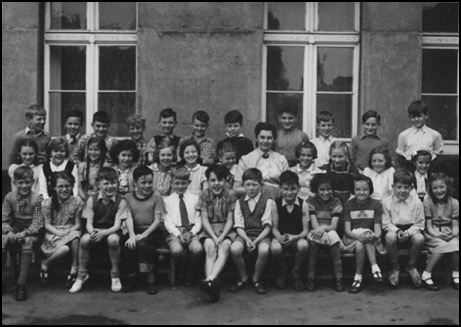
Janine Shirley has sent TACA a delightful photograph [below], of her class at Ratingen School, (West) Germany, in 1952. She writes:
‘My name was then Janine McQuillan, and my earliest travel memories are between 1948 and 1950, when my parents and I lived near Istanbul, Turkey. My father was a captain in the Royal Engineers, instructing the Turkish Army. We lived in a small village on the side of the Bosphorus called Kandilly. We were the only English family in the village, and l attended the local school as Istanbul was too far a ferry ride for a five-year-old.
From Istanbul, my father was transferred to Germany, and my mother and I were sent to the transit camp at the Grand Shaft Barracks in Dover [Kent]. I attended the local school, but spent much time on the beach. This meant many trips walking up and down the 190 historic steps of the shaft between the barracks and the town.
In 1950, we were reunited with my father in Germany. By this time, he had purchased and exported a white Austin A90 convertible sports car. He collected us in this car from the port at the Hook of Holland; we were destined for Brunswick [Braunschweig], and later Düsseldorf. I attended several army schools in Germany, but the one I remember most was in Ratingen [near Düsseldorf, in North Rhine-Westphalia]. The attached photo, taken in 1952, shows me in the front row, third from the right; next to me is my best friend, Gwen Major. The highlight of this period for me was the coronation celebration held at the Rhine Centre.
In 1954, we left Germany and went to Tripoli, Libya. I attended the army school at Azizia Barracks. In 1956, due to the Suez Crisis, all army wives and children were flown back to England. On 5 November, our flight crashed whilst landing at Blackbushe Airport, overshooting the runway and hitting trees. Several people died in the crash, including the aircrew. We later returned to Tripoli on a small merchant-navy cargo ship called the Syrian Prince. The ship, which left from the Manchester Ship Canal, had about twelve passengers, and we ate with the captain and crew.
We left Tripoli in 1957, travelling from Tripoli to Naples, in Italy, by boat; from Naples to Dieppe, in France, by train; and then taking the cross-Channel ferry to Newhaven [East Sussex]. I was thirteen by then.’
Janine would love to hear from anyone who remembers her from Ratingen School, Germany, or Azizia, Libya, or who had similar experiences within the time frames that she’s outlined. She can be contacted at janinemcq16@gmail.com. And we thank her for telling us about her eventful early years as an army child.
PICTURE: BFES PRIMARY BOARDING SCHOOL BRUNSWICK, (WEST) GERMANY, C.1950
We are indebted to Sheila Walker (née Bowen), whose father served in the 1st Royal Dragoons, for contributing the photograph below to TACA. Sheila writes:
‘The photo was taken in about 1950, when I was around ten. It shows staff and pupils at BFES Primary Boarding School Brunswick [Braunschweig], in [West] Germany, which was for army children. At the time, my father, Sergeant F V Bowen, was stationed at Northampton Barracks in Wolfenbüttel. All the children I travelled with from Northampton Barracks were day pupils. We were taken to school each day by an army 3-ton truck. This was something we took in our stride. I have a report signed by my class teacher, M Marshall, and my headmaster, J A Cook.’
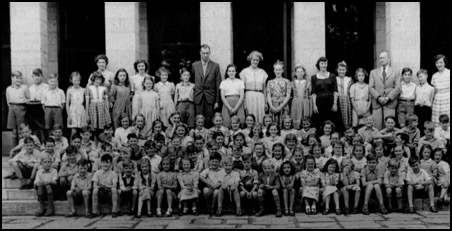
If you attended this school, we would love to hear more about it.
PERSONAL STORY: SCHOOLDAYS IN BENGHAZI, LIBYA
Mick Kiernan lived in Benghazi, Libya, from 1951 to 1955 when his father, a clerk of works, was posted there. During this period, Mick was to all intents and purposes an army child, and attended Queen Elizabeth II Coronation School, a school for forces' children, from the ages of twelve to fifteen. In the extract from his memoirs that follows, he describes that school, as well as a memorable school camping trip to Ras el Hilal. (To read about the Kiernan family's stopover in Malta in 1951, click here; and for more on how Mick spent his leisure time in Libya, click here.)
'My school was a couple of miles away from our flat, close to the town centre, and we children were transported to and fro on army lorries or buses. It was my introduction to boys and girls of many nationalities, including Anglo-Indians and Maltese children, an Israeli girl, a Yugoslav girl and one especially beautiful Eurasian girl. I quickly settled in with the other children, who were mainly from army families, many of whom had attended schools in other parts of the world where Britain had a military presence. (This was a time when large areas of the world map were still coloured pink, denoting the British Empire.) Friendships at this school tended to be rather less deep than in England as service families moved from posting to posting, so some friends might be with you for a year or two, whereas others might be there only for a few months.
Education at this school was not especially good, and after a short period in a class with children of my own age, I was moved into the top form just short of my thirteenth birthday, where I remained until I left school at the age of fifteen. In my thirteenth year, I sat the Moray House examination, a sort of second chance for those who had failed the Eleven Plus exam, and, probably because I felt under no pressure to succeed, I passed this time with high enough marks to be able to go to a grammar school. My father wanted me to return to the UK to have a better education, but I wanted to remain in Libya. My mother took my side, and so it was decided that I should stay where I was.
At the end of 1952, our school transferred to new, purpose-built premises on the outskirts of Berka. Here, in 1953, when I was fourteen, we created a den. In one corner of the playground, there was a tree that had branches hanging down to the ground, rather like a weeping willow. With the consent of Mr Punton, our headmaster, we senior boys were allowed to build a dry stone wall about 3 feet high around the tree's circumference to make a secluded place where we could spend break times. Almost all of us smoked by now, and there must have been times when rising smoke made it appear that the tree was on fire. On one occasion, the headmaster suddenly entered the den from behind me before I could stub out my cigarette. My pals in front of me had seen him approaching at the last moment and had ditched their fags, but I hadn't. As he spoke, I could only cup my cigarette underneath my seat and hope for the best. After a few words, Mr Punton departed, pausing long enough to say, "Don’t smoke at school Michael" – and that was that. He didn't mention the incident again, but from then on, we always had a lookout!
The senior-class children were all made prefects, and we now held our own court weekly to hand out minor punishments, such as offenders being gated at break time or being made to write lines. We also had a gang – usually ten of us. Among our escapades, there was brick-fighting with crowds of Arab boys. It was a frequent occurrence, but I don't remember any of us receiving a direct hit, though sometimes we would be caught by a bounced stone that had lost most of its force. We progressed to using slingshots, and these were quite lethal, but as the Arab boys weren't very adept at handling a sling, they came off worse and did get hit.
In August 1953, we children started out for Ras el Hilal, 185 miles to the east, for the school camping holiday. Travelling on TCVs [troop-carrying vehicles], the journey, including stops, took seven hours before we arrived at the site, where tents had been erected for us. Before bedding down that night, and every other night, we had to check out the tent and sleeping bags for scorpions.
Below the camp was a beach, where we had early-morning swims before breakfast whenever we weren't away on trips or doing fatigues. On one of our days out of camp, we visited the nearby town of Derna, which proved to be too quiet for us. There was little to do apart from drinking lemonade outside a small bar or ambling around the tree-lined streets. In these pre-Ghadafi days, there were bars in the towns selling alcohol. More to our liking was a day spent at Cyrene amongst the impressive remains of an ancient Greek, and later Roman, town, with its temple columns and standing statues, most of which had their heads broken off. The town even had an amphitheatre where we could sit on the tiered rows of seating, looking down to the arena, picturing in our minds the gladiators who may once have fought there.
Cyrene is situated on the hills high above the coast, and from there we drove down for what would be my second visit to Apollonia. Another day saw us at the old submarine pens of Ras el Hilal, and to us boys, this was great. The pens had been blown up either during or following World War II. Our teachers were not able to enlighten us on this matter, and the pens were now a jumble of enormously thick, broken slabs of concrete, piled upon one another. We explored the area without finding any souvenirs.
Our final day at the camp was spent taking down the tents and tidying the area, and after this we played long games of hide and seek in the surrounding woods and bushes. I was being chased back to the camp when, running between bushes, I came almost face up to a web spanning the path, with an enormous spider in the centre. Very frightening! (I have always had a dread of spiders.) That night, we slept under the stars. In the morning, I rolled up my sleeping bag to discover a small scorpion, which must have been beneath me in the night. I took it back to Benghazi with me in a box.
Our fourteen days over, we broke camp and began our journey back to Benghazi. We passed a column of armed Arabs on horseback, who gave us not so much as a glance. These were desert tribesmen, and were quite unlike the town-dwellers that we were accustomed to. They were having some sort of land dispute and were en route to Derna, where they shot up the local police station.'
Mick Kiernan (b.1939).
TACA CORRESPONDENCE: A SUNDAY-SCHOOL TEACHER, BAD OEYNHAUSEN, (WEST) GERMANY, 1950
Donald Bridge lived in Bad Oeynhausen, (West) Germany,
‘This photo fell out of a book. On the back is written: Bad Oeynhausen Sunday School 25 November 1950 Miss Olive Courtney Jones, Chaplain's Assistant. Maybe some of your other correspondents will remember the lady and had been at her Sunday school.’
If this photograph does indeed bring back memories, please contact TACA.
PERSONAL STORY: ‘MY SCHOOLING AT ARMY SCHOOLS WAS ON A PAR WITH, IF NOT BETTER THAN, AT THOSE NON-ARMY SCHOOLS THAT I ATTENDED’
As Donald Bridge related in his account of his army childhood (‘PERSONAL STORY: ‘THERE WERE NONE OF THOSE RAINY, FOGGY DAYS OF THE UK. GOOD TIMES’’, and see also ‘TACA CORRESPONDENCE: A SUNDAY-SCHOOL TEACHER, BAD OEYNHAUSEN, (WEST) GERMANY, 1950’, above), his father’s career in the Royal Army Ordnance Corps saw the Bridge family travel to postings in India, England, (West) Germany, the [Suez] Canal Zone, Cyprus and (West) Germany from the 1940s until 1971. Here, Donald looks back on his schooling.
‘Regrettably, I remember very little of my schooling. I know of most of the schools that I went to, but cannot remember any of the premises or any of the teachers or pupils, except with reference to photographs and autographs. Even with the autographs, I cannot put faces to names.
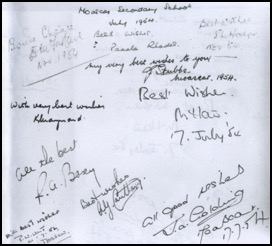
Above and below: These messages in my autograph book were written at Moascar Secondary School in 1954 and 1955.
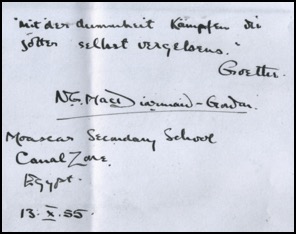
I presume that when I was five years old, travelling out to India on the troopship Britannic, and when I was nearly seven years old, returning from India on the troopship Georgic, there would have been some sort of schooling for the children. There must have been some occupation arranged to stop the children from driving the adults mad, running around the ship and eventually falling overboard. My first school would have been the primary school in the cantonment at Kirkee [Khadki], in India, from 1946 to 1947, and there was probably something arranged in the transit camps at Kalyan and Deolali.
When we were living in Leyton, London, and my father was at the ordnance depot at Mill Hill, I went to Canterbury Road Infants School in Leyton, and was also a choirboy at St Paul’s Church in Leyton.
MY SCHOOLS IN GERMANY, ENGLAND, THE CANAL ZONE AND CYPRUS
In Bad Oeynhausen, (West) Germany, I attended the junior school there (which I remember as being a good school, with pleasant teachers), went to Sunday school and was a choir boy at Christ Church. I eventually became head choirboy and sang on the stage at the Garrison Theatre for a YWCA [Young Women’s Christian Association] production. The name of the show was Cinderella, and I was at the edge of the stage singing “Mademoiselle de Paris” whilst some act was performed. I must have been a right little horror. I also went to the house of, and sang Christmas carols for, the commanding officer of the British Army on the Rhine [BAOR], Field Marshal Sir John Harding, and his wife at Christmas in 1951. Then my voice broke, and my singing career ended.
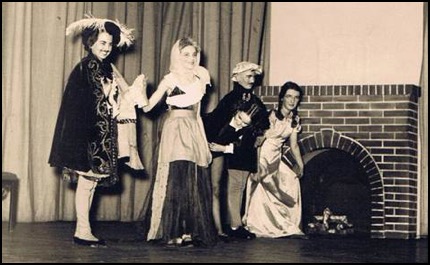
Above and below: I took part in Cinderella in January 1953, and can be spotted second from right in the picture above, wearing a cap and false moustache.
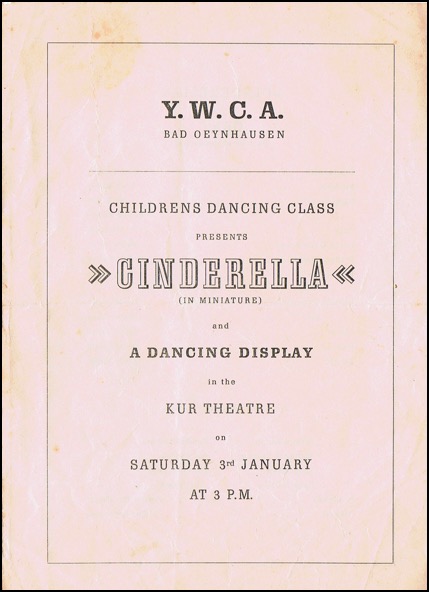
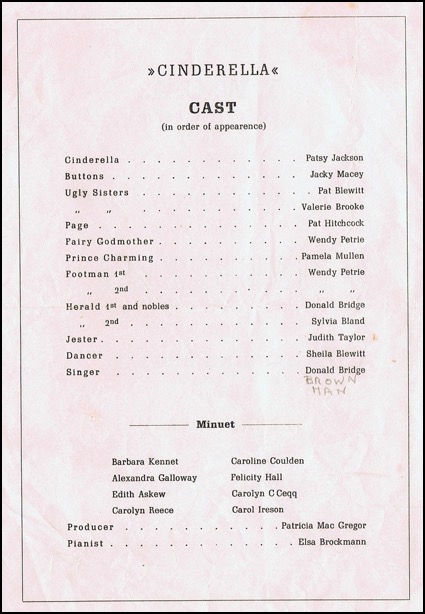
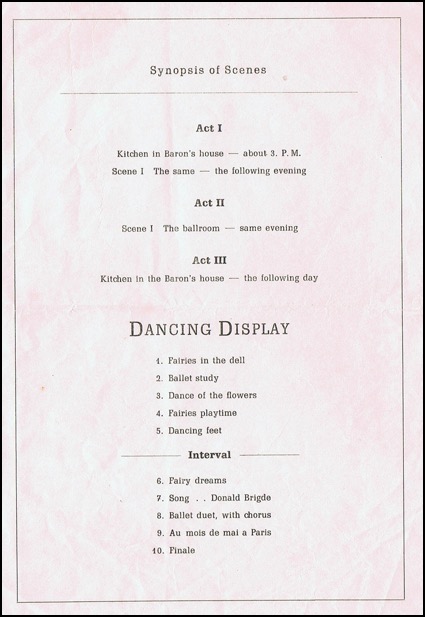
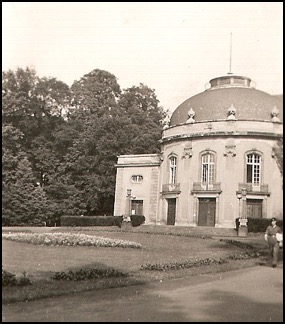
Below: These pages from my autograph book date from 1952 and 1953, and were signed in Bad Oeynhausen.

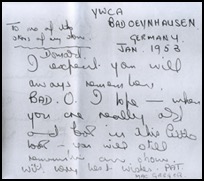
After taking the Eleven Plus, as with all forces children in (West) Germany, I went away to school because the local schooling in the garrisons only went to junior-school level. For the first two terms of the year 1953, I went to Prince Rupert School in Wilhelmshaven. I think that I was in Collingwood House, and I have included some rather poor photographs of what I presume are Collingwood House and its entrance, with a ship model and photographs on the wall behind it.
Below: Two views of Prince Rupert School.
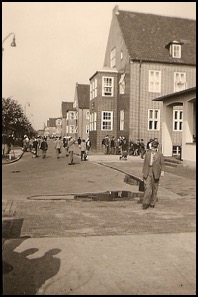
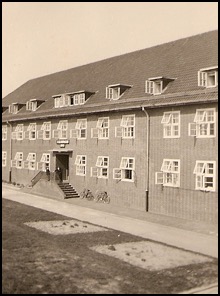
Below: Prince Rupert School, Wilhelmshaven.
Below: Drake, Frobisher and Collingwood houses at Prince Rupert School.
On returning to England in the middle of 1953 and going to live at Westbourne Transit Camp, near Emsworth, in Hampshire, I spent one term at Chichester High School for Boys, in West Sussex. We then went to Moascar, in the Canal Zone, in January 1954, and I spent the next eighteen months at Moascar Secondary School, which I remember as being a very good and advanced school. There, I took and obtained GCE O’ levels in maths and English at the age of thirteen. I was prepared for confirmation at St George’s, the Anglican church in Moascar, and, on 7 May 1955, was confirmed at the Church of the Epiphany in Port Said by the Anglican bishop in Egypt.
Below: Moascar Secondary School in 1955.
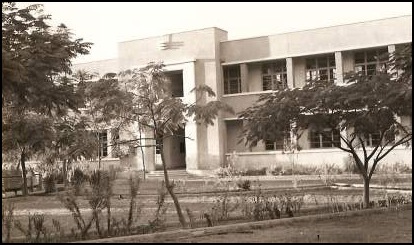
Below: St George’s Church, Moascar, in 1955.
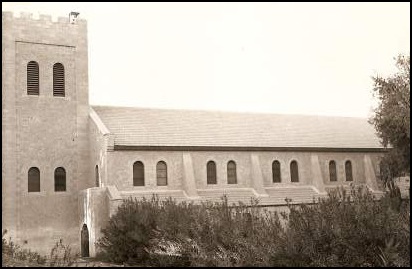
From October 1955 to August 1956, I was at the Berengaria Village School, just outside Limassol in Cyprus, where I got two more GCE O’ levels, geography and history, but was very unhappy there. I did not like Cyprus, it being a terrorist-activity zone, with the restrictions that this brought about. Bad Oeynhausen and Moascar, although also enclosed by barbed-wire fences, were large places, but Berengaria Village was small, and there was nothing for the schoolchildren to do. I must admit, the authorities tried hard, though. There were tennis courts, an Astra cinema opposite our house and regular ENSA [Entertainments National Service Association] shows from the UK, often featuring well-known names. (I can remember Frankie Howerd as the lead in one of the shows, and also Jimmy Edwards.) There were classes in the school hall for Scottish and country dancing, and I cannot hear Jimmy Shand and his band without thinking of Berengaria Village, the Gay Gordons, the Dashing White Sergeant, and the Eightsome Reel, all of which I have forgotten the steps for now.
TRAINING FOR A CAREER IN THE MERCHANT NAVY
On 24 August 1956, having driven my parents mad in Cyprus (they twice discovered that I had gone into Limassol on my own against all the rules, being a bored teenager), I left Famagusta, and all British army schooling, behind, as a passenger on the troopship Dunera. I was heading for two years of very strict schooling and discipline at the naval training ship HMS Worcester, at Greenhithe, in Kent. Moving around the world as an army child had got me used to living and visiting different countries, and meant that when later at sea, being in foreign countries was quite a normal occurrence for me. Also, army life got me used to the obeying of orders and discipline: you went where you were told and did what you were told. My two years on the ship re-enforced the need for discipline and the obeying of orders without fuss and in the correct manner, which was very necessary when serving on a ship for the safe operation of the vessel.
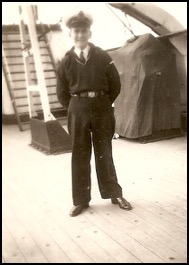
Below: My sisters, Sheila (left), aged ten, and Barbara (right), aged nine, on the jetty in front of the ship in 1957.
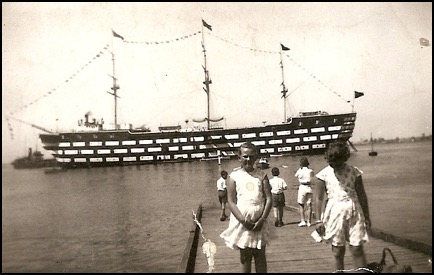
I was then apprenticed to Ellerman & Bucknall SS Company as a cadet until I had gained sufficient sea time to sit for my second-mate’s certificate, attending lessons at King Edward VII Nautical College in Mile End Road, Poplar, London, while staying with my godmother in Leyton. Having passed the exams at the age of nearly twenty-one, I went back to Ellerman Lines as a third officer until I had sufficient sea time to sit for my first-mate’s certificate, which I did between 1963 and 1964, studying at Sir John Cass College, in Houndsditch, London, and staying with relatives in Wembley. I returned to Ellerman Lines as a second officer, but in October 1966, left their employ to wander through T & J Harrison, of Liverpool, and Strick Line, of London. After obtaining my master’s certificate in February 1968, again studying at Sir John Cass College in Houndsditch (but this time staying in lodgings in Brixton), I went to work for Safmarine (the South African Marine Corporation) as a senior second officer. I left them at the beginning of 1970, emigrating to South Africa on the Edinburgh Castle in February of that year to join the coastal-shipping company Unicorn Lines, first as a chief officer, and later becoming master of the Cape Town–Port Elizabeth–Durban car ferry (Zwartkops). I left Unicorn Lines in mid-1976 for a stint as a master on an oil-rig supply vessel based at Sharjah, in the United Arab Emirates. I didn’t like the job (it was good money, though), so I left after six months, returned to Cape Town as a passenger on the SA Vaal, and joined the South African Railways and Harbours Service in February 1978. I was immediately sent to a small town called Port Nolloth, on the west coast, as harbour master and government shipping surveyor (I was in charge of all shipping activities from the Orange River, in the north, to Hondeklipbaai, in the south). Port Nolloth is in the diamond-prospecting and -recovery area, and all around the town are diamond areas that you need a permit to enter. I stayed there for twenty-two years until I took early retirement in October 1999 (the coastal-shipping services had ceased to exist due to the silting of the harbour at Port Nolloth, plus good road communications with the rest of the country) and retired to Cape Town, where I have lived ever since.
CONCLUSION
I have always considered that my schooling at army schools was on a par with, if not better than, at those non-army schools that I attended. When at Chichester High School for Boys, and at HMS Worcester, I was always thought somewhat advanced, having a much better knowledge of world events and the world around us than boys who had never been outside the UK in their lives. I knew where the Suez Canal was, while they had trouble identifying which country Oostende was in, or Lübeck; I had been to all of these places. On HMS Worcester, I won the annual prize for general knowledge, which was a wristwatch donated by Prince Line. When going through the Suez Canal on my first ship at sea aged seventeen, I remember telling the officers that I had lived over there, had swum at that beach and had taken holidays with my family at Port Said. The captain and chief officer thought that I talked too much: apprentices were supposed to be silent unless spoken to in 1958. However, I was excited at seeing Port Said and the Suez Canal again after the good times that we had had there in 1954 and 1955.
While studying in London for my maritime qualifications, I was considered something of an exotic oddity, living at that time in Germany and taking holidays in northern Italy, and having previously lived in India, Egypt and Cyprus. For second mates, driving a blue Vespa motor scooter with funny number plates – British Forces in Germany (BFG) registration, with the country-identifying disc BFG on the rear – wasn’t the norm; nor was driving a left-hand-drive car, again with an odd registration (again British Forces in Germany), for first mates. In college breaks, whilst other students went home by bus or train, I went home by the Dover–Oostende [Ostend] ferry, driving through Belgium and then Holland to our home in Viersen. And although I was obviously English, and spoke with a southern-counties accent, I also spoke German – with a slight Dutch accent.’
Donald Bridge (b.1941).
TACA CORRESPONDENCE: DOES ANYONE REMEMBER WHERE THE ARMY SCHOOL IN HANNOVER, GERMANY, WAS?
Denise Gray, whose father served in the Royal Army Education Corps (RAEC), has contacted TACA with the following request for information.
‘I have just returned from a weekend visit to Hannover/Hanover, in Germany. Between 1951 and early 1953, I went to the army school there by army bus from Buchholz. On my recent visit, I tried retracing the route, but too much has changed. I think the school might have been in Kleefeld. I remember that there was a German kindergarten beyond the playground that was eventually fenced off with wire netting. Mr Snowball was our headmaster.’
If you think that you can help pinpoint the school’s location for Denise, please contact TACA, and we’ll pass on your message. (And see below for Mark Fynn’s suggestion, ‘TACA CORRESPONDENCE: PINPOINTING THE POSITION OF THE ERSTWHILE ARMY SCHOOL IN HANNOVER, GERMANY’.)
TACA CORRESPONDENCE: PINPOINTING THE POSITION OF THE ERSTWHILE ARMY SCHOOL IN HANNOVER, GERMANY
Mark Fynn, who served in the German city of Hannover/Hanover during the early 1990s, when, as he recalls, ‘the BMH [British Military Hospital] was the only substantial structure left in British hands’, contacted TACA after reading Denise Gray’s appeal, above, for help in locating the site of the army school there (‘TACA CORRESPONDENCE: DOES ANYONE REMEMBER WHERE THE ARMY SCHOOL IN HANNOVER, GERMANY, WAS?’). Mark writes: ‘I believe the school was in Wallmoden Strasse. However, a check on Google Earth suggests that the building has been demolished and replaced with houses’. We are grateful to Mark for his input.
TACA CORRESPONDENCE: SCHOOLS IN CYPRUS AND SINGAPORE, 1950S
Dr Alastair MacKenzie, whose father served in the Royal Artillery, has sent TACA the following message:
'I came across your website when I was trying to find details of the school I went to in Cyprus, 1952–53. I am sure it was called Sessions School and the headmistress/my teacher was called Mrs Scissors. Does anyone else remember this or am I quite wrong? In 1956-59 I went to Alexandra Junior School in Singapore – motto: "Manners Maketh Man" – and the headmistress was Mrs Boswell. I then spend a year at Alexandra Grammar School in Pasir Panjang. I was a soldier and now my son is a soldier!'
If you can help Alastair confirm the details of his school in Cyprus, he can be e-mailed at the following address: arfmack@xtra.co.nz (and can alternatively be contacted through TACA).
TACA CORRESPONDENCE: A MESSAGE FOR THOSE WHO ATTENDED SCHOOLS IN SINGAPORE AND THE FAR EAST
TACA contributor Lynne Copping (née Wilson) has been in touch regarding those who attended schools in Singapore and the Far East:
'I went to a British army primary school on a tiny island in the middle of Singapore harbour from 1958 to 1961. Initially, the school was on the island of Blakang Mati, and in 1959 it moved on to the island that I lived on, Pulau Brani.
Thanks to the National Army Museum archives, I have a copy of the school register from 1950 until the school closed in 1967. I have found many former pupils by searching the internet and social media.
If you went to either of these schools, then please e-mail me at singaporeschool.reunion@gmail.com, and I can give you the dates that you started and left there. I also have the day books, detailing what happened each day, such as sports day, educational visits, Christmas parties etc. The school only had three classes; it was the smallest school in Singapore.
If you went to any other school in the Far East, then please e-mail me to be added to our reunion mailing list. We were due to be going back to Singapore in November 2020, but sadly had to cancel it. Our regular spring and autumn reunions in London also had to be cancelled.'
To read about Lynne's childhood experiences, see 'PERSONAL STORY: MY ARMY CHILDHOOD IN EGYPT, THE UK AND SINGAPORE'.
PERSONAL STORY: GOING TO SCHOOL ON BOARD A TROOPSHIP, AS WELL AS IN GERMANY, HONG KONG, WALES, PLYMOUTH, SINGAPORE, SOUTHAMPTON AND CYPRUS
Because this army child's father was in the Royal Artillery, she and her sister went to school all over the world, and even at sea.
My father was 868780 WOII Joseph Barnes Fox. My sister, Beryl, and I travelled with our parents to all his postings. My first "army school" was in Bad Oeynhausen, Germany, in the early 1950s. After that, we were stationed in Hong Kong, where I attended Gun Club School and my sister went to Whitfield Barracks School, in Nathan Road. We then went to school on board the troopship MV Devonshire.
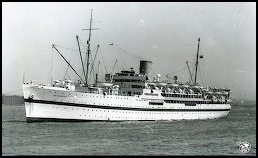
We next went to school in Wales whilst my father was stationed at Court y Gothlen, near Crickhowell. Then it was to Plymouth, where my father was based at the Citadel on Plymouth Hoe. Thereafter it was to Singapore, aboard a troopship. From Singapore, we travelled back to Southampton, where my father became a sailor/soldier escorting regiments to and fro aboard the troopship Oxfordshire. Next was Cyprus, where I attended, along with my sister, St John's School, Episkopi. I left school here and had a job on the camp.
We returned to the UK aboard the MV Devonshire. Next, we moved to Sennelager, in Germany. I worked for 30 Field Ambulance and my sister went to school in Gütersloh. It was now 1964, and my father had a heart attack at the age of 48 and sadly died. He is buried in the military cemetery at Hanover. His funeral was a big occasion and was attended by many of his friends and colleagues from his postings all over the world. SSAFA was very kind to my mother and helped us tremendously as a family to return to the UK. I myself now work for SSAFA as a caseworker.
Thelma Jean Marshall (née Fox, b.1946).
TACA CORRESPONDENCE: RATINGEN JUNIOR SCHOOL, GERMANY, 1956–59
Stephanie Strawbridge (née Hollier), whose father was in the Royal Army Education Corps (RAEC), attended a BFES junior school at Ratingen, near Düsseldorf, in (West) Germany, between 1956 and 1959. She would be delighted to hear from anyone who was also a pupil at this school (she's not sure of its exact name) during those years, and is particularly keen to trace one particular friend: Jane Stewart, with whom she lost contact during the 1970s. Stephanie can be contacted either directly (e-mails should be addressed to stephaniestrawbridge@yahoo.co.uk) or via TACA.
PICTURE: QUEEN’S SCHOOL, RHEINDAHLEN, GERMANY
Pictured on the front of this black-and-white postcard is Queen’s School, in Rheindahlen, Germany (then ‘British Rhine Army H.Q.’, as is stated on the back). Now no longer in existence, this secondary school educated army children and other British pupils from 1955 to 1987, and from 1987 to 2013 as Windsor School. Click here to visit the website devoted to the school.
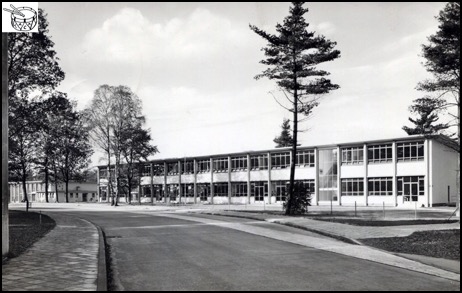
ARTICLE: ‘LESSONS FOR THE ARMY’S BACK-ROOM BRIGADE’, 1956
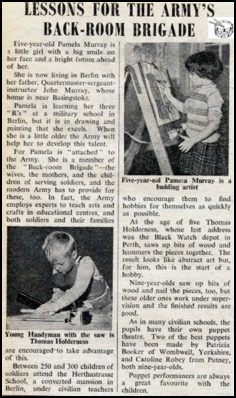
‘Five-year-old Pamela Murray is a little girl with a big smile on her face and a bright future ahead of her.
She is now living in Berlin with her father, Quartermaster-sergeant-instructor John Murray, whose home is near Basingstoke.
Pamela is learning her three “R’s” at a military school in Berlin, but it is in drawing and painting that she excels. When she is a little older the Army will help her to develop this talent.
For Pamela is “attached” to the Army. She is a member of the “Back-room Brigade” – the wives, the mothers, and the children of serving soldiers, and the modern Army has to provide for these, too. In fact, the Army employs experts to teach arts and crafts in educational centres, and both soldiers and their families are encouraged to take advantage of this.
Between 250 and 300 children of soldiers attend the Herthastrasse School, a converted mansion in Berlin, under civilian teachers who encourage them to find hobbies for themselves as quickly as possible.
At the age of five Thomas Holderness, whose last address was the Black Watch depot in Perth, saws up bits of wood and hammers the pieces together. The result looks like abstract art but, for him, this is the start of a hobby.
Nine-year-olds saw up bits of wood and nail the pieces, too, but these older ones work under supervision and the finished results are good.
As in many civilian schools, the pupils have their own puppet theatre. Two of the best puppets have been made by Patricia Booker of Wombwell, Yorkshire, and Caroline Robey from Putney, both nine-year-olds.
Puppet performances are always a great favourite with the children.’
PERSONAL STORY: PRINCE RUPERT SCHOOL, WILHELMSHAVEN, (WEST) GERMANY; THE AUTUMN TERM OF 1957
Barbara Steels learned that she would be attending Prince Rupert School (PRS), a school for service children then located in Wilhelmshaven, (West) Germany, while living with her family in Lüneburg (‘PERSONAL STORY: LIFE IN LÜNEBURG, (WEST) GERMANY, 1955–58’). Prior to her family’s posting to Germany with the NAAFI, she had lived in Egypt’s (Suez) Canal Zone: in Moascar (see ‘PERSONAL STORY: ‘MY EXPERIENCES WERE RATHER UNIQUE FOR A SEVEN-YEAR-OLD’, MOASCAR, EGYPT, 1953–54’), and in Fayid (‘PERSONAL STORY: ‘WE VISITED THE SUEZ CANAL FREQUENTLY; I COLLECTED THE NAMES OF SHIPS IN A LITTLE NOTEBOOK’, FAYID, EGYPT, 1954–55’). Now Barbara describes her first term at PRS (and see below, ‘PERSONAL STORY: PRINCE RUPERT SCHOOL, WILHELMSHAVEN, (WEST) GERMANY, 1958 THROUGH TO EARLY 1961, AND TWA TODAY’ and ‘PERSONAL STORY: MALTA, 1961-63; FILLING THE EDUCATIONAL GAPS; THE ROYAL NAVAL SCHOOL TAL-HANDAQ’, for the next instalments of her story).
‘I was a little disappointed to learn that I was going to Prince Rupert School [PRS]: I had hoped to be going to King Alfred School, Plön, as I had a friend who was already there, and I had visited the school. However, PRS it was to be, and I soon forgot my original preference. A very exciting occasion was the arrival of the clothing list – 2 navy pleated skirts, 4 shirts, 2 navy jumpers, 6 pairs of socks . . . and so it went on. Every item of clothing needed for a three-month term was recorded, and each item had to have my name on it and my laundry number; my mother and I sewed on dozens of labels. Informal clothing was also specified, and this was name-tagged as well. The first day of term was 4 September 1957, and a large trunk and smaller overnight case were packed and ready well in advance of this date.
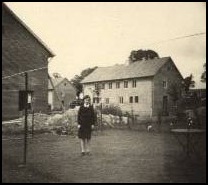
I boarded a special school train at Lüneburg station. There were a couple of other people going to the school on it, but as soon as the train pulled out of the station, I experienced a strange sense of being on my own for the first time. The train stopped many times as it picked up more pupils on the long journey to Wilhelmshaven. It arrived at the back of the school at about 6 pm; there was no platform, and we had to jump down to the ground.
I was going to be in Hood Girls, a junior house, for a year. I don’t recall getting to the house, but it would have been only a short walk from the train. Miss Marter, the housemistress, greeted us, and I was allocated to Room 11, which was a five-bed dorm.

Above: Hood Girls as it was when I was there.
Left: In 1997, I attended a reunion at the former Prince Rupert School, which had closed in 1972. The first building that I went to was Hood House and, to my absolute amazement, forty years on, my old room still had the same number – 11!
Below: Nelson (Hood House was the building to the left). I presume that we must have had supper in the dining room in Nelson on the first night.
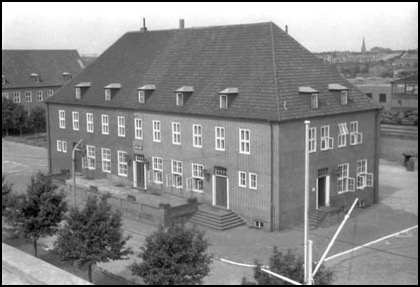
I remember being very homesick on the first evening, and that a few of us in the same situation were invited into Miss Marter’s flat for a bit of comfort. I still recall crying myself to sleep on the first few nights. I also remember the horrible feeling of waking up in the morning and being in strange surroundings. I absolutely hated it there, and wanted to go home. I wasn’t alone, as I’m sure that most of the new girls felt the same, but it seemed as though I was the only one feeling like this.
The next day was spent unpacking our trunks and undergoing “heights and weights”. We unpacked our trunks and laid everything on the bed; Matron then came and checked everything, including the name tags on each item. At some time during the day, we had to go to Churchill House, the school hall, where we lined up and were weighed and had our height checked. This subsequently happened to me at the beginning of each term for nearly four years.
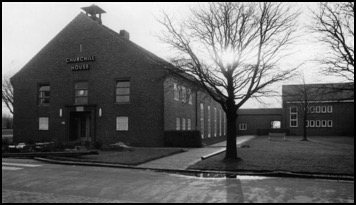
Hood Girls had a German matron, whose room was just opposite my room, and I had never known such a horrible person. There was a very strict daily routine, starting with a loud knock on the door: “time to get up, girls; strip your beds and get washed and dressed”. The beds were very strange, and the mattresses consisted of three parts, known as “biscuits”. Every day we stripped our beds and folded the bedding up neatly on a chair. There were plenty of chores to do before breakfast, and two of us would be on mat duty, which involved taking the bedside mats outside and shaking them. There was also a rota for corridor-sweeping and “bumpering” [see the shiny corridor outside Room 11, pictured above!] This technique required swinging a long-handled square mop, covered with a heavy cloth and inserted into a large metal bearing, in a sideways action along the corridor. Every day someone was on room-sweeping duty, and surfaces had to be dusted, too. After breakfast, we came back to the house, made our beds and had to leave the room in an immaculate condition. All of our cupboards and drawers were to be really tidy, and if they weren’t, we’d come back at lunchtime to find the contents tipped on to the bed and the lapse recorded in the black-mark book. With hindsight, this disciplined routine, although strict, was good for me – I just got on with it because everyone else did, and it did teach us to be tidy and to look after our personal possessions and surroundings. So although I hated the matron at the time, looking back, she wasn’t that bad, and she did teach me how to darn socks quite well.
WEEKDAYS AND WEEKENDS AT PRS
Classes started the next day. I was in Class 1d. I recall being rather upset by this as the girls in my room were all in 1a or 1b. I wasn’t in the bottom class, though, as there were 1e and 1f as well! I now realised what my Moray House test result of a borderline pass meant. I recall finding the schoolwork very easy, and, indeed, each year I went up a grade, ending up in 4b at PRS. Having had rather a disjointed education and already having attended seven primary schools, going up a grade each year was just as bad as changing school as there were always things that I hadn’t done before. For instance, I didn’t do French in the first year, so had to work extremely hard in the second year and never really felt that I had caught up with the others.
Weekdays followed a regular daily routine. The day started with assembly in Churchill House. We always sang a couple of hymns and said some prayers. The Catholic pupils came in after our worship and stood down the sides of the hall while the headmaster read out notices. I remember dreading being told that I had a dental appointment, and the relief that I felt when my name wasn’t called out.
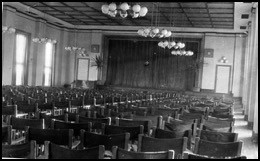
Classes started after assembly, and mid-morning we all traipsed back to our houses and went down to the common room in the cellar, where we were served lovely hot cocoa and buns. More lessons followed, and then it was back to Nelson for lunch. Afternoon classes stopped at about 4 pm, and then we were off to Nelson again, this time for afternoon tea. Most of us attended clubs between 5 and 7 pm. I joined the Guides and also the folk-dancing club. I also had a piano lesson once a week. If we didn’t have a club, we could relax in the common room and read and listen to music, while in the summer, we could play tennis or rounders. At 7 pm we were off to Nelson again, this time for supper, and then it was prep until 8.30 pm, followed by lights out at 9 pm. The punishment for talking after lights out was to get up and strip and make your bed several times, or else to go up to the prep room and write a hundred lines: “I must not talk after lights out ...”. The house monitors – senior girls with responsibilities – administered these punishments.
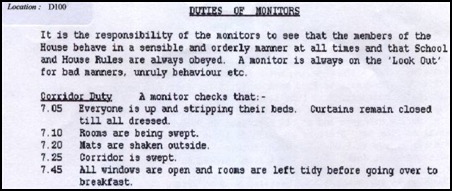 Above: Some of the monitors’ duties listed in writing.
Weekends at PRS were different from the weekdays. To start with, we got up half an hour later and could wear “mufti”: our own clothes. Breakfast was slightly later, but we still had to do the usual chores. On a Saturday, we had two hours of prep from 10 am until noon. After lunch on Saturdays and Sundays, we could go out of the school grounds for a walk – in fact, we had to vacate the house, and our rooms were out of bounds until 4 pm. There was a specific route called the “Deich walk”: this was circular, and you could go either way. If you turned right outside the school gate, the walk went over a causeway to the Fliegerdeich and followed a footpath either at the top of the Deich or alongside the sea. After half a mile, you reached the Kaiser Wilhelm Bridge, and the route crossed this and then went down some steps to the Bonteheim side of the inner-sea area. The route then followed the towpath until you reached the Deich Bridge; crossing the bridge led you back to the school gate. Wearing berets was compulsory in my time, but later, following a head-lice infestation, the berets were all sterilised and shrank, after which they were not reintroduced.
After supper on a Saturday evening, films were shown in Churchill House. These really were enjoyable occasions. Several times a term house socials replaced our cinema, but there was always something to which we could look forward. Sunday mornings required that everyone went to church. I rather enjoyed this activity, but know that a lot of people would have preferred to have done something else. Sunday evenings were usually quite a relaxing time, spent doing such things as unwinding in the common room, catching up on some prep, washing hair, reading and so on.
Twice a term we had “easy weekends”. We still had compulsory prep on Saturday morning on these, but after this, our parents were allowed to visit and we could spend the rest of the day with them, returning to sleep at the school and then attending church on the Sunday morning before being free to join our parents for the rest of the day. Some children who lived very locally (for example, in Jever or Oldenburg) were allowed to spend these weekends at home. If your parents weren’t visiting, you were allowed to go into Wilhelmshaven on the Saturday of the “easy weekend”, when wearing berets was again compulsory for the girls, while the boys had to wear caps.
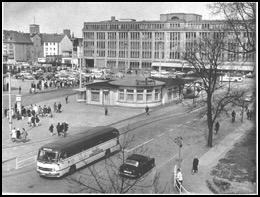
Parents of all of the children at the school were required to send pocket money at the beginning of term. The school banked this, but once a week – usually on a Friday evening – we queued up to withdraw our weekly allocation.
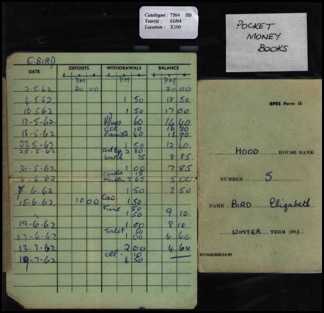
TRANSPORT, SPORTS AND SICKNESS
Up to now, I have made little mention of the fact that PRS was a co-educational boarding school. The girls were all accommodated on the main site, while the boys’ houses were on two other sites: one on the Fliegerdeich, the other on the Bonteheim.
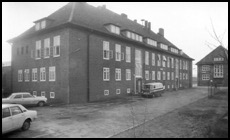
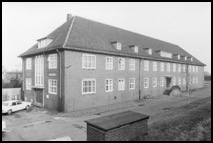 Above, left and right: Houses on the Fliegerdeich.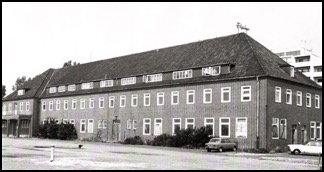
The school had its own transport system, and the boys were ferried to the main site for lessons and back to their houses. Buses were also used to take boys and girls to the Sportsplatz [sports area], where there were football and cricket grounds, an athletics stadium with a running track and spectator stand and an enormous swimming pool.
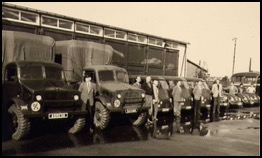
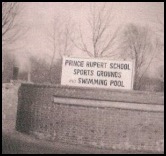 Above, left and right: The transport-department staff and vehicles (left). The entrance to the Sportsplatz (right).
So far, I have written about PRS as it was for me in the autumn term of 1957. Some of my memories are purely personal, but I’m sure that others would have had similar experiences and memories. There are two more things that any pupil attending the school at that time will remember. Firstly, there was a requirement for all pupils to have TABT [typhoid, paratyphoid A & B and tetanus] injections and other immunisations. The TABT injection was very painful, and I may not be correct here, but I’m sure that the nurse, Miss Mollett, went down a line of girls with the same syringe: we had to stand there, sleeve rolled up and hand on hip, waiting for the attack! For about three days afterwards the inoculated arm was very painful and stiff, and it was vital to protect it from accidentally being knocked.
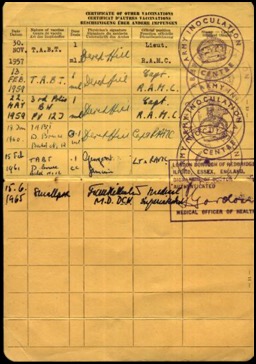
Secondly, Asian flu struck in the autumn term of 1957, and it seemed as though everyone was suffering from this virus. It started slowly, but the sickbay was full very soon, and the pupils were then nursed in the dormitories. I can’t quite remember how this worked as I was one of the few who didn’t catch the virus during this peak period. I did, however, go down with it when everyone else was better, and spent my time recovering in the sickbay. My stay in the sickbay was an interesting experience, and it was rather nice to have friendly nursing staff looking after me. The sickbay was a building at the end of the main site, right on the edge of the expanse of water known as the Banter See – a landlocked area of sea. On one occasion, I really didn’t want the hard bun that was supplied for tea, and the only way that I could get rid of it was to throw it out of the window into the sea. For the rest of the week, I made regular inspections of the progress of the bun, which I could see quite clearly, and it was still there, looking like a large pebble, when I left at the end of the week!
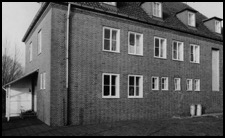
Above, left and right: The sickbay building in 1957 (left). The photo at right was taken in 1997, looking through the same window from which I had thrown the bun forty years previously. Following this bout of Asian flu, I have not had flu again!
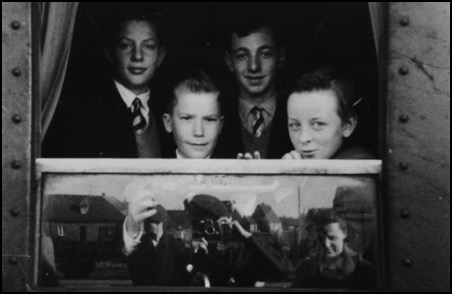
What a packed term my first at PRS was, with memories of it still being etched on my mind over fifty years later!’
Barbara Steels (née Miller, b.1946).
PERSONAL STORY: PRINCE RUPERT SCHOOL, WILHELMSHAVEN, (WEST) GERMANY, 1958 THROUGH TO EARLY 1961, AND TWA TODAY
In her account ‘PERSONAL STORY: PRINCE RUPERT SCHOOL, WILHELMSHAVEN, (WEST) GERMANY; THE AUTUMN TERM OF 1957’, above, Barbara Steels described her first term at Prince Rupert School (PRS), a boarding school in Wilhelmshaven, (West) Germany, for service children. At the time, her family was living in Lüneburg (‘PERSONAL STORY: LIFE IN LÜNEBURG, (WEST) GERMANY, 1955–58’) following postings with the NAAFI to Egypt’s (Suez) Canal Zone: to Moascar (‘PERSONAL STORY: ‘MY EXPERIENCES WERE RATHER UNIQUE FOR A SEVEN-YEAR-OLD’, MOASCAR, EGYPT, 1953–54’), and to Fayid (‘PERSONAL STORY: ‘WE VISITED THE SUEZ CANAL FREQUENTLY; I COLLECTED THE NAMES OF SHIPS IN A LITTLE NOTEBOOK’, FAYID, EGYPT, 1954–55’). In the next part of her account, Barbara outlines her experiences at PRS from the spring term of 1958 to the spring term of 1961. In her postscript, she also describes the founding of The Wilhelmshaven Association (TWA) for former pupils of PRS during its time at Wilhelmshaven (the school has since relocated to Rinteln); the enormous task that she undertook in cataloguing PRS memorabilia; and the DVD that was made of the history of PRS. (And see below for the final part of her account: ‘PERSONAL STORY: MALTA, 1961-63; FILLING THE EDUCATIONAL GAPS; THE ROYAL NAVAL SCHOOL TAL-HANDAQ’.)
‘I remained in Hood Girls until the end of the summer term of 1958. The routine established in the autumn term of 1957 continued as the seasons came and went. Living on the edge of the North Sea as I now was, I experienced weather previously unknown to me. The winter was memorable for its lovely warm buildings, with their double windows and wide hospital radiators. Outside was a different matter, however, and the compulsory walks at the weekends were an exciting experience.
When the weather was cold, wet or snowy, sporting activities varied according to the conditions. If it was just cold, we played hockey and netball; if it was wet, we would have an afternoon of fun in the hall or gym; and if it was snowy or frozen, the buses would take us out of the school to go for lovely walks in the countryside alongside a frozen river.
Above, left and right: The frozen North Sea (left). The school site can be seen in the background, and these girls are just off on the “Deich walk” (right).
The summer term of 1958 was very different from the two colder terms. The weather was surprisingly warm, and we girls wore blue-and-white gingham dresses with white collars, along with short white socks and the traditional leather sandals with diamond cut-out patterns on the front. There were a lot of sporting activities – rounders, tennis, sailing and athletics – and there were regular trips to the swimming pool at the Sportsplatz.
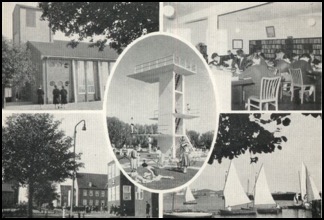
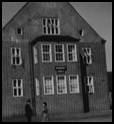
It was in the senior houses that we began to make real friends (and enemies), and there was continuity of friendships as you could request with whom you would like to share a room in the following term. During my first year in Rodney, I shared a room with the four girls shown in the two left-hand photographs below. Melodie then had to leave to attend Queen’s School in Rheindahlen; we had been been particularly close and corresponded with each other for a few years. Our group was then joined by Geraldine Milton, seen in the right-hand photograph, whose two brothers also attended the school.
Above, left, centre and right: Pictured from left to right: Felicity Ayling, Pat Newbon and Angie Wallace (left); Melodie Hayter (centre); and Felicity Ayling and Geraldine Milton outside Rodney Girls (right).
I was very much into the Girl Guides, and became patrol leader of the Daffodils in my third year. Guide camp took place in the summer of 1960. This was a great experience, and we travelled to the RAF station at Jever and camped on one of the grass-banked shooting ranges.

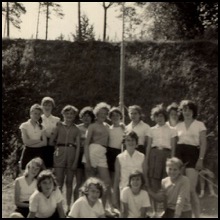
Above, left and right: Domestic chores (left)! The area shown the background of the photograph of our camp was a steep bank, and to get to the latrines, we had to climb up this bank and down the other side. The Guide company (right). I took this photo, and, many years later, I met the girl in the white shorts. She had an almost identical photo that she had taken, in which I am standing where she is.
Lots of things happened during these terms – too much to mention here – against the background of the daily routine established for me in the autumn term of 1957. We were taught good manners, which have stayed with me for a lifetime. We were expected to say “Good morning”, or the appropriate greeting for the time of day, to every member of staff we passed; they, in turn, would return the greeting.

Mr Sharp was the headmaster, and I can recall him walking around the school grounds with his gown flowing out behind him. I did fairly well in my schoolwork, but always hated maths, which I had struggled with right from the start. I recall going to see Mr Sharp to ask him if I could give up the subject. The lady teacher who took me for maths at the time was always picking on me, and I hated her, and the subject. I think Mr Sharp must have spoken to her as she didn’t seem to pick on me quite so much after this.
It’s difficult to describe the camaraderie at Prince Rupert School – it was definitely centred on the boarding house and friends with whom you shared rooms. Apart from one or two people, I can’t remember my classroom colleagues, but I can remember my roommates, housemistresses and the monitors and prefects in Rodney Girls.
During the 1960 Christmas holiday at my parents’ home, which was now in Bad Oeynhausen, I learned that my father’s job was to finish in Germany and that we were to move to Malta. I went back to PRS after Christmas and, some time during February 1961, my father collected me from school and we returned to the UK for a short holiday before leaving for Malta.
POSTSCRIPT: THE WILHELMSHAVEN ASSOCIATION (TWA)
I continued to be in contact with some of my friends for a few years after leaving PRS, but this eventually stopped as we all went on to the next phase in our lives – the world of work.
Then, in 1994, I was reading the letters page of my local paper one Saturday morning, when the heading of one of the letters jumped out at me: “Did you go to Prince Rupert School?” It was just a short letter from someone called Hilary Caswell, but it said enough, and there was a contact number that I immediately phoned. I learned that a lady called Liz Bird was forming The Wilhelmshaven Association (TWA); that the word was somehow getting around; and that former PRS pupils and staff were being located all over the world. By the end of 1994, Liz and her team had contacted nearly a thousand former pupils and staff. And in 1995, the first TWA reunion was held in Newbury, in West Berkshire, which over six hundred people attended. Some of my friends had been located, and as I live in Newbury, I invited them to my home first.

The Newbury reunion was something quite special, and I can only describe it as being the most exciting day of my life – well, up until then! I could recognise some people, others not, but it was amazing that memories and names that I had not thought of for over thirty years were still in my mind. Teachers, prefects and pupils were sharing memories and exchanging information. At the evening event, a representative from the town of Wilhelmshaven sprang a complete surprise on everyone: he invited us to a reunion in Wilhelmshaven in 1997. Liz and her team had done an amazing job in organising the Newbury reunion and enabling so many people to join TWA.

Right: Me on the headmaster’s balcony; several of the boarding houses can be seen in the background. It was really amazing that the site had not changed at all since the school’s closure in 1972.
After the Wilhelmshaven reunion, Liz decided to establish a committee to continue with the organisation of TWA. I was one of several members invited to join the committee, and I accepted this offer. Liz then asked me if I would be interested in cataloguing a large amount of memorabilia that was being stored at her house. I was new to computers at the time, but thought that it would be a good way of learning a bit more about them as I would be working with a database. Liz accordingly came to my home with her car loaded with boxes of photos and other items. After she had gone, I remember thinking, “Where do I begin with this lot?” before sitting in my lounge sorting things into piles. The school houses seemed to be the best place to start with, and then there were the sports photos, the drama photos and programmes, the CCF [Combined Cadet Force]… A system gradually evolved, and after about eighteen months I had catalogued everything, and all items were displayed in albums and files. In the collection today – and it is still growing – we have 2,600 photos and 1,400 other items, ranging from early administrative letters to a short film clip of Hitler inspecting the German Navy at the submarine base that became the PRS school site.
THE HISTORY OF PRINCE RUPERT SCHOOL, 1947–1972
I had all of this material stored at my home, so if anyone was going to record the history of the school, it had to be me. A few years ago I therefore began this task. I knew that it would involve a lot of work, but once I had written a storyline, had taken some advice from a former BBC producer and had received lots of support from the TWA committee and members, I began. Five years later, the project was ready for the final, and rather technical, process of compiling the material and creating a DVD. John Leggett, one of our members, took on the task and spent many hours putting together material from different sources, including old photos, cine film, audio recordings and recent interviews done with a camcorder. The result was a DVD entitled The History of Prince Rupert School, 1947–1972. The DVD is divided into three parts, which represent the early, middle and later years of the school – a total of three hours of viewing! [Note: Links to some clips from the DVD that can be viewed on YouTube have been posted above: see ‘PRINCE RUPERT SCHOOL (PRS), WILHELMSHAVEN, GERMANY: THEN AND NOW’.]

Barbara Steels (née Miller, b.1946).
PERSONAL STORY: SCHOOLDAYS AT HOHNE AND PRINCE RUPERT SCHOOL, WILHELMSHAVEN, GERMANY
In this extract from his memoirs, Terry Friend, whose father was in the Royal Horse Artillery, looks back on his primary school at Hohne, (West) Germany, where the Friend family lived between 1951 and 1961, and his time at Prince Rupert School (PRS), a secondary boarding school for forces' children in Wilhelmshaven, also in Germany. (For Terry's memories of the camp at Hohne, click here; to read about his family's married quarters in Hohne, click here; for his childhood view of the repercussions of the Hungarian uprising in 1956, click here; for his reflections on Remembrance Day, click here; for his account of Christmases in Germany, click here; and for more about Terry himself, visit his website: http://www. anothercountrysong.com.)
'In Hohne, it was quite a walk from home to school, possibly twenty minutes or so. The school building was almost like one of the married quarters. At least, it was the same on the outside; inside, it had been converted into eight or ten classrooms, with the assembly hall on the ground floor. The playground had a large, paved area near the building, and the remainder was grass, with a few pine and silver-birch trees. The whole area was surrounded by a 6-foot-high wooden fence made of criss-crossed slats. Next door to the school was the playing field. Opposite, on the other side of the road and a little to the left, was a marvellous wood-and-heather area to play in. At the top end of the playing field was yet another of these wooded, heather play areas. Hohne was simply dotted with these natural playgrounds; this one in particular was a firm favourite for lizard-hunting.
I was to commence my schooling in the autumn term of 1952. There were eight or ten classes in the school; you started in Class One and gradually worked your way right through to Class Ten. When Chris, my brother, and I finally departed from Hohne in 1961, we held a school record: we were the only pupils the school had ever had who actually started in Class One and went through all of the classes before leaving the school. There were always new pupils turning up and old pupils departing as their fathers were posted in and out of Hohne. The school was called BFES (British Families Education Service) Hohne, and was a primary school for pupils from the age of five to eleven. After that age, the military family was faced with a choice: send the child back to the UK to live with relatives, or send the child to a BFES boarding school. There were three in Germany: one at Hamm; one at Plön; and one at Wilhelmshaven. It was to the latter, Prince Rupert School, that I would eventually be sent, but that was another seven years away.
At the end of the summer term of 1959, I walked out of Hohne primary school. As I left, I took with me the knowledge that I was the first pupil who had ever started in the first class and then worked his way right through the whole school. Before me lay the seemingly endless balmy, relaxed days of the summer holidays. But this year, for me, was to be a year of change, and drastic change at that. At the end of the holidays, in the early part of September, I would not only be starting a new school, but I would also be leaving home for the first time. The jolt of this was somewhat cushioned by the purchase of what I felt to be mountains of kit for me. All the items had to be brand new and consisted of two blue blazers, one grey suit, two pairs of slacks (grey or black), three sets of vests, pants, shirts and socks, one jumper, a raincoat, a cap, towels, shoe kit, football boots, plimsolls, sports shorts and vests, and washing kit. Pocket money of DM 1.50 per week had also to be arranged and sent to the school in advance. This had to cover my expenses for notebooks, pens, rubbers, pencils etc.
I was astounded by the amount of clothes that had been purchased for me. How on earth could we afford it all? Did we, in fact, get a grant? I never did find out the answer. Poor Mother had the unenviable task of sewing my name and laundry number on to each and every garment, even down to each individual sock and handkerchief. H33 was the number, and like the army number that I was later to have, it is stamped deep into my brain, never to be forgotten. The school badge, a rising phoenix, was sewed to my blazers and cap. Several trips were made to the NAAFI in Celle before I was fully kitted out satisfactorily.
I already knew which house I was going to – Drake Boys. I also wasn't going alone: there was a whole class of us leaving Hohne, although some would be going to the other boarding schools at Hamm and Plön. I would be going with about ten kids from my class, one of whom, called Andrew Young, I'd known for some time. All too soon the day of departure arrived. We all boarded a coach, which was to take us to Hanover railway station, where we would catch a special military 'school' train to convey us to Wilhelmshaven.
Prince Rupert School was situated on three separate sites in the Baltic town of Wilhelmshaven, on premises that were previously German naval barracks. The school consisted of four houses: Drake, Collingwood, Howe and Rodney. Collingwood and Drake Boys were situated side by side on the sea front, with the appealing panorama of a large bay before them. The buildings were isolated and were, in fact, surrounded by water. Across the harbour, with its contingent of German naval ships, could be seen the houses of Howe and Rodney Boys. Also across the harbour, and just beyond Howe and Rodney, lay the sprawl of the large town of Wilhelmshaven itself. To the right of the harbour could be seen the Kaiser Wilhelm Bridge. It looked like a miniature version of a two-span replica of the Forth Bridge in Scotland. We were told that it was the largest swing bridge in Europe. It was constantly opening and closing as the large vessels made their way in and out to sea. To the left of the harbour was the man-made causeway that linked our little neck of land to the mainland. Just over the causeway, and on the very outskirts of Wilhelmshaven, was the main site of the school itself, which consisted of the girls' boarding houses and all of the classrooms, the gymnasium, church, assembly hall (Churchill) and a sports field. There must have been more girls than boys in the school, for as well as the 'sister' houses of Drake, Collingwood, Howe and Rodney, there were also two other girls' houses called Frobisher and Hood. I seem to remember that one of the rituals of every term was what I used to call the 'weigh-in'. At the start and end of each term, we were all despatched by houses to Churchill (which also doubled as a cinema on the weekend evenings) to be weighed and have our height measured.
It wasn't too long before we had all settled into the routine of things. We had the daily trek to school across the rubble-strewn causeway; back again by coach for lunch, and then, of course, returning once more for the afternoon's lessons. Usually, first thing in the morning, we would walk, and at the end of the day, we would do the same. We were also allowed to walk into the town, and there was also the dyke walk. This was a firm favourite of mine. It was several miles long and consisted of a circular walk along the coast. I would normally take my walks on a Saturday or Sunday afternoon.
I seem to recall that we had to be in our billets by six in the evening. Lights out for us juniors was at nine o'clock, and an hour later for the seniors. The house consisted of three floors: the seniors were on the ground floor, we juniors were on the floor above, and above us was the attic, which was used as a prep room. There were two hours of prep every night, and another two hours every Saturday morning. The main part of the building was kept clean by civilian staff, but we were all responsible for our own rooms. We had to make our own beds, with hospital corners, and our cupboards, drawers and lockers had to be spotless, with all their contents folded neatly. Matron was responsible for inspections and she was ruthless. It was a very harsh regime, but it obviously hardened us and made us grow up a good deal faster than the kids who stayed at home until they were almost adults. It certainly gave me a sense of independence, but there was, I suppose, a drawback to this experience, which would have a major effect on the remainder of my life.
My boarding-school days finished in spring 1961, and I once again returned home to live with my family on a permanent basis, rather than spending just holidays with them. From that point on, having tasted independence, I never again felt comfortable at home.'
Terry Friend (b.1947).
TACA CORRESPONDENCE: SEEKING INFORMATION ON THE BFES PRIMARY SCHOOL IN DELMENHORST, (WEST) GERMANY
TACA has received the following message from Phil Craig, whose father was in 12 Regiment Royal Artillery.
‘I am trying to track down some information regarding the BFES primary school in Delmenhorst, in (West) Germany. My father was posted to Delmenhorst after his time as a permanent staff instructor (PSI) with a Territorial Army (TA) unit in Portsmouth. We moved there in November 1957 (our address was 14 Ruben Strasse, although I’m not sure of the spelling) and returned to the UK in 1963. I have three brothers, two older and one younger; I and my next older brother attended the primary school in Delmenhorst, while our older brother went straight to Prince Rupert School in Wilhelmshaven. Any help in tracing photos, former schoolmates and so on would be appreciated.’
If you can help Phil, please e-mail him either directly, at silverfox696@hotmail.com, or through TACA.
TACA CORRESPONDENCE: BOURNE SCHOOL, KUALA LUMPUR, MALAYSIA, AND GROUP WEBSITES
Colin McCormac (whose father was in the Royal Australian Army Service Corps serving with the Royal Army Service Corps) contacted TACA partly to report on a recent return visit to Bourne School, Kuala Lumpur, Malaya (now Malaysia), and partly to spread the word about the Bourne School, Kuala Lumpur, Yahoo! and Facebook groups that have been set up to reconnect the school's ex-pupils, as well as other Yahoo! Groups dedicated to former forces' schools in the Far East. (Links to these groups can be found under the 'LINKS' heading towards the bottom of this page.)
'I attended Bourne School, Kuala Lumpur, in 1958 and 1959. My father was an Australian Army officer attached to a British Army Gurkha transport unit based at Batu Cantonment. I visited Bourne School for a reunion in 2006 and found that it still exists almost unchanged (it's now the Malaysian defence force's senior officers' training college). We were made welcome and were given a guided tour, including tea in the officers' mess (the old school library). The CO's office is the old headmaster's office. I was also surprised to find that after fifty+ years, my old family home still existed, and that it was almost unchanged.
There is a site in Yahoo! Groups for Bourne School, KL, and also in Facebook; our Yahoo! Group is very active, which has resulted in reunions in the UK, Australia and Malaysia. There are also sites in Yahoo! Groups for Slim School, Cameron Highlands; Terendak School, Malacca; and the Ex Far East Britbrats Schools Yahoo! Group, which covers just about every other school.'
PERSONAL STORY: MY TIME AT ALEXANDRA GRAMMAR SCHOOL, SINGAPORE, 1959–62
Many army children attended Alexandra Grammar School when their parents were posted to Singapore after World War II. In an evocative account, Roger White, whose father worked for the NAAFI (Navy, Army and Air Force Institutes), recalls what it was like to be educated there during the late 1950s and early 1960s.
'I flew to Singapore with my parents in the (European) summer of 1959. I was eleven, my father worked for the NAAFI, and he had just been given a three-year posting to Singapore after five years in Germany, where I had been at BFES primary schools in Bad Salzuflen and Herford.
I remember clearly being at school in my first year in Singapore, at Alexandra Grammar School, but my first day I cannot remember at all. The school's first year was based in an annexe several miles from the main building (which was in Gillman Barracks). To get there, you went south and west through Pasir Panjang village and out along the coastal road to what seemed, in my memory, a sleepy, rural setting. At that time, I think the road was an eventual dead end, although now it, or its successor, must surely go though to Jurong new town.
The school buildings were on the right-hand side of the road (the landward side). Opposite, on the left-hand side, was a kampong [village] amidst the coconut palms, with a shop where we used (against the school rules?) to buy lollipops and sweets after school ended and as we all piled out to the waiting buses to go home. Here, and throughout the island, shops adroitly combined the sale of sweets and gambling. Lollies on sticks costing 5¢ were stuck like chessmen into a rectangular board. Wrapped tightly around the hidden end of a small proportion of lolly sticks was a blue Singapore $1 note (worth about 2/6d then – 12½p).
The buildings of both kampong and school were made of the same materials – wooden frames and floors, and dried palm-leaf walls and ceilings. There were no windows, just crude blinds that folded down on a hinge below the sill level during school time and that were closed up after school. The roofs overhung the walls outside by a couple of feet to give the maximum amount of shade during the hot day. These huts were known, to the British Army at least, as "bashas", or, more correctly, as attap huts. Some of the families who lived upcountry in Malaya [Malaysia], and whose children boarded at school in Singapore, lived in similarly constructed houses. There was electricity in the school and running water, but no mains sewage. The toilet blocks were earth-closet latrines, albeit stone-built, beyond the school buildings. My memory tells me that there were quite a few separate huts, with neat paths between them, and a tarmacked play area at the front of the school. We assembled here for the school photos that I still have – of my form, the whole first year, and a separate photo of the staff with the year head (did we call him that? He seemed like the headmaster at the time). One of the teachers (a gentle man with short hair) clutches an abandoned puppy that somehow made its way on to the school site and was adopted, for a while at least, by the staff.
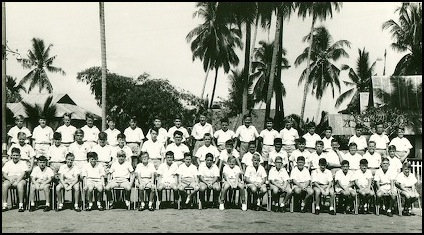
Above: Alexandra Grammar School's first-form boys pictured in 1959.
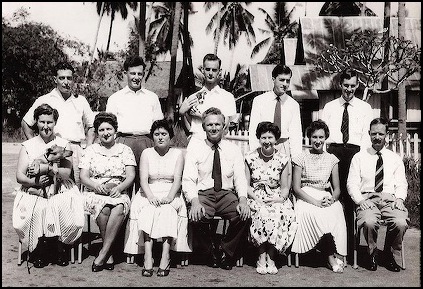
Above: The members of staff who taught Alexandra Grammar School's first form in 1959.
Few of the lessons and subjects that I studied remain with me from this first year at the grammar school. I can remember more the feel of lessons, trying (or not) to concentrate in the humid heat, punctuated during the monsoon season by the tropical downpours that are difficult to visualise if you have not experienced them – the thundering of rain on the roof; the intense humidity; the ferocity of the rain reducing visibility to literally a few yards; the water splashing back up into the air as it hit the ground; and, within a few minutes, the ground being awash with water and the monsoon drains being full with a rushing, swirling, junk-laden, muddy mess. And then the whole performance stopping abruptly, leaving the sound of drips loud in the quietness, and steam rising into the air all around, but with no relief from the dampness.
I made my first friends here, and I have a set of photos that I took of them, mainly draped in various poses over the outside of the toilet blocks, one or two of the braver souls giving the camera a defiant V-sign, and all wearing the school uniform of white short-sleeved shirt and khaki shorts. Because of the V-signs, I took the film from my camera to be developed separately, and then refused to show those pictures to my parents. They were quite concerned, imagining who knows what indecency being played out in the small black-and-white images.
Most defiant and "cool" (although it’s not a word that we knew then, except in relation to temperature) was my Australian pal, Chris Jones. Like me, Chris was a "civilian". His father was the Australian Broadcasting Commission's Southeast Asia correspondent, and he lived in (by our standards) some considerable splendour in a detached house off the Tanglin Road, not so far from Grange Road. Apart from an amah, they had a gardener and chauffeur for the large black car that took his father to and from work and his mother on her shopping trips and social visits.
Because of the heat, school was from 8 am to 12 noon. Unlike most of the kids, who came from much of the island, I travelled, to begin with, to and from school not in one of the hired red-and-silver Changi Bus Co buses that carted forces children to and from school ("Oh, you’ll never get to heaven on a Changi bus, 'cos a Changi bus makes too much fuss . . ."), but in a grey Bedford minibus that picked up various NAAFI children and took them to two or three different schools. My first-year grammar school was the furthest away, so I always had the longest journey, since the minibus started and finished at the transport depot at Grange Road. The driver was an amiable Chinese man called Henk. The big treat was to get to sit in the front passenger seat by the sliding door, which was left open to let in the cool breezes. There were no seat belts then.
After some time, not surprisingly, the NAAFI decided that this commitment of vehicle and driver to run a few children hither and yon was uneconomic, and we were transferred to a Changi bus. It was more anonymous than the Bedford, but more fun. Best of all, and I am ashamed to remember it, was sitting on the back seat and hurling abuse at locals as we passed them. At the end of one term, we spent the whole of the last few days surreptitiously tearing up paper into confetti-sized pieces during class, and then tipping the whole lot through the back window of the bus as it set off from school on the last day, leaving a cloud of snow-like fragments in the slipstream of the bus as we accelerated away.
After a year in the rural idyll of the grammar-school annexe, a new extension at the main school was completed for the expanding number of children (we were, after all, part of the post-war baby boom), and we moved to it as I moved into the second form. Why, I don't know, but the transition seems to have somehow left me with much clearer memories of the school day thereafter, compared with that first, rather isolated, year.
THE MOVE TO THE MAIN SCHOOL, AND THE END OF THE IDYLL
Alexandra Grammar School was on the top of a hill in the army's Gillman Barracks. From the bus, our day began with a long trek up the steep footpath that led to school. Our new classrooms were at the rear of the school, past the single-storey, brick-built huts that housed some of the older pupils, and through the two-storey main school building that must have dated from the 1930s and that housed the school office, the hall, and many of the specialist classrooms, including the art and music rooms.
After that first year, lessons somehow became more serious, and I can remember much more clearly the separate subjects. These included:
- English language and literature, taught as two separate subjects – which I enjoyed and was good at, parsing sentences and all;
- maths – a continuing struggle against subject matter and boredom;
- French and Latin – in both of which three years of study left me way behind my contemporaries when I eventually returned to England in 1962.
Then there were sciences, music, art and geography. We studied sciences in different laboratories for each subject. Physics was taught in a room in the new building. The only thing I can remember is that the laboratory was equipped incongruously with presumably bargain-price balances made in the People's Republic of China, then regarded as "the enemy" and the real reason why our fathers were in Southeast Asia, that is, to stem the threatened communist tide (the communist insurgency in Malaya had been effectively suppressed only in the last year or two, and Vietnam was just beginning to look like another interesting hot spot). We learned chemistry in one of the single-storey huts at the front of the school, and biology in one of the adjoining rooms. I remember observing the dissection of a frog in my third year, undertaken in a way that would be regarded as cruel and unacceptable now for schoolchildren. I remember trying to make a thermometer in physics – having to heat a glass tube and blow a bubble in one end before filling it with spirits, calibrating the temperature and sealing the other end. I could not get past the blowing-the-bubble stage, failing time and again to get it right while other people earnestly set about their calibration. And, tedious brat that I must have been, I found only boredom in observing the refraction of light through a prism. It would be fair to say, and it catches the tone of my attitude at the time, that I was crap at science.
I was also not much good at music, a trait that I could trace back to primary school in Germany, when, during some all-school rehearsal of hymns for a forthcoming service, I remember a teacher cruising up and down the rows of children, ear lowered to catch the quality of sound coming from each small mouth, and, reaching me, whispering in my ear: "You’re out of tune. Don't sing. Just move your mouth". Was this the reason why I played up during music lessons? The music teacher frequently had his eye on me, his tongue ready to rebuke, and his ruler ready to rap my knuckles with its sharp edge when I got too out of hand. Recently, when I dipped into one of the "exbritbrat"-type websites, his features leered out at me unexpectedly from a collection of photos of teachers.
Art, on the other hand, I enjoyed. I remember spending several weeks making an elaborate linocut ("Lino? What's that, Dad?" I can hear my children saying now) of a vintage car in several colours, a subject that I'd chosen from some book of illustrations. The whole thing brought out a sort of aesthetic sensuality in me that I can recall even now in detail: the touch of the different-shaped lino-cutting tools in my hand; the distinctive feel of the lino peeling away under the pressure of their use; the smells of lino and inks; the sticky noise of the roller squidging the paint on to the lino; and the pressing of the lino on to the paper.
But best of all, and a forewarning of what I would study at university, was geography. A geography exercise book is the only remaining schoolwork that I still have from Singapore, apart from a crabbedly written and worn notebook of French vocabulary. How could anyone not like geography? It was all around you: the tropical climate and weather; the coconut plantations on the low-lying land near the coast yielding up the liquid and flesh of the coconut, as well as the copra used in the manufacture of coconut matting; the paddy fields of rice; the plantations of rubber trees and palm oil, and, beyond them, the jungle hiding a rich flora and fauna, as well as the indigenous tribes of Malaya and Borneo, who were leading nomadic or semi-nomadic lives; the different races in the towns and countryside – Malays, Chinese, Indians – leading separate, but related, lives; and Singapore, the entrepôt port sited strategically on the route between the Far East, Australasia and Europe, with its huge oil refineries on offshore islands. I loved it.
Our study was interrupted each day by a mid-morning break, when we could choose from a bottle of plain, chocolate- or strawberry-flavoured milk that was provided for us to drink, abuse (by threatening to throw the contents at each other) or ignore. At the end of the day, we would flood down the hill to the buses waiting for us lined up alongside the road through the barracks, finding time, if were we lucky, to buy an ice-cold Fraser and Neave ("F & N") cherryade or another fizzy drink from the machine outside the small NAAFI shop at the bottom of the hill. The technology of this early bright-red-and-yellow drinks' dispenser was something that is no longer seen. Its lid opened upwards, like a chest freezer. Inside, rows of bottles were suspended from racks, one flavour per row. Having put your money in, you eased your chosen bottle towards the open end of its row and then released it upwards and outwards. On the outside of the machine, there was a bottle-opener. Insert the lid, pull up, and the top would fall into a container underneath.
My personal study was interrupted in year two, when my hormones kicked in and I became a particularly obnoxious adolescent: disruptive in class and cheeking the teachers when I could, sulky when I couldn’t; running with a group of similarly-minded horrors; suddenly interested in girls, but not sure how to approach them without causing offence (but sometimes doing so deliberately) – in brief, a teenage arsehole. The cycle was only broken at the end of that school year, when I received both a stinker of a school report and a severe talking-to from my father, who made his extreme displeasure clear and set out a doom-laden set of consequences for me if I didn't reform my ways. Thereafter, the hormones still raged, but I did at least knuckle down to some serious work. (Interestingly, when my father was in his declining years and, in his own mind, settling his affairs, he gave me an envelope with virtually all of my school reports from primary school to sixth form in it. I didn’t know that my parents had saved them. The only one obviously missing was the stinker from year two.)
My memories of sport (and exercise) in Singapore are almost wholly positive for some reason. I certainly didn't excel in them. But I remember doing things that I would later have shied from, and actually enjoying them. First and foremost were the glories of swimming. Even now, as I plod up and down the local pool for my weekly forty lengths, my mind clicks instantly back to the joys of tropical swimming. As far as school was concerned, that meant weekly trips down the hill to the outdoor pool (well, they all were in Singapore. Who needed an indoor pool in the sunshine at 80°F?) in Gillman Barracks. There, we were taught breaststroke, crawl and backstroke, diving and life-saving by two teachers. "Mr X" was the head of the PE [physical education] department. A squat old army PTI [physical training instructor], with leathery skin and wavy hair, always in white shorts and plimsolls, he taught us as though we were a bunch of recalcitrant squaddies, bellowing at us from the side of the pool. He had a blonde female colleague in a tennis skirt, whose knickers we would surreptitiously squint at from the safety of the shallow end as we underwent instruction. Occasionally, there would be a swimming gala in the same pool, with flags put up around the sides and what now seem like innumerable heats that everyone took part in.
Then there were the cross-country runs (for boys only) through the scrub behind the school. The route took us along rutted paths and what seemed at that age to me like rolling hills, mostly devoid of people, the countryside being covered by ferns. The most exciting part of the route passed a local kampong from which emaciated and aggressive dogs would leap barking loudly, until, forcing that extra bit of speed that adrenaline produces, we left them behind, waiting for the next gaggle of runners to reach them.
Once a week, too, we would be taken to the playing fields beyond the swimming pool in the barracks for cricket. (I have a vague memory that elsewhere on the grass the girls played hockey, but I could be wrong.) Here, we actually got a match, if we were lucky. But we more often stood in long rows with a bat, while "Mr X" had us practise different strokes in unison as imaginary cricket balls hurtled towards us ("Defensive stroke, I said, boy, defensive!" or "That would have had you LBW straightaway!" I seem to remember him calling).
People could stay on after school for clubs or activities. For a while, I remember staying for fencing in the gym. First, on with the protective clothing and the helmet (very hot in the humid, tropical weather), then, rather like with cricket, practising thrusts and parries in a row facing the teacher, and finally having a bout or two before heading off for a late bus. Even now, almost on autopilot, I can execute one or two basic strokes with an imaginary épée.
For the last year of my time in Singapore, I stayed at RAF Tengah with an uncle, who was in the RAF, because my father was posted "upcountry" to Terendak Camp in Malaya. My parents then rapidly departed to the UK because my mother was ill. I stayed on and eventually came back by ship to Tilbury, in Essex, with another NAAFI family. There, my father and frail-looking mother were waiting for me on the quayside. We drove through the crowded London streets in the A40 that Dad had bought on his return to Britain, pausing somewhere in what would now be called the "inner city" for a sit-down meal of fish and chips, to the NAAFI flat that they were living in Claygate, Surrey. Everything was drab. I struggled with my adolescent feelings of the injustice of it all. The idyll was over.'
Roger White (b.1948).
PICTURE: A SCHOOL PHOTOGRAPH, UP PARK CAMP, JAMAICA, EARLY 1960S
Barbara Rayner (née Messenger) lived in Up Park Camp, Jamaica, between 1960 and 1962. While there, she attended school in the camp, and kindly sent TACA the class photograph below, observing, ‘I'm not on the photo myself, but a friend of mine sent it to me’.
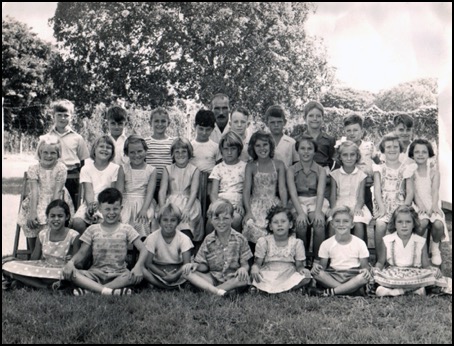
Barbara continued, ‘You may remember that Lord of the Flies was filmed in the Caribbean, and the star was James Aubrey, an officer's son from Up Park Camp. He was chosen from the boys in the camp, and was one of our friends. After leaving Jamaica, he ended up at Windsor Boys School in Hamm [(West) Germany], and sat at the same dining table as my future husband, John! What a coincidence!’ (James Aubrey (1947–2010) is on TACA’s list of famous army children.)
For more of Barbara’s memories and photographs, for which TACA is most grateful, click on the links: ‘PICTURES: TROOPSHIP TIPS, BOAC TICKETS AND TRAVELLING TO AND FROM TRIPOLI, LIBYA, 1950S’; ‘PERSONAL STORY: ‘A COUPLE OF YEARS AFTER THE CLASS PHOTO WAS TAKEN, WE WERE ON A SIX-WEEK VOYAGE TO JAMAICA’’; ‘PICTURES: MEMENTOES OF A JOURNEY TO JAMAICA ABOARD THE MS DUNERA, 1960’; PICTURES: ‘A GUIDE TO FAMILIES GOING TO THE CARIBBEAN’, 1959, AND REVISITING JAMAICA’S UP PARK CAMP IN 1990’ and ‘PICTURES: ‘OUR HOUSE IN JAMAICA, PICTURED IN 1960 AND IN 1990’.
PERSONAL STORY: MALTA, 1961-63; FILLING THE EDUCATIONAL GAPS; THE ROYAL NAVAL SCHOOL TAL-HANDAQ
After years spent living in (West) Germany, where she attended Prince Rupert School, Wilhelmshaven, Barbara Steels moved with her family to Malta. In the final part of her recollections of her childhood, Barbara remembers the two years that she spent there, and her last school, the Royal Naval School Tal-Handaq, which, despite its name, educated all service children, as well as those whose fathers, like Barbara’s, worked for the NAAFI. She also describes filling in the gaps in her education in later life, and re-establishing contact with former friends at Tal-Handaq. (See above, or click on the highlighted links for previous instalments of Barbara’s story: ‘PERSONAL STORY: PRINCE RUPERT SCHOOL, WILHELMSHAVEN, (WEST) GERMANY, 1958 THROUGH TO EARLY 1961, AND TWA TODAY’; ‘PERSONAL STORY: PRINCE RUPERT SCHOOL, WILHELMSHAVEN, (WEST) GERMANY; THE AUTUMN TERM OF 1957’; ‘PERSONAL STORY: LIFE IN LÜNEBURG, (WEST) GERMANY, 1955–58’; ‘PERSONAL STORY: ‘WE VISITED THE SUEZ CANAL FREQUENTLY; I COLLECTED THE NAMES OF SHIPS IN A LITTLE NOTEBOOK’, FAYID, EGYPT, 1954–55’; and ‘PERSONAL STORY: ‘MY EXPERIENCES WERE RATHER UNIQUE FOR A SEVEN-YEAR-OLD’, MOASCAR, EGYPT, 1953–54’.)
‘In early March 1961, the Miller family travelled from the UK to Malta. We arrived in the dark, and I can recall encircling Luqa Airport prior to landing and seeing the lights below. I remember thinking, “This looks rather different from Germany!” As we descended the steps from the plane, the warm air was quite noticeable.
Below: Me on the roof looking out over Sliema.
Left: This is Maria. My mother and Maria still exchange greetings every Christmas, fifty years later!

I was placed in form 4BG, at the same level and grade that I had finished off in at Prince Rupert School. I recall entering the classroom and thinking that it seemed very strange, mainly because everything looked beige: the boys wore beige shorts and shirts, and the girls wore beige dresses. The teacher was a naval officer, and he wore the white shorts and shirt of the summer naval uniform. Fortunately, I had befriended a girl called Jane Henderson, who lived quite close to me, and we used to sit next to each other. The school buildings were all sandstone-coloured, and were dotted around a fairly large site encompassing everything: the classrooms, science blocks, hall, gym and library. Some of the buildings were on two floors, with steps leading up the outside of the building to the upper floor.
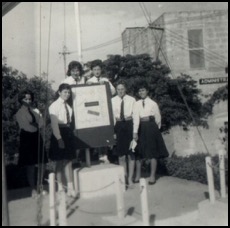
Above, left and right: This was one of my sister’s teachers (left); there were some civilian teachers, but most of mine were naval officers. A group of my sister’s friends in front of the flagstaff (right). This photo would have been taken during a winter term as the girls are wearing navy skirts and white blouses.
Starting a new school near the end of the spring term and nearly two terms into the first of two years preparing for GCE O’ levels was not good for my education. English, geography and history didn’t seem to be too difficult, but maths, French and biology were a real problem for me. In the case of biology, I had missed two terms of a two-year course, and was always trying to catch up. I didn’t ever feel that I settled into Tal-Handaq, but before I left, I managed to get four O’ levels.
Left: My friend, Judith, on the right, and me on the beach at Sliema.
Looking back on my life in Malta, I know that I didn’t really make the most of my time there. Being fifteen and sixteen years old is a difficult age for a girl: sometimes I did things with my parents and their friends, and at other times I wanted to be with people of my own age. My parents didn’t always approve of my friends, and I don’t think that I was very happy.
Above, left and right: These photos were taken on Gozo – I had joined my family and some friends on this occasion, and we had an enjoyable time.
Above: The Shepheard family leaving Valletta harbour to join a UK-bound ship.
During our second summer in Malta, my parents swapped homes with a NAAFI colleague who worked in Tripoli, in Libya. My father’s area included Tripoli, Benghazi and Tobruk, as well as Malta, and he was abroad fairly frequently. Away from Malta and my recently departed boyfriend, life seemed to brighten up, and I met up with some friends whom I had known at Prince Rupert School and we spent most of our time on the beach at the Picolo Capri Officers’ Club. There wasn’t much else to do, and I recall turning down the offer of a trip to the ancient Roman ruins at Leptis Magna in preference to doing nothing on the beach. One evening at the club, the film Breakfast at Tiffany’s was shown outside on the terrace. It was dark, warm and a very memorable occasion; every time I see it or hear the music from this film, I revisit that dreamy occasion in my mind.
Above, left and right: At the Picola Capri Club (left). My father is on the far right with my mother, and I am standing to his left. Right: Me relaxing.
While I was busy attending school, studying and socialising, my mother was deeply involved with the Brownies on the island. She was Brown Owl of the St Andrew’s pack and spent a lot of time attending meetings, rallies and training.
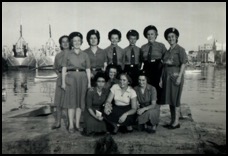
Above, left and right: This photo was taken at a Brownie enrolment (left). Guiders’ training day (right).
Below, left and right: A Brownie excursion (left). A Brownie march/run-past in Valletta (right).
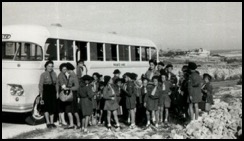
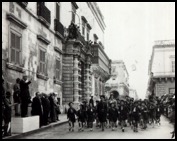
“MY BIGGEST ACHIEVEMENT WAS GETTING MY MATHS O’ LEVEL”
After completing my O’ levels and spending a few more months at school, there wasn’t going to be time for me to complete the two-year A’ level courses, and my parents decided that I should return to the UK and get a job that involved some sort of training. I started to work at a Dr Barnardo’s residential nursery in Essex, trained as a nursery nurse and stayed there for three years. I then worked at a London day nursery for a further year and met my future husband. We settled in Reading in 1968, where we had two girls. Ever mindful of my “incomplete” education, I went to the local college and acquired an A’ level in English. A few years later, we moved further west, just north of Newbury, in West Berkshire, where we still live today.
Our children were both at school and I now had time on my hands, so, what did I do? I set about teaching myself maths – the subject that had been so dreaded throughout my education. I could never get my head around the type of problem that started: “If it takes two men a certain amount of time to dig a hole, how long will it take seven men?” I simply used to shut off as no teacher had ever taken the time that I needed to sit down and explain how to solve mathematical problems. However, at last I managed to work this out, and, after that, I could work out anything! My husband helped and guided me, and having applied to take O’ level maths as an external student at a local college, I passed with a really good grade. At the age of thirty, now with five O’ levels and an A’ level, I applied to go to Reading University as a mature student, where, three years later, I graduated with a BA honours in sociology. For me, though, my biggest achievement was getting my maths O’ level: maths had been the one subject that had played a really negative part in my education, and I got there in the end!
POSTSCRIPT: THE ROYAL NAVAL SCHOOL TAL-HANDAQ
In 2001, while trawling around on the internet, I discovered that there was an organisation for the former pupils and staff of Tal-Handaq. On joining it and receiving the list of those who were there when I was, I was amazed by just how many people I could remember. My sister and I attended our first reunion in 2001, and I was thrilled to meet six of my former classmates, the headmaster, a couple of staff and my first boyfriend, Peter. A man who had lived in the same apartment building in St Julian’s also came and introduced himself to me. I had really not given much thought to my time at Tal-Handaq, or in Malta, since I left in 1963 – life in the world of work had been so different from school life, and I had just moved on.
I have now attended four Tal-Handaq reunions at three-yearly intervals, the last being at Bath University in 2010. Two of my friends had decided to live and work in Malta many years ago and, in 2007, they stayed at my home prior to going to the reunion in Warwick. Two years before this, my husband and I were on a cruise and spent a day in Malta. My friend, Jane Henderson, met us at the port and took us on a tour that included visiting the old school and where I used to live. This was an amazing experience, and the school site was just as I remembered it; it is now a local senior school. We were made most welcome and could wander over the site, although we were not allowed in the school hall as examinations were in progress (this took me right back to 1962, when I took my O’ levels in the same hall!)
If you are interested, please take a look at this website for the past staff and pupils of the Royal Naval School, Malta: http://www.tal-handaq. freeserve.co.uk.’
Barbara Steels (née Miller, b.1946).
PERSONAL STORY: A GERMAN-BORN ARMY CHILD'S EXPERIENCES IN WEST GERMANY, MALTA AND ENGLAND
On recalling his childhood, Hans-Jürgen Kariger, a 'pioneering' pupil at Kent School, Hostert, [West] Germany, comments, 'making friends was probably the main problem for army children: two to three years max at one posting, and then on the road again'. Here, he recalls his own experiences as an army child.
'I was born in 1950 in Gladbeck [then in West Germany]. My mother married Michael George Cilvert [a British soldier] in 1954, in the Standesamt [Registry Office], Gladbeck. To avoid irritation, I would bear my stepfather's surname, Cilvert, from 1954 until 1966. But on applying for an ID card (Personalausweis) to travel to the UK, the authorities would only change the surname (Kariger) on my birth certificate to Cilvert on payment of a fee, although I had an official military certificate stating that I would henceforth carry the name Hans-Jürgen Cilvert. The alteration would involve all official papers. I only had one birth certificate, thus only one official paper to be amended. But it seems that some hold a rigid position and changing the surname would incur costs that we could not afford, so I learnt to answer to the name Kariger.
The year 1954 was also the start of my odyssey, one that many army children have experienced, when we moved to quarters in Hameln [Hamelin] and enjoyed walks along the river Weser. In 1955, I think, we moved to Helmstedt, to Wilhelm Busch-Str. [Street]. I went to infants' school in Braunschweig [Brunswick], travelling in a VW bus with the daughter(s) of Captain Tyson. Dad was then a lance corporal serving with the REME [Royal Electrical and Mechanical Engineers] LAD [Light Aid Detachment]. Between 1956 and 1958 we lived in Berlin, in Scottweg, near the Olympiastadion [Olympic Stadium]. I was now at primary school and a friend was David Smith.
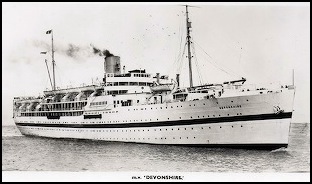
The years 1959 to 1961 found us in Malta, living in Birkikara and Hamrun. I attended primary schools in Luqa and Tigne (where we did a lot of swimming – I learnt it there). We had a good relationship with the locals, and I remember mum being the only lady on the island who rode a bicycle. Although the Maltese disapproved of ladies riding bikes, Mum was the only permitted exception due to the consequences of a childhood polio infection, an experimental operation by local surgeons and the failure of her foot to heal as expected. I remember Malta well, and yet would no longer be able to find my way around the St Luke's Hospital area, where we lived opposite the hospital in Elisabeth Flats. There used to be sandy, dusty paths for donkey-drawn carts where there are now, according to Google Maps, roads, and houses where goats used to graze and feed on paper and prickly pears. I recall the showers, when water dripped from the ceiling and trickled from spaces in the window frames, and when rain gushed ankle-deep down Gwardemanga Hill in all directions to Pieta Creek and Msida Square. An hour later, all was dry again and the scorching sun blazed down from a blue, cloudless sky. (I believe that many, like me, kept their brown, tanned skin for many years thereafter.) I remember St Anton Gardens, Attard, well, too, as I often spent an afternoon there with Mum when we lived on Fleur De Lys Road in Birkikara. Mellieah, or St Paul's Bay, were the beaches where a Sunday would be spent; on a Saturday, following a visit to the barber's, you would find me somewhere along Pieta Pier, trying my luckless hand at fishing.
After returning to Germany, I went to primary school in Essen (1961) and Krefeld (1962), where my stepfather was stationed with 11 Signals at Bradbury Barracks. From 1962 to 1963, I was a boarder at Windsor Boys' School (WBS), Hamm, where David Smith from Berlin was a dorm mate, as well as Dirk Matthews from Krefeld Primary. I remember the gym-shoe (plimsoll) punishment here. I then went to Queen's Lower, in Rheindahlen.
Previous reports having stated that if only I would work half as much as I chatted . . . in 1963 I applied myself and learnt to look, listen and understand. And I had come to recognise that words cut deeper than the mightiest sword. At Kent School, which I attended between 1963 and 1965, I was one of the prefects, and we prefects had many discussions, so that we knew all of the capers that anyone could get up to, and where. The most stupid place to smoke was the toilets – and imagine two people in a classroom cupboard sitting on two chairs! Two girls in my class, Dalia and Marianne, thought that one up. It brings back a smile because they said that I gave them the matches. Yes, but not for smoking – only for the Bunsen burner! The smoke gave them away as, unfortunately, a mistress came into the room directly behind me while I was on my duty round, checking classrooms. I think that it was Miss Gilmour, my art mistress. Other staff included Mr Ford (the head); Mrs Hutchinson (his deputy and a music teacher); Mr Cork (maths); Mr Worral (languages: German and French); Miss Valerie Perkins (English, who, in 1964, had me rewriting an essay, "Heat", three times for the first Kent Chronicle, which I never saw because I had left for Catterick by the time that it was published); Miss Pole (girls' sports); Mr Woodall (science); and, at the beginning, after Miss Pole, our form teacher, Mr Davis (geography). There was also a woodwork teacher whose name I've forgotten, but who used to play table tennis with me. He was a good athlete (he beat me at the 100 yards, so that was the answer to me thinking that I was the fastest: amongst the students, yes, but against the staff, no).
During '64, I think, Kent held an initial trial for boarding. I had been asked what I thought of the idea, due to my Hamm experience, and, with Mr Lacklison, my former WBS gym teacher who had also moved to Kent, we agreed it worth a try. The experiment took place over three to four weeks, I believe, during the summer holidays, with the house behind the 'playground' functioning as a dormitory. The pupils who took part were fascinated. Kent School later became a day and boarding school.
Looking back, WBS, Hamm, offered excellent possibilities, but a boarder of 11 or 12 years old was there too early, I think. Queen's, Rheindahlen, was overcrowded, with 36 to 40 or more pupils per class, so that the teachers could not cope with individual needs, even if they wanted to. Kent School, then newly established, with smaller classes of 12 to 16 pupils, absorbed Queen's' surplus. Kent School was an important milestone for me in showing and giving responsibility. "You represent your school within and without" is a phrase that I will never forget. Kent's, and thus our, aim was to do things better. I think that we achieved this, despite all of the hardships, sticks and stones. I remember that we had two groups for dinner (and praise to the cooks and ladies!) Was the dining room a former "mortuary or morgue?" It was not a morgue, but received incoming ambulances, with a ramp leading to the operating theatre. The entire West Wing was strictly out of bounds in my time, and, quite naturally, lurid stories started to feed childish fantasies (and maybe there are still those who believe in the existence of "Peg Leg" at Hamm or the "White Lady" at Hostert).
From the autumn of 1965 to 1966, my school was Hipswell County Modern in Catterick Camp, where I fitted in almost perfectly. (I should note that I communicated with headmasters and staff myself after leaving WBS.) Here, the fifth-form class was asked how many pupils had attended BFES [British Families Education Service] schools in Germany and could speak German – it was only Roswitha (a German girl, of course) and myself. Thanks to good reports from Kent, I was in the top stream, and the class consisted of under 20 pupils, and later even fewer because some left school. I remember that reading and writing about books and authors took up most of our time, and that we studied Shakespeare for drama, and not just one of his works, but three or four: The Merchant of Venice, Macbeth, Romeo and Juliet and Julius Caesar. Dad was demobbed in '66 and we left Catterick for his home in Dorset, Sturminster Marshall, where I attended Lytchett Minster Secondary Modern, having been squeezed in to enable me to take my exams. I was in the top stream here, too, and the teachers were very helpful indeed. The standard at maths was higher than at Catterick (or maybe it was because I had missed three weeks). English was OK as they were reading Golding, whom I had already read. We were given ample time for private study in order to brush up those areas in which we were believed to be a little weak, and a well-stocked library helped our researches.
In June or July 1966 we returned to Germany, where Mum cared for her ill father, a former coal miner who was suffering from the after-effects of coal-dust inhalation.
To all of the staff I met on my way, it is my turn to say: well done! And thank you.'
Hans-Jürgen Kariger (b.1950).
PERSONAL STORY: ‘IT’S TRUE, I FAILED THE ELEVEN PLUS BECAUSE I NEVER WENT TO ANY SCHOOL FOR LONG ENOUGH!’
Christopher Smith, whose father served in the Corps of Royal Electrical and Mechanical Engineers (REME), has generously shared his recollections of his army childhood with TACA, starting with his birth in (West) Germany, and encompassing postings to Cyprus and stints in England, as well as Germany.
‘I was born in BMH Rinteln in 1951. My mother had served in the Women’s Royal Army Corps (WRAC), met my father whilst he was serving in BAOR and they married in 1950. I was brought up in Herford and apparently spoke German before I spoke English, courtesy of a German “Frau” who helped my mother. We lived in Bad Oeynhausen from 1951 to 1953.
My earliest recollections are of travelling by plane to Cyprus in 1955. We stopped in Malta, my mother having spotted one of the engines leaking oil. We eventually arrived in Nicosia, where my father picked us up and drove us to Dhekelia fully armed. It was a paradise for service kids. I remember the Mediterranean Squadron of ships firing a salute in Dhekelia roads and service families visiting the ships. The beach (Cessac) was close by, and I lived at 42 Mandalay Road.
Above: Me in front of 42 Mandalay Road, Dhekelia, Cyprus.
I left Cyprus by the normal route . . . Famagusta . . . the SS Dilwara . . . for home in 1957. From 1957, my father was posted to Jordan, unaccompanied. This meant that my mother and I were in service accommodation in Scarborough. My first UK school was St Mary’s Convent there. There were boys, but my grandfather (a Glaswegian Orangeman), would have turned in his grave!
Then, in 1958, it was back to Germany. I remember wearing a Union Jack pinned to my cardigan until I realised that the BFES Mülheim school was full of British kids.
Above: My class at Mülheim. I’m the boy sitting down on the far left. You can’t miss me be because I hadn’t pulled up my right sock – my mum was livid!
Then my dad moved to Fallingbostel, where I took the Eleven Plus and failed spectacularly because I never went to any school for long enough (I also never agreed that Christopher Columbus discovered America). My dad had been promoted and could send me to a prep school in England. I took my Thirteen Plus and went to a grammar school, which was the longest I had ever spent at one school. Nomadic education for service children didn’t help educationally, but helped them to adapt!
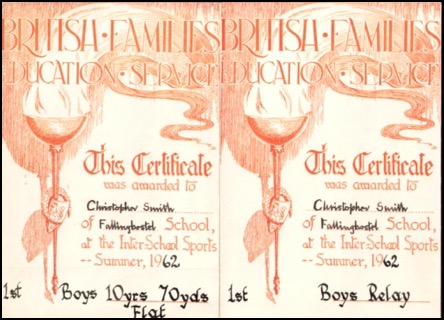
Above: BFES sports certificates dating from 1962, awarded to me while I was at Fallingbostel School. I was too busy running to worry about studying for the Eleven Plus!
Between 1963 and 1964, we lived in Cornwall, and between 1965 and 1974, in Germany: Paderborn, Dortmund, Lippstadt and Willich. We didn’t live in the “cabbage patch” in Lippstadt, but in civilian-type accommodation in Wiedergrunde (I’ve been back to Lippstadt since – how it’s changed). While there, I took part in a pantomime, “Sleeping Beauty”, at Christmastime in 1970. I also recall working in the Hella Factory in Lippstadt for six months as a translator before joining the army and then the merchant navy (I’ve been around). Fond memories.’
Christopher Smith (b.1951).
PERSONAL PICTURES AND PAGES FROM PUBLICATIONS: MALAYSIA AND SINGAPORE, THEN AND NOW
Jeff Harrison, whose father was in the Royal Engineers, went to ten schools in ten years. One of those was Bourne School, Kuala Lumpur, in Malaya (now Malaysia), which Jeff attended as a boarder between 1963 and 1965, followed by a term at St John's School, Singapore. To see some of Jeff's photographs from that time, as well as a selection of pages taken from Bourne School publications, click here.
TACA CORRESPONDENCE: MEMORIES OF BOURNE SCHOOL, KUALA LUMPUR, MALAYA
The images of Bourne School, Kuala Lumpur (KL), Malaya (now Malaysia) included in Jeff Harrison's contribution (see above, and to view it, click here) prompted Richard Mellish to contact TACA. Richard, whose father was in the Royal Electrical and Mechanical Engineers (REME) and who was born in 1952, attended the BAC [British Army Children's school] Taiping, Malaya; Bourne School, KL (Arakan House); St John's School, Singapore (some photographs of his time there can be seen on the Memories of Singapore website); BAC Majehidy [sic], JB (Johor Bahru), Malaya; and Alexander School, Singapore. Richard writes of his time at Bourne School, KL:
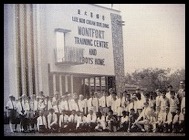
I still remember the paintings in the common room and the Paludrine tablets each morning. Both Robert and I sang in the choir at a matron's wedding at St Andrew's Cathedral, and I recall being driven back to Arakan with a tipsy Miss Boyd. Does anyone else remember that?'
If you share Richard's post-wedding memory, do let him know (via TACA).
TACA CORRESPONDENCE: CAN ANYONE TELL US MORE ABOUT MISS SEED’S SCHOOL IN ALDERSHOT, HAMPSHIRE?
Peter Barnes has been in touch regarding a school that he attended in Aldershot, Hampshire.
‘I was born in 1958, and my father served in the Irish Guards. After living in Kenya, we moved to Aldershot in 1964. When I was six, I went to Miss Seed’s School (a school for officers’ children) for around a year, from 1964 to 1965.
I am now having great difficulty trying to find out more about this school, despite having typed in numerous permutations on the web! I would like to know, for example, for how long this school was in existence. When did it close, and what happened to Miss Seed? What ages did it cater for?’
Can you help Peter to fill in the gaps? We’ve set the ball rolling by quoting Hilary Plew, a contributor to Roy Bainton’s book, The Long Patrol: The British in Germany, 1945–90 (2003), who told the author that before moving to Iserlohn, in (West) Germany, she had attended ‘an old Dame school in Aldershot housed in a Nissen hut which had three classrooms divided by curtains with an outside toilet . . . men teachers [were] . . . unheard of at Miss Seed’s establishment in Aldershot’. See below for more recollections of Miss Seed’s School. If you can tell us more, please contact TACA.
TACA CORRESPONDENCE: ‘I ATTENDED MISS SEED’S SCHOOL IN ALDERSHOT, HAMPSHIRE, IN THE EARLY 1950S’
Judy Wells has responded to Peter Barnes’ call for information about Miss Seed’s School, in Aldershot, Hampshire (see above, ‘TACA CORRESPONDENCE: CAN ANYONE TELL US MORE ABOUT MISS SEED’S SCHOOL IN ALDERSHOT, HAMPSHIRE?’ and ‘TACA CORRESPONDENCE: MORE MEMORIES OF MISS SEED’S SCHOOL, ALDERSHOT, HAMPSHIRE’, below). She writes:
‘I was born in 1946, and attended Miss Seed’s School in Aldershot in the early ’50s, while my father was in Kenya during the Mau Mau period (1951-54).
Miss Seed’s School for the Children of Officers at North Camp, Aldershot, was indeed housed in a Nissen hut. There were three classrooms: the classroom for the older children was at one end of the hut, and was divided from the other two classes with a wooden wall; the two classes for the younger children were divided with a curtain. It was a mixed junior school, but I’m not sure of the age range.
My memories of my time there are fairly eclectic, but I remember being taught French from an early age, and we all learnt to sew. Once or twice a week we would walk into Aldershot to have lunch at the Odeon (?). There was little in the way of facilities at the school, but I think we ate packed lunches in the older children’s classroom on the other days.
Miss Seed was very liberal with the ruler – either across the knuckles or the back of the legs. There was an eclipse while I was there; we were given smoky pieces of glass to view it through. The uniform was red. I do know someone else who was there after me; his memories are very similar to mine. He tells me that Miss Seed was granted an OBE or MBE.’
We are most grateful to Judy for having added to our knowledge of Miss Seed’s School.
TACA CORRESPONDENCE: MORE MEMORIES OF MISS SEED’S SCHOOL, ALDERSHOT, HAMPSHIRE
Roger Noble contacted TACA on reading Peter Barnes’ request for information about Miss Seed’s School, in Aldershot, Hampshire (see above, ‘TACA CORRESPONDENCE: CAN ANYONE TELL US MORE ABOUT MISS SEED’S SCHOOL IN ALDERSHOT, HAMPSHIRE?’). Roger, whose father served in the Royal Army Service Corps (RASC) and Royal Corps of Transport (RCT), was born in 1947. He writes:
‘I refer to the search for information on Miss Seed’s School for officers’ children in Aldershot. My family returned from a posting in Mombasa and then Nairobi, Kenya, in 1954 and settled in Farnborough, where my father was the quartermaster.
I went to Miss Seed’s for a year or two. I remember marching round the classroom singing rousing military songs like “The Grand Old Duke of York”. At lunch, we walked in a crocodile to the Odeon Cinema. I have a vague memory of going to Buckingham Palace because Miss Seed had been awarded something like an OBE. The school was, as your other contributor pointed out, in a Nissen hut at the top of a small hill on the road to Fleet.’
Many thanks to Roger for providing this additional insight into Miss Seed’s School. And for more on his army childhood, see ‘PERSONAL STORY: ‘MY EARLY YEARS IN KENYA AND ELSEWHERE . . . I WOULD LOVE TO KNOW MORE’.
TACA CORRESPONDENCE: RECALLING HAPPY DAYS AT MISS SEED’S SCHOOL, ALDERSHOT, HAMPSHIRE
Having read other people’s memories of Miss Seed’s School in Aldershot, Hampshire (see above, ‘TACA CORRESPONDENCE: CAN ANYONE TELL US MORE ABOUT MISS SEED’S SCHOOL IN ALDERSHOT, HAMPSHIRE?’, ‘TACA CORRESPONDENCE: ‘I ATTENDED MISS SEED’S SCHOOL IN ALDERSHOT, HAMPSHIRE, IN THE EARLY 1950S’’, and ‘TACA CORRESPONDENCE: MORE MEMORIES OF MISS SEED’S SCHOOL, ALDERSHOT, HAMPSHIRE’), Andrew Muston contacted TACA to tell us his own. Andrew, whose father was in the Royal Army Service Corps attached to 16 Para Ordnance Field Park, reckons that he attended Miss Seed’s School from around 1968 to 1970, when he was around five to seven years of age. He writes:
‘The school was in a three-roomed Nissen hut, as others describe. For one term, I recall decamping to another brick building while the Nissen hut was “done up” – with new paint and brown lino, I think.
Miss Seed was by then exceedingly old (probably even allowing for all adults seeming old to youngsters) and lived alone in a house with brown paint. I recall her feet being deformed, almost akin to the old Chinese style, but perhaps just due to old age.
I was left-handed, and Miss Seed wouldn’t have that, so I learnt to write left-handedly at the start of the page before transferring to my right hand halfway across (or whenever she was looking). I do recall once forgetting how to spell “up”. She mostly took the senior class, which I never reached. We were taught beautiful copperplate handwriting in ink, but no one would think that now.
We wore scarlet blazers and caps (berets for the girls). There were no trips to the Odeon, but lots of playing outside among small trees. Happy days!’
We are grateful to Andrew for sharing his recollections of Miss Seed’s School.
TACA CORRESPONDENCE: ‘WHILE AT MISS SEED’S SCHOOL IN ALDERSHOT, WE WERE KNOWN AS “SEEDLINGS”’
Other army children’s recollections of Miss Seed’s School in Aldershot, Hampshire (see above), prompted Katrina Luddington (née Gibson) to contact TACA. Katrina’s father served in the Army Catering Corps (ACC), attached to the Royal Army Service Corps (RASC)/Royal Corps of Transport (RCT), and she returned with her family to Aldershot, her place of birth, on their return from her father’s posting to Tripoli, Libya, in 1958. Katrina takes up her tale:
‘I was five years old when I attended Miss Seed’s School. As others have said, it was a wooden Nissen hut with an outside toilet. There were two classes separated by a curtain, but the senior classroom had a closing door. I started in the “mixed infants”, and our teacher, Mrs Gallagher, was a very tall lady with large spectacles and dark, curly hair.
Every morning, Miss Seed would lead us in singing “All Things Bright and Beautiful”, and we would recite the Lords Prayer before going to our classroom. At lunchtime, I remember going to the Odeon once a week, walking in a crocodile holding hands with a partner. After lunch, Miss Seed would call out the names of children who had been sent for punishment and would, in front of the other pupils, either crack her split cane across the palm of a hand or put small boys across her lap and slap their legs with a ruler. Once a week, I remember doing ballet, with Miss Shilling playing the piano. In the senior class, taught by Mrs Graham, we first used ink pens. We had long, high desks attached to benches. In the desks were inkwells, which monitors would need to fill with ink into which to dip the nibs of our pens. When it was time to go home, we would line up to say "goodbye" to Miss Seed. The boys would shake her hand and bow and the girls would curtsey.
I remember that Miss Seed had a very tatty Bible and drank very fragrant lapsang souchong tea. She wore a hat, complete with hatpin, on top of her wispy, grey hair, which was caught back in a bun. I thought that she was the oldest lady I had ever known – but my sister, Jill, who had attended Miss Seed’s School ten years earlier, thought the same! I left in 1962.
I would be interested to know when the school closed and what became of Miss Seed. We were known as “Seedlings” – very apt!’
We are most grateful to Katrina for sharing her memories of Miss Seed’s School. If you can add any more, please contact TACA.
(For more on Miss Seed’s School, see above for contributions from Peter Barnes: ‘TACA CORRESPONDENCE: CAN ANYONE TELL US MORE ABOUT MISS SEED’S SCHOOL IN ALDERSHOT, HAMPSHIRE?’; Judy Wells, ‘TACA CORRESPONDENCE: ‘I ATTENDED MISS SEED’S SCHOOL IN ALDERSHOT, HAMPSHIRE, IN THE EARLY 1950S’; Roger Noble, ‘TACA CORRESPONDENCE: MORE MEMORIES OF MISS SEED’S SCHOOL, ALDERSHOT, HAMPSHIRE’; and Andrew Muston, ‘TACA CORRESPONDENCE: RECALLING HAPPY DAYS AT MISS SEED’S SCHOOL, ALDERSHOT, HAMPSHIRE’. See also Myfanwy Morgan’s question, below: ‘TACA CORRESPONDENCE: WERE MISS SEED OF MALTA AND MISS SEED OF ALDERSHOT ONE AND THE SAME?’)
TACA CORRESPONDENCE: WERE MISS SEED OF MALTA AND MISS SEED OF ALDERSHOT ONE AND THE SAME?
Reading the correspondence initiated by Peter Barnes regarding Miss Seed’s School in Aldershot, Hampshire, on TACA’s ‘Schooling’ page (see ‘TACA CORRESPONDENCE: CAN ANYONE TELL US MORE ABOUT MISS SEED’S SCHOOL IN ALDERSHOT, HAMPSHIRE?’, above), prompted Myfanwy Morgan (née Parry) to contact TACA. Myfanwy, whose father served in the Royal Engineers, wrote:
‘I have been reading about Miss Seed’s School in Aldershot. Could this possibly be the same lady who taught me in the army primary school on Tigne, Malta, in the 1930s? There were just two teachers: Miss Smith and Miss Seed. I have many happy memories of my time in Malta.’
If anyone can shed any light on this intriguing possibility, please let us know.
‘SCHOOL IS EVERYWHERE’, AN INSTRUCTIONAL FILM, 1965
TACA is grateful to Martin Powell for drawing our attention to ‘School is Everywhere’ (i.e., wherever the servicemen fathers of the army children of the time were stationed), an ‘Instructional Film sponsored by THE DIRECTOR OF ARMY EDUCATION’. Produced to train army schoolteachers before their postings to army schools run by the British Families Education Service (BFES) during the 1960s, it provides an interesting introduction to, and oversight of, the roughly one hundred army schools all over the world that were then educating more than 30,000 army children, often through al-fresco lessons aimed at teaching youngsters important aspects of the countries in which they found themselves living. The film, which lasts just over twenty-three minutes, was officially approved for screening in April 1965, and is now viewable on YouTube: https://youtu.be/2xVGjO0Op5Y.
PERSONAL STORY: MY SCHOOLING IN THE UK AND SINGAPORE
Frances Pountney’s father served in the Royal Signals, as a result of which Frances spent around three years at St John’s School in Singapore between spells at schools in Devon and North Yorkshire, as she explains.
‘I spent a miserable four to five years at a convent boarding school in Devon, but on Dad’s posting to Singapore, the reputation of St John’s School meant that I was allowed to leave boarding school and attend St John's for approximately three years, from about 1966 to 1969. (I had a ball there, as did most of us military brats who attended!) I then spent two terms at Richmond Girls’ High School on our return to my birthplace: Catterick Camp (I was born in the military hospital there), which is now known as Catterick Garrison.’
Frances Pountney (née Knight, b.1952).
TACA CORRESPONDENCE: 'I WONDER IF I'LL EVER FIND OUT WHICH HOUSE WAS BLUE IN PASIR PANJANG'
Leslie Rutledge has already contributed a detailed and informative account of his and his siblings' army childhood to TACA (click here to read it, and here for his observations on its legacy), but reading Jeff Harrison's photo-story (see above, and to view it, click here) prompted him to send some more photographs. And see below for the name of the blue house in Pasir Panjang to which Leslie refers, which was kindly supplied by Paul Loy.
'I read the story of Jeff Harrison with great interest because, like me, he had to change school so many times. It also seems that we actually went to the same school (Bourne School) in Singapore, if only for a few months, but I was in the first year, and so I don't suppose we had any contact. Bourne School was originally situated in Kuala Lumpur, in Malaya [now Malaysia], but moved to Singapore the year I started secondary modern in September 1964. As far as I can recall, only first- and second-year pupils attended Bourne School in Singapore, while the third- to sixth-formers went to St John's.
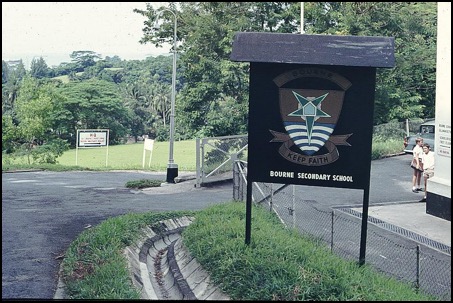
Above: Bourne School, Singapore, pictured in the mid-1960s.
I thought I'd send you photos (copied from the school magazine) to show that the drawings of the Alexandra buildings [see Part V of Jeff’s contribution] were not quite to scale – the square at the front is far too large – but by and large the drawings are excellent. I spent most of my schooling at the Gillman buildings, but also had some lessons (like science, and I remember sticking my finger in a blue flame to see if it was cold) in the Alexander building, so I knew them both fairly well.
Above: The Alexandra buildings (left). The Gillman buildings (right).
Like Jeff, I would also say that my second visit to Asia was the highlight of my childhood in the army [see parts VI to VIII of Leslie's story]. Reading some of his comments also jogged my memory because I was in a blue house in Pasir Panjang [Part VII] and a red house in Bourne, but couldn't for the life of me remember their names. Well, now I remember that my house at Bourne was called Slim, named after Field Marshal William Slim, who commanded troops in the Burma campaign. I wonder if I'll ever find out which house was blue in Pasir Panjang.'
TACA CORRESPONDENCE: THE NAME OF THE BLUE HOUSE AT THE SCHOOL IN PASIR PANJANG WAS . . .
Paul Loy has contacted TACA in response to the item above, headed 'TACA CORRESPONDENCE: 'I WONDER IF I'LL EVER FIND OUT WHICH HOUSE WAS BLUE IN PASIR PANJANG'', in which Leslie Rutledge wondered what the name of the blue house was at the junior school that he attended in Pasir Panjang, Singapore, in 1963 (for further details, click here and scroll down to Part VII of Leslie's story). Paul writes:
'The house was called BRITANNIA. For completeness, the other houses were: red – RESOLUTION; yellow – MAYFLOWER; green – VICTORY.'
Many thanks to Paul for providing this information.
PICTURES: TWO SWIMMING CERTIFICATES AWARDED IN SEREMBAN, MALAYSIA, IN 1968 AND 1969
As he outlined in his previous contribution, ‘TACA CORRESPONDENCE: LOOKING FOR INFORMATION ON RASAH CAMP, SEREMBAN, MALAYSIA’, Chris Fowler lived in Seremban, Malaysia, between 1967 and 1969. During this time, he attended the British Army Children’s School there, where he learned to swim. It was at this school that he passed, as the two certificates below show (the first has since gone missing), a test for general progress in swimming, which required him to swim ’50 yards Free Style Enter water head first from side of bath’; and a test for swimmers, involving swimming ‘100 yards Free Style 25 yards Backstroke Good standing dive from spring board’. His examiner in both 1968 and 1969 was P J Wootton, and Chris wonders whether anyone can tell him anything about this person (if so, please contact TACA, and we’ll pass on your information). We are grateful to Chris for sharing his charmingly illustrated certificates with us.
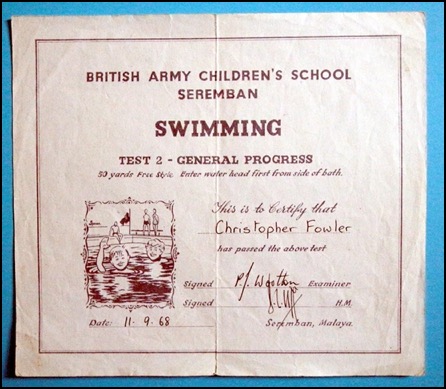
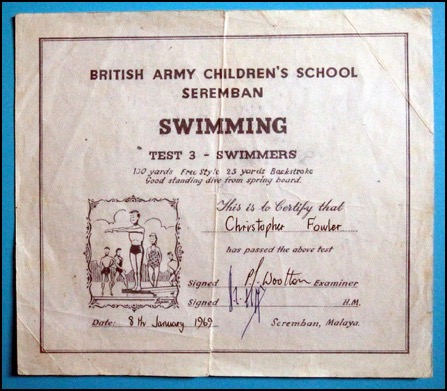
PERSONAL STORY: BOARDING IN BROADSTAIRS
This army child had already attended five primary schools before the age of eight when, in
'January 1969, I, the eldest of two brothers, was left at Hildersham House, Broadstairs, Kent, just prior to my father's post-staff-college posting to Malta. One of several Victorian institutions set up on the east Kent coast, the school had not changed much since its establishment by the then headmaster's grandfather in the late 19th century.

The first day as a 7-year-old was somewhat bewildering, not least as several boys were crying with homesickness. Wrought-iron bedsteads surrounded the perimeter of purpose-built 20-person dormitories with a central isle of hand basins, which were filled each morning from metal jugs by 12-/13-year-olds for morning washing.
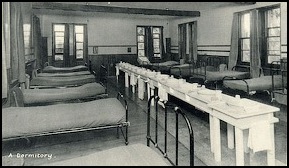
Dormitory antics were punished by cane or gym shoe, but escape committees and end-of-term dormitory feasts of corned beef and sweets, carefully smuggled in and hidden under floorboards, gave the prison-like discipline at least an edge of excitement.
Prayers that the school would burn down or close down were finally answered in 1971 with a letter to parents. In order to try to compete in an era of falling demand for boarding places, the school had offered reduced fees to sons of the army, which, it seems, were not financially viable.'
KW (b.1961).
PICTURE: BFES INFANT SCHOOL, LIPPSTADT, (WEST) GERMANY, 1969. (ONE FROM CLARE’S FAMILY ALBUM TO MARK TACA’S TENTH ANNIVERSARY)
October 2017 marks The Army Children Archive’s tenth anniversary, and we send our heartfelt thanks to everyone who has so generously contributed to TACA, or has otherwise taken an interest in it, over the past decade.
To commemorate this milestone, TACA founder Clare Gibson (whose father served in the Royal Signals) has contributed a photograph from her own family album. Dating from autumn 1969, it’s a class photo from her first term at the British Families Education Service (BFES) infant school in Lippstadt, (West) Germany. Clare is standing in front of the class teacher, Miss Williams. If anyone else recognises their younger selves in this photograph, we would be delighted to hear from them.
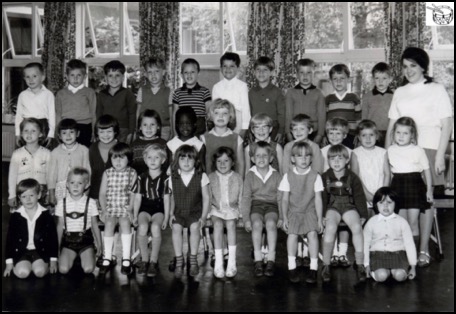
TACA CORRESPONDENCE: WHERE ARE THE ADMINISTRATIVE RECORDS OF RNS VERDALA, MALTA, ARCHIVED?
David Woolfenden has sent TACA the following message concerning the whereabouts of the administrative records of the Royal Naval School (RNS) Verdala, in Malta, which educated British forces' children until its closure in 1976.
'I was a pupil at the Royal Naval School Verdala, Malta, between 1957 and 1960. I have been very interested in the website http://www.verdala.com, which has contributions from ex-staff and many pupils who attended the school. Several commentators have asked where the records of the school now reside, as they wish to find out more from the archives about the life of the school and other details about their school chums and the teachers that they knew. A few individuals have tried to trace these records, but have had no luck.
There is to be a reunion in Malta in September 2010, and I would really like to be able to tell the assembled audience that records/archives are available. Are you able to help in any way? When a British forces' school abroad ceases to function, what happens to the records? Are they all dumped, or are they deposited in a secure archive? I would be delighted if you could give me guidance on this matter, please. Even a suggestion on the records' whereabouts would be much appreciated.'
If you have any information that you think will be of help to David, please e-mail him at the following address: dwoolfenden@toucansurf.com.
PICTURE: DETAIL FROM A ‘SERVICE SCHOOLS’ EXERCISE BOOK, 1970S
The printed detail below appears on the front of a music exercise book used by a pupil at a primary school in (West) Germany during the early to mid-1970s. Although the colours of their covers varied according to subject, all ‘army-issue’ exercise books used at British Families Education Service (BFES) primary schools at this time bore Queen Elizabeth II’s royal cipher.
PICTURE: ST ANDREW’S SCHOOL, RHEINDAHLEN, (WEST) GERMANY
This colour postcard, which was mailed in 1970, shows St Andrew’s School in Rheindahlen, (West) Germany. A primary school, it educated army children until its closure in 2010.
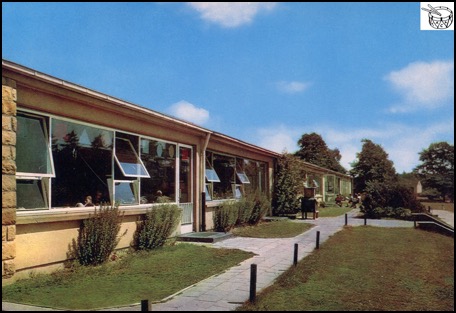
PERSONAL STORY: AN ARMY SCHOOL TEACHER IN NEPAL, 1976–78
During her career with the Service Children's Education Authority (SCEA), Angela (Vikki) Richardson taught in RAF schools in Singapore (1966–71) and Cyprus (1971–75), and in army schools in Hong Kong (1975–76) and Nepal (1976–78, a period that she recalls below). 'I found the children of army service personnel a delight to teach', says Angela. 'They were bright, enthusiastic and self-disciplined. They accepted life as it came and appeared to settle into any new environment. I found that service schools had a high standard of education and were easily on a par with any good state school.'
'I spent twelve years – from 1966 to 1978 – teaching in British forces' schools. I was employed from the UK and was part of the SCEA – the Service Children's Education Authority. My first tour with SCEA was in Singapore, where I taught in RAF Seletar and RAF Changi. My next posting was in Cyprus in 1971, still teaching with the RAF. I thoroughly enjoyed my nine years with the RAF, but as this is the TACA website, I will talk about my time with army schools, in particular in Nepal. I went to Hong Kong in 1975 and was based in the New Territories at Sek Kong. A year later, I was offered the post of primary-school head teacher in Dharan, Nepal, which I started in April 1976.
Dharan Cantonment was built in 1958 as a recruiting depot for Gurkha soldiers joining the British Army. It was situated in east Nepal, about 100 miles from Kathmandu. The camp was 1,000 feet above sea level, and 5 miles from the foothills of the Himalayas. When we climbed to 5,000 feet behind the camp, we could see Mount Everest, plus a full panorama of snow-capped mountains.
As well as being a recruiting depot, Dharan was also a centre for paying Gurkha soldier-pensioners. There were REME [Royal Electrical and Mechanical Engineers] workshops run by the Royal Engineers, and in 1960 a British military hospital was built to treat British and Gurkha soldiers and their families. There were about sixty to eighty British expats, including twenty primary-school-aged children who attended our SCS [Service Children's School] Dharan. There were two teachers: Maggie Howell, who taught the infant children, and me, and I was responsible for the junior class. Our classrooms were attached to the church, which we also used as a school hall, and alongside our playground was the camp swimming pool.
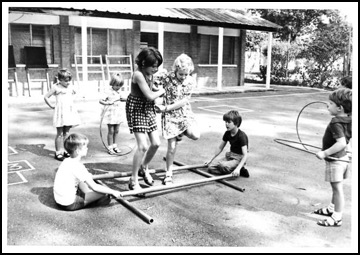
Dharan was a wonderful place for bird-watching. We saw storks, cattle egrets, herons, tiny green bee-eaters, kingfishers and long-tailed black drongos. We often saw the more sinister Bengal and Egyptian vultures outside camp, usually devouring some large dead animal. We regularly went on one-day expeditions, leaving camp at 4 am to catch the dawn chorus. We would travel in a Land Rover alongside the padi (rice)fields on the flat, open plains heading towards the Kosi Barrage (the barrage was built to cross the river Kosi and to control excessive flooding in the monsoon season). Nearby was an observatory where we could make our camp for the day. Apart from wonderful views of hundreds of different species of water birds, we were also able to watch families of otters playing near the water's edge.
When the young Gurkha soldiers had undertaken their basic training, there was a ceremony on camp where they pledged allegiance to our queen. As they were a long way from home and didn't have any family in Dharan to share this event, we at school were invited to go along to the parade ground and stand in for their family and friends. It was very moving to see these young men march up to the portrait of our queen and pledge allegiance to her. It was also a reminder to us as to the main purpose of our reason for being in Nepal.
Also on camp was a school for the children of the Gurkha soldiers, and we often joined up with them for several activities, including sports days and painting competitions. Outside camp was an orphanage for local children run by an ex-army pay sergeant called Tom Hughes. Some of Tom's children were handicapped and didn't have a place in their local school. Sometimes, when our school day had finished, we would go across and do some activities with these children. None of us knew much of the local language, but it was a good chance for each group to get to know each other better.
Although we aimed to absorb as much as possible of this fascinating environment, we also kept to our traditional syllabus. Each year, we produced a children's Nativity play in the school/church hall, which was attended by nearly everyone on camp. One year, it was Chuck, the camp mongrel, who nearly stole the show: he followed the Three Wise Men down the aisle to the manger and then lay down in front of Mary, Joseph and the baby Jesus for the rest of the performance.
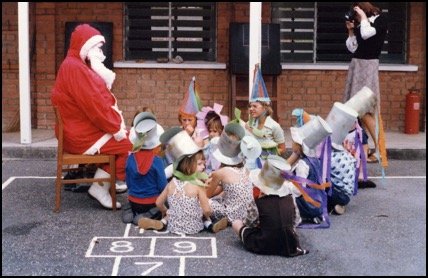
Above: Christmastime at the school in Nepal.
Before I left Dharan, I was presented with a small wooden shield that has since become one of my treasures. On the front is a mountain scene, which we saw from our camp. It includes the crossed-kukri swords, a pair of binoculars and a perched hoopoe, which was a favourite bird on camp. On the back of the shield is a list of the pupils who came to the school from 1976 to 1978.
Below: Front and back views of Angela's treasured shield.
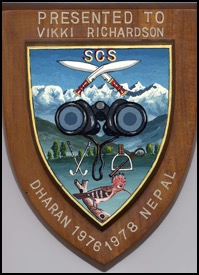
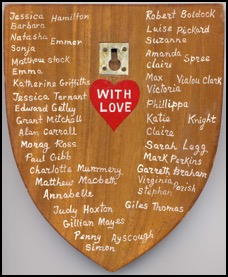
I feel very privileged to have spent two years in such a unique and fascinating place. I have some wonderful memories of Nepal, and I hope the children who spent time there were old enough to remember some of their experiences.'
Angela (Vikki) Richardson.
PERSONAL STORY: 'MÜNSTER – I CAN’T FAULT THE PLACE'
The reference to Edinburgh School in Münster, (West) Germany, above, prompted Gerald Lipton to share his own memories of his schooldays in Münster (BFPO 17), where his father was serving in 4 Royal Tank Regiment. Gerald, who was born in Singapore, also recalls how difficult it was to adjust to life in the UK after the Lipton family moved to Scotland, and reflects on some of the lasting legacies of growing up an army brat.
'I attended Edinburgh High School in Münster from 1976 to 1980, and before that, Swinton Primary School in the village of Senden, along with my brother and sister. Senden had a large British housing estate set in the countryside, about three-quarters of an hour from Münster. At that time, the school was a new, state-of-the-art, open-plan building, which even now would be hard to beat. I was one of the first pupils to attend it, and my teacher there was Mr Bishop, who had a sailing dinghy. It's amazing how things influence you when you are a child: little did I know then that sailing would become a large part of my life, and of my children's, as we go sailing most weekends. I cannot remember my first primary school in Münster, but it was in an old army barracks, just along from the Edinburgh High School site.
I have been back a few times since, and the primary school in Senden is still there and being used by the locals. The high school has been converted back to an army barracks, as mentioned on your page. However, the main buildings are clearly recognisable. I had a great time there, and remember it clearly, even after all this time. My teacher was Miss Mackie, and I remember how, when the sun was splitting the sky, she would take the whole class out to a small shop next to the school (which is still there today) for ice cream – thank you, Miss! Footballer Jeremy Goss also attended Edinburgh High School at that time, and was linked, or played, with Southampton Football Club as a schoolboy and then had success with Norwich City and Wales.
LIFE AFTER MÜNSTER
I now live in Fife, Scotland, in an old mining community on the Firth of Forth, overlooking Edinburgh. I was abandoned here when my father left the army in 1983 (his last posting was in the town of Kirkcaldy, with army carriers). My mother was in tears when my dad told her we were going back to Britain – little did I know how bad it was. It was a shock coming here. Compared to Germany, it was like going back twenty years in time: freezing cold, no central heating, coal fires, sash-and-case windows – it took some getting used to. I finished school here, at a place that was not as good as my school in Münster. Sport has always been a major part of my life, and schools here simply did not cater for, nor encourage, this.
I left school in 1982, with five O' levels, and went straight into a government employment scheme (the YTS [Youth Training Scheme]) as a plumber. I was then a car-body worker before getting a start as a roof slater and plasterer. I got my City & Guilds and did a five-year apprenticeship. After that, I became self-employed and now run a small building firm. I firmly believe that my own success is down to having been an army brat.
The funny thing about army kids is their accents. For instance, in our family, we all speak differently. My dad, although he is Scottish, sometimes does not pick up what I'm saying; my brother, on the other hand, stays in Northampton and speaks with more of an English tone. Even now, when this is the place that I have stayed in the longest, the locals are puzzled as to where I am from, with my mix–match of difference accents. If I find that someone does not hear me right, it comes as no surprise, and I instantly change my accent from a Scottish tone to an English one so that they can understand me.
Thankfully, the standard of life in Scotland has changed for the better. However, everything about me is German, from the way that I work to the food that I eat. I even drive a VW and will not buy anything British if I can help it. The only problem I have is that I feel that I have no roots. I still move around every couple of years – I am sure that it's in the blood – but at least I am staying local. Given the chance to move back to Germany, I would. That’s not so easy, but with cheap flights, it’s no problem to visit. I was last in Münster in New Year 2009, to look up old friend. I can't fault the place.'
Gerald Lipton (b.1965).
PERSONAL STORY: 'I HAVE CHANGED COMPLETELY'
Taima McDonald-Pizey's father was in the Royal Army Ordnance Corps (RAOC), and it was as Lynda Carter that she travelled all over the UK and (West) Germany with her family from April 1972 until March 1984. Taima sums up her army-child experience as follows.
'As an army brat, I suppose that the thing I loved most was the travel aspect of our lives. I lived in Hiddingsel and Senden, near Münster, in Germany. I attended Senden Primary School and then moved up to Edinburgh High School in Münster from 1979 to 1980. I remember Alan Jones, Martin Jones, Mandy Smith, Sean Bell, Jackie Mohammed and Kim Linton. My name was Lynda Carter then, and some thought that it was amusing that I was named after the actress Lynda Carter, who played "Wonder Woman". I was very much a loner, and was never one of the "popular" crowd – I never wanted to be, either. I have since changed my name and have changed completely.'
Taima McDonald-Pizey (née Lynda Carter, b.1967).
SUPPORTING MILITARY CHILDREN AND FAMILIES: THE SCE DEPLOYMENT RESOURCES WEBSITE
Schools and support services working with British military families affected by deployment, as well as the families themselves, may find it worth visiting the Service Children's Education (SCE) Deployment Resources Site at http://www.sceschools.com/deployment/index.php. Here, you can download, free of charge, guidance booklets, including one for parents, along with a variety of training presentations. As the website states:
'These materials are not simply about protecting children from the stresses of deployment; challenge and change are basic facts of life for everyone. Children that are well supported learn better and in ways that enable them to gain from challenging experiences, they grow to be strong and resourceful as adults and they become better equipped to face subsequent life-transitions.
For children to become the best they can, this support is most effective when it empowers people to do things for themselves. A number of the key developments in the SCE approach in recent years are reflected in these materials; there has been a particular focus on what works and the factors that help children develop positive resilience. In practice, positive, upbeat approaches that focus on what is possible tend to get better results; this is more effective than dwelling on what might go wrong.'
Click here to read more about the SCE approach to supporting service children.
LINKS
The following links relating to the education of army children over the centuries may be of interest.
- The wide-ranging Delta Tech Systems website presents in-depth information about army education during the nineteenth and twentieth centuries. You can also read about the histories of the Royal Military Asylum, Chelsea (today the Duke of York's Royal Military School in Dover), and the Royal Hibernian Military School, Dublin, here. Visit: http://www.achart.ca
- Service Children's Education (SCE), an agency of the MoD, is dedicated to the education of the children of service families and MoD personnel serving outside of the United Kingdom, providing education from foundation stage through to the sixth form. For further information, visit: http://www.mod.uk/DefenceInternet/DefenceFor/ServiceCommunity/ Education/sce/
- The BFES-SCE Association is open to all who have worked with service children's education abroad. Visit its website at http://www.bfes-sce-association.org, and on its 'Links' page you'll find a list of websites dedicated to schools in Malta, Asia and Germany.
- The archives of the Institute of Education, University of London, hold records of the British Families Education Service (BFES)/Service Children's Education (SCE) Association, 1944-2013. For further details, click here.
- The Alexandra Grammar website is aimed at former forces' children who attended British forces' schools in Singapore from 1945 onwards. These include schools at the Royal Air Force stations at Tengah, Changi and Seletar; the army bases at Tanglin, Nee Soon and Gillman; the naval base, HMS Terror; as well as some schools in mainland Malaya/Malaysia. Visit it at: http://www.alexandragrammar.org or http://www.britschools-singapore.org
- St George's School, a school for British forces' children in Hong Kong, closed in 1996. A website devoted to it includes photo galleries and forums. Explore it at: http://www.saintgeorges-hk.com
- Slim School, in Malaya's (now Malaysia's) Cameron Highlands, was a boarding school that educated army children between 1951 and 1964. Visit www.slimschoolmalaya.com/maingate.htm to learn more about the school, and, if you went there, to make contact with past pupils and teachers. There is also a Slim School Club Yahoo! Group (http://groups. yahoo.com/group/slimschoolmalaya2) where ex-Slimmers can interact.
- Bourne School was located in Kuala Lumpur, Malaya (now Malaysia), between 1954 and its closure in 1965 (it then reopened in Singapore). The Bourne School Kuala Lumpur Yahoo! Group was established for those ex-Bournies who attended this school, and its website (http:// groups.yahoo.com/group/bourneschoolkualalumper) includes messages, photo albums and a collection of Bourne School Magazines. There is also a closed Facebook group (Bourne School Kuala Lumpur Malaya) for former pupils.
- Although called the Royal Naval School Tal-Handaq, and run by the Royal Navy, this secondary school in Tal-Handaq, Malta, also educated army children from 1947 until 1978. Past staff and pupils are welcomed at http://www.tal-handaq.freeserve.co.uk, where the history of the school can also be read about. A nostalgic gallery of photographs can be viewed at: http://www.talhandaqnostalgia.org. Recent images of the school (now the Liceo Vassalli) can be seen at: http://www.tal-handaq.co.uk
- Former pupils of the Royal Naval School Verdala, on Malta, which also schooled army children (it served as a primary school from 1949 until 1976), should visit http://www.verdala.com, a comprehensive website aimed at past pupils and teachers. A history of service children's schools on Malta can be accessed by following the two timeline links on this website, and some illuminating memories can be read in its 'Staff Room' section.
- Prince Rupert School (PRS), for the children of British armed forces and Control Commission personnel, was based at Wilhelmshaven, Germany, between 1947 and 1972, and is thought to have been the first comprehensive, co-educational boarding school established under the terms of the 1944 Education Act. Follow this link to read a history of the school: http://www.prs-wilhelmshaven.co.uk/open/school20.html; to become a member (if you went to the school) and access the rest of the The Wilhelmshaven Association (TWA) website, visit: http://www.prs-wilhelmshaven.co.uk. In 1972, PRS moved to Rinteln, Germany, where it remains; follow this link for the Prince Rupert School Reunion Website: http://prs.jwarburton.com, and this one for details of Prince Rupert School today: http://www.princerupert.de
- King Alfred School, Plön, was a co-educational boarding school that educated forces (and Control Commission) children in Germany between 1948 and 1959. You can read about it on the Wyvern Club's website. See: http://www.kas-ploen.org.uk/overview.htm. Peter Dent has produced a film history of the school, which is viewable on YouTube: https://youtu.be/OsmFbM9DA3M.
- The Windsor Society's members are former army children who went to Windsor School, Windsor Girls' School and Windsor Boys' School in Hamm, Germany, between 1953 and 1983. Its website presents information and photographs pertaining to the history of these schools. Visit it at: http://www.windsorsociety.org.uk/index.htm
- Queen's School educated army children in Rheindahlen, Germany, between 1955 and 1987. The Queen's School (Rheindahlen) Association's website, at http://www.queensschoolrheindahlenassociation.co.uk, which is aimed at reuniting former pupils and staff, gives a brief history of the school. In addition, queensschoolrheindahlen.com acts as a community website for former pupils of Queen's School, Rheindahlen; visit http:// www.queensschoolrheindahlen.com for a 'Where are they now?' forum, photo albums and more.
- The Kent School Association website is dedicated to maintaining contact between former pupils of Kent School in Hostert, Germany, which educated army children between 1963 and 1987. It also gives an overview of the school's history. See: http://www.kent-school.co.uk. There is also a Kent School Yahoo! Group: http://uk.groups.yahoo.com/group/ kentschoolpupils
- A number of Yahoo! Groups have been established for those who attended certain BFES/SCE schools in (West) Germany, including: Edinburgh School, Münster (http://groups.yahoo.com/group/edinburghschoolmunster); the Havel School, (West) Berlin (http://groups.yahoo.com/group/havel school); and King's School, Gütersloh (http://groups.yahoo.com/group/ thexkingsschoolgutersloh)
- Ex British Forces Kids is an online, public-access-restricted club open to former army children (and their teachers and parents) who attended BFES schools around the world. It can be accessed at http://groups.yahoo.com/group/exbritishforceskids2 and http:// exbritiishforceskids.multiply.com
- The Friends Reunited website (http://www.friendsreunited.co.uk/) has a number of BFES schools in its ‘UK Overseas’ category; those who have registered with the website can add their names to lists of former pupils and can contact others through the website.
- Ex Far East Brats is a Yahoo! Group for members who attended any Far East forces’ schools from the 1950s to the 1970s. Many ex-pupils attended one or more of these schools during their travels, and through its website they can find each other, share and refresh their memories and make new friends: http://groups.yahoo.com/group/Exfareastbrats.
- Members of The Old Khormaksarians' website are people from forces families, but also civilian families, who accompanied their parents to Aden (which is today part of Yemen) during the 1950s and 1960s. Although the majority of members attended the BFES-run secondary school at RAF Khormaksar, the group welcomes those who went to any of the British schools in Aden (there were two RAF primary schools, an army primary school at Falaise Camp and several civilian schools, too) or, indeed, those at boarding school in the UK who visited Aden during the school holidays. The website has a members' area (there is no membership fee), with discussion pages and a link to a Flickr album that contains several thousand photos from the period, as well as from twenty-first-century visits to Aden. Visit it at: http://www.khormaksarschool.org.uk
- The Terendak Schools Yahoo! Group (http://groups.yahoo.com/group/ TerendakSchools) is for ex-pupils (and staff, family and friends) who attended Slim School, BACS Terendak, Mountbatten, Seaview, Sungei Udang or any other school in, or near, Terendak Camp, Malacca, Malaysia, during the 1960s and early 1970.
- Britbrats.com (http://britbrats.tripod.com) is an online community and magazine for past and present pupils and staff of BFES and SCEA schools.
CLICK HERE TO SEE JEFF HARRISON’S IMAGES OF BOURNE SCHOOL, MALAYA/MALAYSIA AND SINGAPORE, AND ST JOHN’S SCHOOL, SINGAPORE
TO READ A SUMMARY OF DR GRACE CLIFTON'S RESEARCH INTO THE EXPERIENCE OF EDUCATION OF THE ARMY CHILD, CLICK HERE.
TACA SCHOOLING ALBUM: GIBRALTAR


