

If you have an army child or two in your family tree, it may be possible to learn more about them by consulting certain family-history resources, while reading about the military conflicts in which the British Army has been involved over the centuries, and their historical context, may help to inform you about the times, and circumstances, in which they lived.
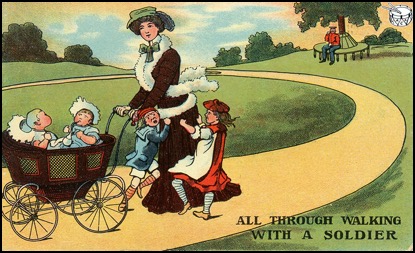
PICTURE: 'ALL THROUGH WALKING WITH A SOLDIER'
Captioned 'All through walking with a soldier', the comic postcard shown below, which is around a century old, reflects the prevailing Victorian and Edwardian belief that most army children were members of large families.
RESEARCHING ARMY CHILDREN
If you are interested in researching an army child in your family tree, it's best to consult a specialist genealogical publication or magazine, such as the Imperial War Museum's book Tracing Your Family History: Army (2006), for advice on how to proceed. Otherwise, the following basic tips may set you on your way if your army child, or children, were 'on the strength', or 'children of the regiment'.
- If the child was born in Britain, you should be able to track down details of his or her birth certificate in the same way as you would those for a child of civilian parentage (FreeBMD, which contains birth, marriage and death indexes for England and Wales, can be searched for free).
- If the soldier father was stationed in England or Wales in 1841, 1851, 1861, 1871, 1881, 1891, 1901 or 1911, you should be able to locate the family in the appropriate national census (for further details, visit http://www.nationalarchives.gov.uk, and note that access to the 1881 census is free).
- If the soldier father was posted overseas, the GRO Army Birth Indexes (1881-1965), the GRO Army Chaplains' Birth Indexes (1796-1880) and the GRO Regimental Birth Indexes (1761-1924) may contain details of his children's births, and can be viewed free of charge, along with the equivalent marriage and death indexes, at genealogical websites like http://www.findmypast.com.
- The births of army children born abroad during the twentieth and twenty-first centuries should have been registered with the British authorities through the British Army, and their birth certificates should therefore be applied for through the General Record Office (GRO). If their births were not registered, however, then they can apply for a late registration by contacting the general section at the GRO. For further information on ordering birth certificates, click here; and click here for more on how to register the birth of a baby born abroad.
- Memorial and gravestone inscriptions may give an army child’s biographical details. See TACA’s ‘ARMY CHILDREN’S GRAVES’ and ‘THE ARMY CHILDREN GRAVES REGISTER’ pages for further information.
- If the soldier father was stationed in India before 1949, the British Library's India Office Family History Search website, http://indiafamily.bl.uk/UI/, may be worth visiting. This offers a searchable database of selected birth, baptism, marriage, death and burial records, taken from the India Office Records, for British and European people living in India between around 1600 and 1949.
- The Families in British India Society (FIBIS) is devoted to members with an interest in researching British or Anglo-Indian ancestors who lived or served in the Indian Subcontinent from 1600 to 1947, and the background against which they led their lives in 'British India'. Non-members will also find viewable social-history-related material on its website, including a range of records and images. To explore it, click on: http://www.fibis.org
- The Jamaican Family Search website (see: http://www.jamaicanfamilysearch.com) contains lists of British Army regiments stationed in Jamaica between 1702 and 1962 and information relating to, and contained in, Jamaican almanacs and directories, transcribed books and newspapers, religious registers and wills, Jamaican monumental inscriptions, maps, photographs and much more. Most web pages are accessible only to members, but certain pages can be viewed by all, among them one that includes some details of baptisms and burials of army children; see: http://www.jamaicanfamilysearch.com/Samples/Soldiers.htm
- The Gibraltar National Archives’ website ‘allows the user to access thousands of birth, marriage and death events records pertaining to the British military personnel that served their tour of duty on the Rock of Gibraltar’. Click here to search for military births on Gibraltar between 1869 and 1914; here for military marriages between 1869 and 1914; and here for military deaths between 1869 and 1914.
- The Malta Family History website, http://www.maltafamilyhistory. com, is a real boon to those researching British individuals with Maltese connections, including soldiers serving in the British Army and their families. On this website, you'll find nineteenth- and twentieth-century registers of baptisms, marriages and deaths in Malta, indexes of the names of those buried in cemeteries on Malta, as well as of British soldiers who were stationed there, an illuminating article on the army chapel-schools in Malta and more besides.
- If you are researching a child who attended the Royal Hibernian Military School, Dublin, between 1847 and 1932, or the Royal Military Asylum, Chelsea, between 1803 and 1901, you may strike lucky if you search the ‘British Army Schoolchildren and Schoolmasters 1803-1932’ category on the http://findmypast.com website. These records were collated by Peter Goble.
A SELECTIVE TIMELINE OF CONFLICTS INVOLVING BRITISH TROOPS
1689-97: War of the Grand Alliance
1701-14: War of the Spanish Succession
1740-48: War of the Austrian Succession
1756-63: Seven Years' War
1775-83: American War of Independence
1793-1802: Wars of the French Revolution
1803-15: Napoleonic Wars (1808-14: Peninsular War)
1812-15: War of 1812
1814-16: Gurkha War
1833-42: First Afghan War
1845-46: First Sikh War
1848-49: Second Sikh War
1854-56: Crimean War
1857-58: Indian Mutiny
1867-68: Abyssinian War
1878-80: Second Afghan War
1879: Zulu War
1880-81: First Boer War
1884-85: Sudan Relief Expedition
1896-98: Reconquest of the Sudan
1899-1902: Second Boer War
1914-18: World War I
1919: Third Afghan War
1939-45: World War II
1950-53: Korean War
1956: Suez Crisis
1969-2007: Operation Banner (Northern Ireland)
1982: Falklands Conflict
1991: Operation Granby (the first Gulf War)
2001 to date: Operation Veritas, Operation Fingal and Operation Herrick (Afghanistan)
2003-9: Operation TELIC (War on Iraq)
TACA-RELATED ARTICLE IN FAMILY HISTORY MONTHLY MAGAZINE'S SEPTEMBER 2009 ISSUE
If you're a family historian who is interested in tracing army children of the past, you may find an article in the September 2009 issue (Issue 173) of Family History Monthly magazine of interest. The piece, entitled 'Following the Drum', by Clare Gibson, also includes background information on TACA. Back issues can be bought from Family History Monthly's website: http://www.familyhistorymonthly.com/issues/issues-list.
PICTURE: THE DEAD SOLDIER, C.1789, BY JOSEPH WRIGHT OF DERBY
The painting shown below is entitled The Dead Soldier. It was painted in around 1789, by Joseph Wright of Derby, and is today part of the Yale Center for British Art’s Paul Mellon Collection. The painting portrays a dead British soldier who has suffered a violent death (maybe, given the painting’s date, in North America, during the American War of Independence). He is being mourned by a young mother and her baby, who has not yet been weaned.
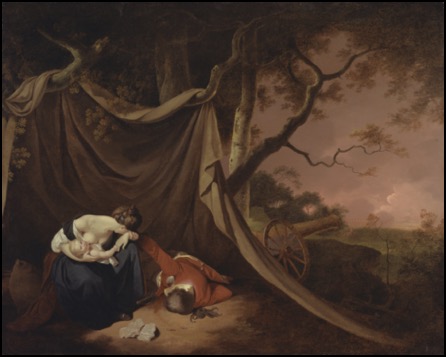
Above: The Dead Soldier, c.1789, by Joseph Wright of Derby (1734–97), oil on canvas, Yale Center for British Art, Paul Mellon Collection.
The painting was reportedly inspired by the poem The Country Justice (1774–77), by John Langhorne (1735–79), and especially by a passage entitled ‘Apology for Vagrants’, which imagines how a widow and her child might have been forced into vagrancy:
‘Perhaps on some inhospitable shore
The houseless wretch a widow’d parent bore;
Who, then, no more by golden prospects led,
Of the poor Indian begg’d a leafy bed.
Cold on Canadian hills, or Minden’s plain,
Perhaps that parent mourn’d her soldier slain;
Bent o’er her babe, her eye dissolv’d in dew,
The big drops mingling with the milk he drew,
Gave the sad presage of his future years,
The child of misery, baptiz’d in tears!’
Although romanticised, the painting gives an inkling of the sorrow and hardship that many female camp–followers and their army children suffered when ‘following the drum’ in the footsteps of their soldier menfolk on campaign. Click here to read more about the painting, courtesy of Carole McNamara, of the University of Michigan Museum of Art.
TACA CORRESPONDENCE: ENLISTMENT AS A DRUMMER, AGED FIVE
Janet Adams has been in touch with TACA regarding her great-great-grandfather, who was born to a British soldier serving at Gibraltar in 1781. Having been orphaned, he enlisted at five years of age and served in the British Army for twenty-one years, seeing action in the Peninsular War. Janet writes:
'Following our enquiry, the British War Office (WO) provided quite detailed information on my mother's grandfather, Colour Sergeant John Murray, who was born on Gibraltar in 1781 to a serving British soldier. Five years after his birth, his father died on duty (cause unknown), and the child was enlisted as a drummer in HM 50th Regiment of Foot. He later served in many campaigns, including the Peninsular War, and was awarded the Military General Service Medal with five bars. He was discharged without a pension.
I am intrigued by the history here, but his parents' names are unknown, so I don't know how to find more information. Details on John Murray's death certificate (in Collector, Australia, 1857) indicated his parents as "father unknown soldier" and "mother unknown", which suggests that the child had no memory or knowledge of either after enlistment. I have been trying (not very successfully so far) to get information about John Murray's parents as this would shed more light on the circumstances of his early life in the army and that of other children of the time. The opinion given by the WO was that enlisting children into service at such a young age was not unknown. They said that wives of soldiers were sometimes allowed to accompany their husbands overseas, but no provision was made for their support if their soldier husband was killed. In this event, the commanding officer of the unit sometimes permitted children younger than the enlisting age to join up, thus saving the mother and child from destitution.
I thought that it would have been relatively easy to find some information about John Murray, given that we had the details of his service unit and his years of service, but so far have been frustrated in my searching. . . . I must say that as much as I am interested in the boy, I am perhaps more interested in finding his mother, in particular to find out what her fate was. Did she also die on Gibraltar? If so, she must have died quite young as it seems that the boy had no real knowledge of his parents. If I can find more information, it could be enhanced by pictures of uniforms and campaigns of the Siege of Gibraltar and the Peninsular War, so I welcome advice on where to look for such information.'
If anyone has any advice to offer Janet, she would be delighted to receive it, and can be contacted through TACA.
TACA CORRESPONDENCE: BOY SOLDIERS AND EIGHTEENTH-CENTURY REGIMENTAL MUSTER ROLLS
Janet Adams' appeal for information relating to her great-great-grandfather, an army child born in Gibraltar in 1781 (see above, 'TACA CORRESPONDENCE: ENLISTMENT AS A DRUMMER, AGED FIVE'), caught the eye of A W (Art) Cockerill (whose website, http://www.achart.ca, is the 'site of choice for histories of the Duke of York's and Hibernian military schools', and more besides). Art's advice to Janet follows, and may also prove useful to anyone else who is researching British soldiers of that period.
'Checking the TACA site, I saw Janet Adams' copy regarding her great-great-grandfather, Colour Sergeant John Murray, who enlisted as a drummer at the age of five in the 50th Foot at Gibraltar. Sergeant Murray is the youngest boy recruit to my knowledge. He beats James Wade, aged seven, who enlisted – also as a drummer – in the 9th Foot (The Royal Norfolk Regiment), served throughout the Peninsular Campaign and got his discharge at the age of twenty-nine, having served his twenty-one years. He was wounded.
I suggest that if Murray enlisted in the 50th Foot, that was the unit in which his father served, which means that he will be found in the muster rolls of the regiment for the period. The rolls will record his age, date and place of enlistment (which is a clue to his parish), and trade or occupation on enlistment. The 50th's stay at the Gibraltar station would be recorded in Kinsella's Forlorn Hope. Anyway, this might help Janet extend her enquiries.’
TACA CORRESPONDENCE: THE ENLISTMENT OF A SEVEN-YEAR-OLD DRUMMER BOY IN CEYLON, 1807
Prompted by previous TACA correspondence about the enlistment of army children as drummer boys during the eighteenth and nineteenth centuries (see above, ‘TACA CORRESPONDENCE: ENLISTMENT AS A DRUMMER, AGED FIVE’ and ‘TACA CORRESPONDENCE: BOY SOLDIERS AND EIGHTEENTH-CENTURY REGIMENTAL MUSTER ROLLS’), Wendy Laigne-Stuart has been in touch regarding a similar case. She writes:
‘I read the comment about the seven-year-old who was enlisted. My great-great-great-grandfather was also seven when he enlisted. William Sugden was in Colombo [then in Ceylon, today in Sri Lanka] when he enlisted as a drummer boy in the 19th Foot on 21 March 1807. [See the extract from his discharge papers reproduced below.]

When they were returning home, he joined the 45th Foot on 24 September 1819. He was pensioned off at twenty-two. After a couple of years at “home”, he joined the Royal New South Wales Veterans Corps and came to Australia. He was given a 100-acre land grant, and I have read that all of those on Veterans’ Flats were veterans of the Napoleonic Wars.
I have yet to trace William’s career as I am in Australia. He is the ancestor of an inordinate number of people engaged in genealogy, and is a major brick wall for all of them! His records state that he was born in Chatham, Kent, in 1800, and those facts are stated consistently throughout his life. I have not been able to find a William Sugden, born at Chatham in 1800, but I have recently found another Sugden in the 19th Foot, and a birth in 1799, but in Yorkshire. At least it was to a father who was a soldier. William’s marriage and daughter’s birth have also not been found, so he remains our International Man of Mystery! I understand that there is no Sugden in the pay book for the Kandy conflicts [in Ceylon]. I hope to find out a lot more about him.’
Although, as Wendy states, her great-great-great-grandfather’s parentage is currently unknown, the combination of his birth in England; his enlistment at such a young age in Ceylon; and the comparable enlistment of other soldiers’ young sons as drummer boys suggests that he was indeed an army child. Wendy continues, ‘I am hoping to get some suggestions as to where to look for enlistment details to find his father’. If you think that you can help Wendy break through her genealogical brick wall, please contact TACA, and we’ll pass on your message.
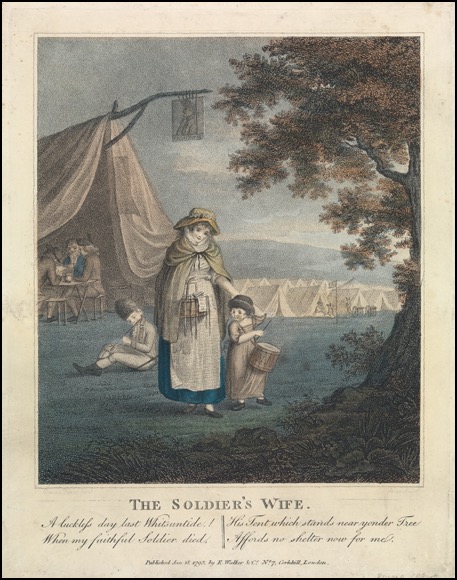
PICTURE: THE SOLDIER’S WIFE, 1793, BY WILLIAM S LENEY
The coloured stipple engraving below is the work of William S Leney (1769–1831), after the original by Emma Crew, and dates from 1793. It shows a woman and her small child, who is banging a toy drum, walking away from a military encampment. Beneath the title – ‘The Soldier’s Wife.’ – is the following explanation: ‘A luckless day last Whitsuntide ! / When my faithful Soldier died, / His Tent which stands near yonder Tree / Affords no shelter now for me.’. Together, the image and words suggest the sad fate of widowed army wives and fatherless army children at this time, for not only did they suffer the emotional pain of losing of their soldier–husband and –father, but also the loss of any army-provided accommodation and rations. In other words, the army cast them out, and they were left to fend for themselves. This engraving is today part of the Yale Center for British Art, Paul Mellon Collection.
PICTURE: L'ENFANT DU RÉGIMENT, 1854 TO 1855, BY JOHN EVERETT MILLAIS
The British artist John Everett Millais painted L’Enfant du Régiment (when translated from the French, The Child of the Regiment), also known as The Random Shot, below, between 1854 and 1855, when the British Army was engaged in fighting the Crimean War.
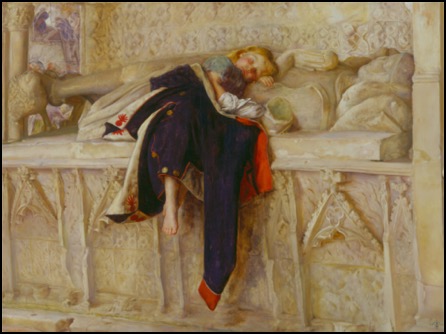
John Everett Millais (1829–96), L'Enfant du Régiment, 1854 to 1855, oil on paper, laid on canvas, mounted on board, Yale Center for British Art, Paul Mellon Fund.
The subject is a wounded child, lying sound asleep on a marble tomb in a church under a soldier’s jacket. In his book The Life and Letters of Sir John Everett Millais, President of the Royal Academy (published by Methuen & Co in 1899), Millais’ son, John Guille Millais, writes of the painting:
‘I am glad to avail myself of Mr. F. C. Stephen's description of it in the following words: “This small picture represents an incident in the French Revolution, where some of the populace, attacking a church which is defended by the military, have accidentally wounded a soldier’s child who had been taken there for safety. The little one, wrapped in his father’s coat, has just sobbed itself to sleep on the tomb of a knight, where the child had been laid out of further danger; the tears of pain have ceased to trickle down its face, and its sobbings have found rest in sleep. The tomb is of alabaster, mostly of pure white, but dashed and streaked with pearly fawn and grey tints, according to the nature of the material, which acquires from time an inner tint of saffron and pale gold. The tale of ‘The Random Shot’ is explained by showing some soldiers firing out of a window of the church.”
The tomb on which the child is lying is that of Gervaise A Hard, knight, one of the many beautiful works of art still to be seen in the old church at Icklesham. Dante Rossetti was probably right in saying that the artist’s first idea was to depict the scene as taking place in a church besieged by Cromwell, for several of the sketches in my possession suggest more forcible and warlike movement than is to be found in the picture itself. The child, too, was originally painted in several attitudes before that of repose was selected.’
A deliberately powerful and affecting image, L’Enfant du Régiment vividly illustrates the dangers that many army children of previous centuries – British, as well as French – faced when trailing their soldier–fathers in following the drum.
DEATH ON THE MARCH: FALLING BY THE WAYSIDE ON THE RETREAT TO CORUNNA, 1808–9
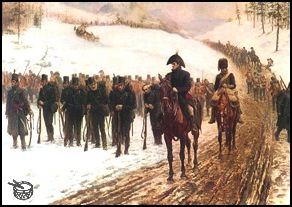
There was a time when army children accompanied their parents abroad on active service. In his memoirs, Rifleman Benjamin Harris, of the 95th Rifles, recalls the heartbreaking scene that he witnessed on the retreat to Corunna (the port of La Coruña, in north-western Spain) during the Peninsular War, which took place over the Christmas and New Year period of 1808–9, 200 years ago. 'About this period I remember another sight, which I shall not to my dying day forget; and it causes me a sore heart, even now, as I remember it', he writes, before describing seeing an army wife and her young son struggle in vain to keep up with the British troops. The few lines in which he tells his story (see below) are just part of a fascinating account that was first published as The Recollections of Rifleman Harris during the mid-nineteenth century. Rifleman Harris' memoirs remain in print, and this extract appears on pages 87 to 88 of a Cassell Military Paperbacks edition, edited by Christopher Hibbert, published in association with the Windrush Press in 2006.
'Soon after our halt beside the turnip-field the screams of a child near me caught my ear, and drew my attention to one of our women, who was endeavouring to drag along a little boy of about seven or eight years of age. The poor child was apparently completely exhausted, and his legs failing under him. The mother had occasionally, up to this time, been assisted by some of the men, taking it in turn to help the little fellow on; but now all further appeal was in vain. No man had more strength than was necessary for the support of his own carcass, and the mother could no longer raise the child in her arms, as her reeling pace too plainly showed. Still, however, she continued to drag the child along with her. It was a pitiable sight, and wonderful to behold the efforts the poor woman made to keep the boy amongst us. At last the little fellow had not even strength to cry, but, with mouth wide open, stumbled onwards, until both sank down to rise no more. The poor woman herself had, for some time, looked a moving corpse; and when the shades of evening came down, they were far behind amongst the dead or dying in the road. This was not the only scene of the sort I witnessed amongst the women and children during that retreat. Poor creatures!'
TACA CORRESPONDENCE: SEEKING INFORMATION ON A BIRTH DURING THE RETREAT TO CORUNNA
Liz Brown has contacted TACA for help in discovering more about the birth of an army child during the retreat to Corunna (La Coruña), in Spain, between 1808 and 1809 (that is, during the Peninsular War). As Liz explains, the newborn in question was the son of a private serving in the 42nd (Royal Highland) Regiment of Foot, or 42nd Royal Highlanders, as the regiment was known at the time of the Napoleonic Wars; it is today called the Black Watch (Royal Highland Regiment).
'The obituary of my great-great-grandfather mentions that his mother gave birth to his half-brother during the retreat to Corunna:
"The deceased, who was born in Huntly, was the son of John Williams, a favourite English jockey in the service of the last Duke of Gordon, and of whose high professional skill, and success in winning races for his noble master, occasionally in the face of somewhat serious difficulties, various traditions yet remain. His mother's history was not less remarkable. Previous to her marriage with John Williams, who was her second husband, she had been the wife of a soldier who served under Sir John Moore; and during the ever memorable retreat from Corunna, she gave birth to a son (Mr. Williams's half brother), who is still alive, and occupying a highly respectable and responsible situation as a head-gardener." [Aberdeen Daily Free Press, July 25, 1876]
My great-great-great-grandmother's maiden name was Elizabeth Rabbet, and her first husband was a private in the 42nd Royal Highlanders, surname McDonald. I'm interested in finding out more about either of them, and their son, born in such harrowing circumstances.'
The Black Watch's website provides an outline of the regiment's activities during the Napoleonic Wars (http://www.theblackwatch.co.uk/index/ napoleonic-wars), while an item above ('DEATH ON THE MARCH: FALLING BY THE WAYSIDE ON THE RETREAT TO CORUNNA, 1808–9') gives an indication of the nightmarish conditions endured by the women – many pregnant – and children attached to the regiment during the retreat to Corunna.
If you have any suggestions that you think may help Liz to learn more about this particular army family, do get in touch: she can be contacted through TACA.
TACA CORRESPONDENCE: WAS MY SPANISH-BORN, WELSH-SPEAKING ANCESTOR AN ARMY CHILD?
TACA correspondent MH is researching her family history, and wonders if anyone can help her discover more about one of her ancestors, who may have been an army child.
‘One of my great-great-great-grandmothers, the Welsh-speaking wife of a Welsh-speaking agricultural labourer in rural Cardiganshire (near Aberystwyth), was born in 1809 (ish) in Spain, according to the censuses. I had wondered whether she might have been the child of a soldier on the Peninsular campaign, and I see from other postings on TACA that that is perfectly possible, dates-wise. Please could anyone tell me whether there were any Welsh regiments involved, and how I could find out about them? Everything I know is written above, apart from her name – I have nothing else to go on. I have tried the military registers on Ancestry and FMP without success. All help or leads gratefully accepted!’
If you think that you can help MH, please contact TACA, and we’ll pass on your message.
TACA CORRESPONDENCE: TRYING TO PINPOINT A PENINSULAR-WAR BIRTH
In the course of her research, TACA correspondent Alyson McGarrigle discovered that she had an army family in her family tree. She is now keen to discover more about the birth of one of her 4 x great-grandfather’s children, an army child who seems to have been born on campaign in Spain. Alyson explains:
‘I have been trying to find information about the family of a 4 x great-grandfather, Thomas Owens, and his family. Thomas was born in Montgomeryshire and joined the 53rd Foot in 1807. His first child was born in Spain in 1810 in a place named on the child's later army discharge record as Gelida. The second son was born at Brabourne Lees, in Kent, in 1814. The last child that we know survived to adulthood was born on St Helena in 1817, when his father’s regiment was guarding Napoleon. The family then all moved to India, where the father died in 1822.
All of the sons joined the army and served for around twenty years. The two older boys remained and died in India, and the youngest eventually returned “home” to the UK.
We would like to find out where in Spain the oldest boy was born. The regiment did see action at Talavera in 1809, and remained around the Spanish/Portuguese border until 1813, when part of the regiment returned to England. But we cannot find a place name that seems to fit the description, and wondered if you had any suggestions.
That our family-history research uncovered this family has been fascinating for us, and it seems incredible that the boys survived what must have been a very dangerous and terrifying experience. It also says much about the bravery and tenacity of their mother!’
Indeed! If you think that you can help Alyson, do get in touch. She can be contacted through TACA.
TACA CORRESPONDENCE: THE 43RD REGIMENT OF FOOT AND A MISSING BIRTH RECORD, c.1811
Judith Curtis has been researching a soldier ancestor, but has now hit a brick wall, prompting her to contact TACA.
'My 3 x great-grandfather, James Longley, joined the 43rd Regiment of Foot in Leeds, Yorkshire, on New Year's Eve 1830, at the age of nineteen. I have his attestation and discharge papers from the National Archives. I also have his marriage certificate for his marriage to Mary McKenzie in 1834, and have traced the births of his children between 1836 and 1851, in various parts of Ireland where he served, via the GRO Regimental Birth Indexes. Incidentally, the marriage and all births have been registered in the surname of Langley, instead of Longley. However, I know that I have the right man as his wife, Mary, and some of the children, can be traced back to Leeds on the census records. The army pension records also show that James retired to Leeds in 1852 after being discharged due to having tuberculosis (from which he died in 1853).
On his attestation papers, James states that he was born in the parish of Morley, Yorkshire, and he would have been born in about 1811. However, I cannot find any records of his birth in Morley or anywhere in Yorkshire, which leads me to suspect that he may also have been the child of a soldier.
I have found a possible father for him, namely, a Job Longley, who was born in Morley in 1791. It appears that Job also joined the 43rd Regiment of Foot. I have Job's army records, which show that he joined up on 1 April 1812 at Harwich, Essex, at the age of twenty-two years, and that he fought in the Peninsular War and at the Battle of New Orleans. The army also refers to this man as Langley instead of Longley. I discovered that Job was discharged in August 1829 and returned to the Leeds area. James joined up the following year – 1830 – at Leeds. In addition, the description of these two men in their army papers is almost identical. Another reason why I think that Job may be the father of my Sergeant James Longley is that James named one of his sons Job. This is quite an unusual name that seems to have been handed down through several generations. Also, it seems too much of a coincidence that both James and Job joined the 43rd Regiment of Foot. Yet the birth of James cannot be found in the GRO Army Birth Indexes under either the surname Langley or Longley.
The questions I have are:
1) Would it have been usual for a married man of twenty-two with a child (or children) to join the army, i.e., would he have been accepted if he was already married?
2) If Job Longley's wife and children went with him, but were considered to be off the strength, could this be the reason why James' birth doesn't appear in the GRO Army Birth Indexes?
3) Any ideas or suggestions for other records that I could try would be much appreciated as I have now reached a dead end with my research.’
If you think that you can help Judith break through her genealogical brick wall, she can be contacted through TACA.
TACA CORRESPONDENCE: MYSTERY BIRTH IN 'ISLEY BLOU'
Anne Hitchen has contacted TACA to ask if anyone can help her solve a puzzle that has been bugging her for years.
'For some time now I have been trying to discover more about the birth of my great-great-great-grandmother, born Eliza Isley Kelly to William Kelly of the 1st Regiment of Foot Guards in about 1812. On census returns, she is described as "Born in Spane of british parents" and also "born Isley Blou, Spain". However, I can find no such place as "Isley Blou", and it has been suggested that it could be Isla de León. I think William fought in the Peninsular War and took his wife with him, but I cannot find a marriage or death record for her. On the census returns, he is described as a widow, and he became a master shoemaker. I suspect that Eliza's mum died, possibly in childbirth, as I imagine that conditions would have been horrific, and also wonder if she was Spanish, which makes the mystery even more complex. Can anyone help?'
If you think that you can point Anne in the right direction, please get in touch. She can be contacted through TACA.
TACA CORRESPONDENCE: WILLIAM ISLEY AND THE 52ND (OXFORDSHIRE LIGHT INFANTRY) REGIMENT OF FOOT
Anne Hitchen's appeal for help in discovering more about the birth of Eliza Isley Kelly in about 1812 (see above, 'TACA CORRESPONDENCE: MYSTERY BIRTH IN 'ISLEY BLOU'') prompted CC to send the following message concerning another army child, with the observation, 'The name Isley is quite uncommon, so I thought I would throw this in'.
'My great-great-grandfather William Isley was in the 52nd (Oxfordshire Light Infantry) Regiment of Foot from about 1831 until 1851. I think his father was also in the same regiment, which was in England and Sicily between 1803 and 1807, and then in Portugal, Spain and France from 1808 to 1814. I'm not sure where my great-great-grandfather William Isley was born as he claims several different places in England in about 1805. His wife was Margaret Lucas.'
TACA CORRESPONDENCE: INVESTIGATING AN ARMY CHILD'S IRISH-BORN SOLDIER FATHER
Gill Bassett has contacted TACA with the following request for help.
'My 3 x great-grandfather was John McKee, who I have been able to follow through the UK censuses. John's father was William McKee, who was a soldier who came from Ireland and joined the British Army. The fact that John was born in Spain as a British subject leads me to think that William went to fight in the Peninsular War, took his wife, and that she gave birth to John during the time that the army was in Spain.
A relative has searched for military records for a William McKee from Ireland at around the time of John's birth, 1814, but unfortunately he has found four of them. One strong possibility is one from Aughnacloy in Ireland, who joined the Connaught Rangers. I would love to know if there is a way of confirming this as there is no record for the birth of John registered in this country, therefore we cannot check the names of his parents, thus leaving us stuck. I would appreciate any help.'
If you have any advice for Gill, e-mail her at rich.gill@talktalk.net.
TACA CORRESPONDENCE: THE KING'S GERMAN LEGION AND NINETEENTH-CENTURY ARMY SCHOOLS
TACA has received the following message from Peter Cole requesting assistance.
'I belong to the Bexhill Hanoverian Study Group. As the name suggests, we are researching the King's German Legion (KGL), who were in Bexhill, East Sussex, between 1803 and 1815. They had a garrison school and sent some children to the Royal Military Asylum (RMA). The KGL was an integral part of the British Army, and whilst the soldiers, and sometimes their wives, were in the Peninsula, the children were still in Bexhill. The wives and children had an allowance from public or army funds in their husbands' absence. Although some of the soldiers' marriages were to Bexhillians, a large number were to women of German, Dutch and other nationalities. Therefore the wives could not be sent back to their parish or the workhouse or similar while their husbands were away. The chances of finding the site of the garrison school is remote, but I do have some badly copied records of the school register and the timetable – in German, which I am trying to translate. (These come from the Hannover Record Office in Germany.) If anyone would like to throw in some more information, it would be appreciated. (I already have a fair amount of information from RMA connections.)
Also, can anyone date the 8th Acting Army Schoolmasters' Course (circa 1901 or later)? I'm asking regarding Herbert Cole, who was in the 1st Battalion, Suffolk Regiment, 1.7.1875–27.5.1914.'
If anyone has any information that may help Peter, you can contact him through either TACA or the Bexhill Hanoverian Study Group's website: http://www.bexhillhanoveriankgl.co.uk/.
‘TACA DRUM’ BLOG POST: WATERLOO VETERANS: THE ARMY CHILDREN OF WATERLOO
This year marks the two-hundredth anniversary of the Battle of Waterloo, which was fought on 18 June 1815. Click here to read our ‘TACA drum’ blog post on some of the army children of Waterloo, among them ‘Dukies’, Barbara Jones, Elizabeth Gale, Donald Crawford and Frederica McMullen of Waterloo.
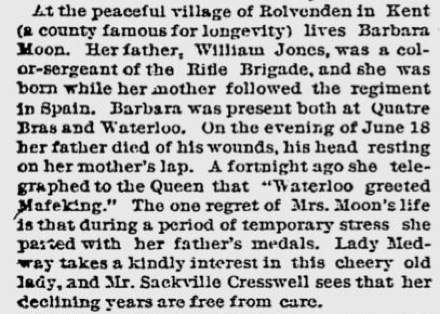
Above: An extract from ‘Waterloo’s Anniversary: Few Survivors of the Glorious 18th of June’, an article published on 5 July 1900 in The Boston Evening Transcript, which reported on the recollections of Barbara Moon (née Jones).
TACA CORRESPONDENCE: BORN UNDER A CANNON?
Fiona C M has contacted TACA with both an intriguing story and a request for help.
‘I would be so pleased to receive any help regarding a family legend that has passed down through the generations to involve me. My middle name is Cannon. So was my grandmother’s, and her grandmother’s surname was Cannon. My father left some pencil-written notes before he died to say that there was a baby born under a cannon during the Battle of Waterloo, to a soldier, which was possibly illegitimate as the mother was a "camp follower". The soldier was a guardsman, and went on to guard Napoleon at St Helena. I met two long-lost cousins at a family funeral for the first time a couple of years ago, and they reiterated the story.
I am afraid that I have no idea which regiment the soldier was in, except that my great-great-grandmother came from Glasgow, and on her birth certificate it reads ‘born in foreign parts’. I have looked into this in detail, but have been unable to come up with anything. It is possible that it was a previous battle, a different place in Scotland (i.e., Edinburgh), or a story of fact mixed up with some fiction, as some of these legends sometimes are. However, there are remarkable coincidences in its telling, and I would just love to find out more. I would be so grateful for any help at all.’
If you think that you can help Fiona, please e-mail TACA, and we’ll pass your message on to her.
FAMILY-HISTORY RESEARCH: AN ARMY CHILD BORN AT SEA AND THE CARTER FAMILY, NINETEENTH-CENTURY SOLDIERS WITH LINKS TO ST HELENA
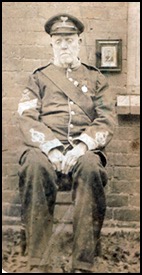
Ray and Janet Durnall have been generous enough share the cradle-to-grave story of Ray’s great-great-grandfather, one-time army child John Malcolm Carter. As Ray initially outlined, John Malcolm was born aboard a troopship carrying his parents to Ceylon [now Sri Lanka]. He later ‘had an interesting career with the Saint Helena Regiment and West Bromwich Rifle Volunteers, serving a total of nearly fifty years, and was given a full military funeral upon his death’. Ray also provided a fascinating glimpse into a family with a soldiering tradition and links to the island of St Helena: ‘John’s father was in the 90th Foot when posted to Ceylon. He later transferred to the 61st Foot and returned to the UK in 1840. He then joined the newly formed Her Majesty’s Saint Helena Regiment.’
Writing in The Bugle newspaper (‘My ancestor was a St Helena soldier’, 23 January 2014), Ray outlined how his research had given him an illuminating insight into life for nineteenth-century army families. An abridged version of the article follows:
‘My great-great-great-grandfather Matthew Carter . . . was born in 1805 in Stanwell, Middlesex . . . He enlisted in the 90th Foot Regiment on 13th April 1826. . .
I found details of his marriage to Martha Martin at Gosport in 1831, confirming the marriage date in his military record. At that time six men in 100 were allowed to have their wives accompany them overseas.
The 90th were serving in Ireland in 1835 when they were ordered to Ceylon (now Sri Lanka). Matthew embarked aboard the Sir Charles Malcolm, an Indian Navy merchant ship built of teak by the same shipyard that built HMS Trincomalee, the oldest wooden British warship still afloat, nowadays berthed in the historic dock at Hartlepool.
The ship carried four companies, probably 110 men in each, plus the headquarters staff, maybe another 20, in addition to officers’ wives and enlisted men’s wives, plus its English crew and possibly the Indian crew as well, which had sailed the ship to England and although not being allowed to sail it back were guaranteed their passage home, so there were maybe 500 souls aboard.
The ship was leaking enough for it to need repairing at Plymouth before its five month voyage to Ceylon, during which John Malcolm Carter was born. He was given the name Malcolm, I assume, in respect of the ship . . .
Matthew transferred to the 61st Foot on 1st September, 1837, while in Ceylon and this regiment boarded HMS Jupiter for the return to England in October 1839. In addition to officers and their wives, it carried 399 men, 29 women and 76 children of the regiment.
Most sailing ships from those parts would have returned to England via St Helena. When the ship arrived back at Southampton it could not land due to high winds, and having beat offshore for two weeks it continued on to Cork, collected the remainder of the regiment and was towed to Cowes by HM Steam Frigate Cyclops, landing 14th March, 1840. The regiment then had their first train ride back to barracks.
The 1841 census records Matthew, John, Matthew junior (born in Kandy) and a soldier’s wife, Catherine, at Woolwich Barracks. Apart from the wedding details, I found no further mention of Martha, but both sons had daughters that they named Martha.
GARRISON
About this time it was decided by the British government that instead of garrison troops, some previously supplied by the Honourable East Indies Company, St Helena would have its own British army regiment. All volunteers, the men would have to be of good character to fit into island life and be physically fit as they were used as stevedores (in 1845 about 1,500 ships called at St Helena).
Henry Simmonds, formerly a major of the 61st, was appointed commanding officer with the rank Lieutenant Colonel on the 7th January, 1842. Matthew transferred to this regiment on the 1st February, 1842, being given the distinction of regimental number 1, and they arrived on St Helena in October that year. He completed his five year term and retired from the army in 1847 . . .
SONS
Both of his sons joined the regiment, John at 14 and Matthew junior was under 12. In the 1860s the regiment was disbanded . . .
Both sons returned to England in the 1860s. Together with his two boys, John brought with him his wife Ann Bertha, who was born on the island in 1830. Her father, through his association with the 66th Regiment, had been one of Emperor Napoleon’s guards during his incarceration and death on the island. Grenadiers of the 66th carried the emperor’s coffin to his original grave; later his remains were exhumed and returned to France.
Matthew the father, according to parish records for births, had further children on St Helena with his wife Eliza Watson, two girls in 1856 and 1858. On both records his occupation was listed as prison officer at Rupert Bay’s military and civilian gaol, which was burned down in one hour by a military prisoner in 1867.
His death record in 1881 states he was a pensioner and groom, the informant being Eliza. She may well have been a freed slave, as a family named Watson had belonged to a prominent family on the island named Meliss and an Eliza of about the correct age was among them . . .
After a short spell in London where his daughter and my ancestor Susan was born, John Malcolm and his family settled in West Bromwich.’
Below right: A photograph of John Malcolm Carter in old age.
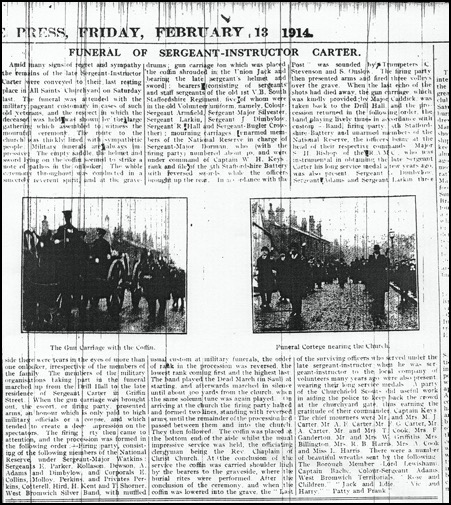
Above : The Free Press newspaper reported on Sergeant-instructor Carter’s funeral on 13 February 1914.
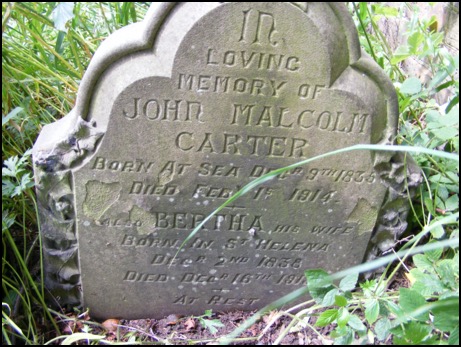
Above: John Malcolm Carter’s gravestone, in All Saints’ churchyard, West Bromwich, states that he was ‘Born At Sea On Decr 9th 1835’ and ‘Died Feb 1st 1914’. It also commemorates his wife, Bertha, who was buried in the same grave. She was born in St Helena in 1838, and her father was one of the troops who guarded Napoleon during his exile there.
Ray and Janet would love to hear from anyone who can add anything more to their knowledge of the Carter family. If you can do so, please contact TACA, and we’ll pass on your message.
For more information about the St Helena Regiment, click on the link: http://sainthelenaisland.info/regiment.htm.
TACA CORRESPONDENCE: BRITISH ARMY BIRTH, MARRIAGE AND BURIAL RECORDS IN BERMUDA
Seán Pòl Ó Creachmhaoil has been in touch with TACA to explain the conventions regulating the recording of the births, marriages and burials of those connected to the British Army in Bermuda during the nineteenth century, and also highlights a reference book that may aid those researching Bermuda’s nineteenth-century church registers.
‘In reference to the births of children to British Army (and other services) personnel in Bermuda, as well as marriages and burials, records for these would have been kept by the Church of England (parishes for the colony). Some records were kept by other denominations, although in the earliest part of the colony’s history, all residents were expected to be practising members of the Church of England, and Catholicism and other religions were not legally able to be practised in Bermuda. Although the rule in the nineteenth century became that any church permitted to operate in Britain could also do so in Bermuda, there were, for a time, restrictions placed upon them, with only the state church (Church of England) ministers permitted to conduct marriages and burials. Note that births were not recorded in Bermuda until the local-government registrars began recording births, marriages and deaths at some point in the second decade or so of the twentieth century. The church records actually recorded baptisms, marriages and burials. If families did not record them themselves, then actual dates of births and of deaths are not always obtainable from the church records.
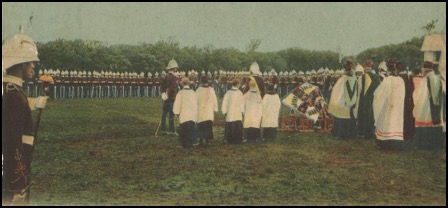
Above: A church parade at Prospect Camp prior to World War I.
In any case, the Bermuda Maritime Museum publishes a collection of all the nineteenth century (to approximately 1910) church records of Bermuda, collected and indexed by A C Hollis Hallett. This has numerous entries relating to army personnel, especially for St George’s and Devonshire parishes (housing St George’s and Prospect army garrisons) and Sandy’s (“Sands”) parish, housing the HM Dockyard (as well as Clarence Barracks (army) at the turn of the century). If anyone wishes to obtain the book, they should refer to the website of the Bermuda Maritime Museum Press, where details of the book are given as follows:
19th Century Church Registers of Bermuda
Indexed by: A.C. Hollis Hallett. Updated by: C. F. E. Hollis Hallett
Published by Juniperhill Press and Bermuda Maritime Museum Press, 2005
Pages: 1406
Cover: Hardcover
Dimensions: 9 x 11 inches
ISBN: 0-921992-23-8
Retail: $50 / Wholesale: $30
This is an updated volume of the 1996 edition. Many of the questioned names and spellings have been reinterpreted by comparing and cross-referencing with details from other sources, in particular the Registry General.’
We are most grateful to Seán for his advice, which is an invaluable starting point for anyone researching the births, marriages and burials of Bermuda-based British army children. (See also below, ’THE HISTORICAL RELATIONSHIP BETWEEN THE BRITISH ARMY, BERMUDA AND BERMUDIANS.)
THE HISTORICAL RELATIONSHIP BETWEEN THE BRITISH ARMY, BERMUDA AND BERMUDIANS
Having helpfully explained the registration conventions in respect to Bermuda’s birth/baptism, marriage and death/burial records (see above, ‘TACA CORRESPONDENCE: BRITISH ARMY BIRTH, MARRIAGE AND BURIAL RECORDS IN BERMUDA’), Seán Pòl Ó Creachmhaoil now unravels the closely intertwined historical relationship between the British Army, Bermuda and Bermudians, and sounds a note of caution for those researching their family history in Bermuda. We are immensely grateful to Seán for his illuminating insight into this area of Bermudian history.
‘At the turn of the nineteenth/twentieth century, the (professional) military made up something like a quarter of Bermuda’s population, and still more of its adult male population. Numerous non-Bermudian soldiers and sailors married into Bermudian families and either lived out the remainder of their lives, and raised their children, in Bermuda (this was particularly common in the case of enlisted men), or took their Bermudian wives away with them, raising their children wherever the service sent them next (this was more common with officers, many of whom were aristocrats, and some of whom ultimately reached high rank, and had sons who followed them in their careers). This means that many members of the senior ranks in both the British Army and the Royal Navy (RN) had Bermudian parentage, or were raised in Bermuda whilst their fathers were assigned to the colony, such as RN Admiral of the Fleet Lord James Gambier (1756–1833, who had a Bermudian mother), of Battle of the Basque Roads (1809) infamy.
Other prominent Britons have had Bermudian connections as well, such as Denis Keegan (1924–93), who was elected in 1955 for a single term as the Tory MP for Nottingham South, during which he strongly (and unsuccessfully) argued for the retention of the British Army garrison in Bermuda (you can read the parliamentary debate here). Keegan’s mother was Bermudian, and he spent a considerable part of his childhood in Bermuda.
Although Bermudians have always been few in number, a steady stream enlisted in the British Army in Bermuda or elsewhere during the two-and-a-half centuries or so that regular soldiers were stationed in Bermuda. Many others served in locally raised, part-time reserves. During both World Wars, many Bermudians served in all three services, but especially in the army. The local volunteer units drafted contingents to regular British Army units, the most enduring relationship being that between the Lincolnshire Regiment, the 2nd Battalion of which was garrisoned in Bermuda at the start of World War I, and the Bermuda Volunteer Rifle Corps (BVRC) and their descendant units, the Royal Anglian Regiment and the Bermuda Regiment. Two BVRC contingents totalling 126 soldiers served as part of the 1st Lincolns from June 1915 until the end of the war. The BVRC also sent contingents to the Lincolns in 1940 and 1944. Several transferred to other regiments or corps. The BVRC was amalgamated in 1965 with the Bermuda Militia Artillery (which had sent two drafts totalling 263 soldiers to the Royal Garrison Artillery on the Western front during the Great War, and provided the training cadre of the new Caribbean Regiment in 1944) to form the current territorial unit of the colony, the Bermuda Regiment.
Bermudians also enlisted directly, or took commissions, in various British Army regiments, such as Company Sergeant Major William Thiele, of the 6th East Yorks, and Corporal George C Wailes, of the 2nd Lincolns. (Wailes was a Bermudian whose father, also named George C Wailes, had come to Bermuda in 1883 as a private soldier in the 2nd Battalion, 84th York and Lancashire Regiment, purchasing his discharge in 1858, and marrying and raising a family in Bermuda. I presume that the younger Wailes enlisted in the 2nd Lincolns in 1914, during the brief period when the regiment was garrisoned in Bermuda.) Others include brothers Lieutenant Donald Christopher Smith (Royal Field Artillery) and Acting Captain Sir Alan Chalmers Smith (1st King Edward’s Horse and Royal Field Artillery), and their cousin, Major Charles Gray Gosling Gilbert, OBE, MC (Royal West Kent Regiment and the Machine Gun Corps), who all enlisted during World War I, as well as Gilbert’s son, Major General Glyn C A Gilbert, CB, MC (who joined the British Army during World War II, along with numerous other Bermudians. He was one of four Bermudians to reach the rank of major while serving in the Lincolnshire Regiment during the war. Another was Major Anthony “Toby” Smith, killed in action during the battle of Overloon, who is the subject of an award-winning new film, In the Hour of Victory. After the war, Gilbert served in the Parachute Regiment, retiring from the army in 1974).
After World War II, Bermudians continued to filter into British Army regiments in small numbers (there were three in the Gloucestershire Regiment who took part in the last stand at Imjin Hill during the Korean War, these being Bernard L Martin, Robert Wheatley and Vernon Smith, of whom only Martin evaded capture by the Chinese). The UK Immigration Act of 1971 (which first raised barriers against colonials entering the mother country) and then the British Citizenship Act (which came into effect in January 1983, stripping the inhabitants of the majority of colonies of their full British citizenship) did not create a completely impassable barrier as Bermudians have continued to slip into the ranks and officer corps of all three services.
This is going the long way about suggesting that Britons looking to colonial records – or, at least, to Bermudian records – to track their ancestry should keep an open mind as they may find that their family tree includes actual Bermudians. Even checking British records for soldiers who entered the service in Britain and were never posted to Bermuda may turn up Bermudians or other colonials, and attempting to decide who is a colonial and who is British, as if they were two alien and incompatible things, will be difficult. (Major Charles Gilbert, for instance, went from Bermuda – where the Gilbert family has been established since the 1630s – to England before World War I to study. When the war began, he left his studies to enter the army. While serving in the British Army, he married an English woman. Their first child, (later Major General) Glyn Gilbert, was actually born in England, but was raised in Bermuda when his father and mother relocated there after the war.)’
Seán Pòl Ó Creachmhaoil.
TACA CORRESPONDENCE: WHAT HAPPENED TO A NINETEENTH-CENTURY ARMY CHILD BETWEEN HER BIRTH IN BARBADOS AND MARRIAGE IN SCOTLAND?
Susan Brouwer, who is researching a nineteenth-century army-child ancestor who was born in Barbados, wonders whether any of TACA’s visitors can help her learn more:
‘According to census records, Jessie McKay McPherson was born in Barbados, West Indies, 1834 to 1840. On her 1857 marriage certificate to James McPherson, it says that her father, Murdoch McKay, was a soldier (and deceased by 1857), and that her mother’s name was Eliza Elliot (also deceased). The only military birth record that I could find in Barbados was one for a Jannet McKay (I understand that “Jessie” can be a derivative of “Jannet”), born 1834 in Barbados to a Murdock McKay and wife Leah (I’m not sure if this is Eliza or not). It said that the father was in the 93rd Highlanders. On Jessie McPherson’s death certificate, it says “occupation of father – 93rd Gordon Highlanders”. I understand that the 93rd were the Sutherland Highlanders and that the Gordons were the 92nd, so I think that this is a mistake. My belief was that her father, Murdoch, was serving in the 93rd in Barbados in 1834. My question is: what happened during that time period of 1834 and her marriage in Aberdeen, Scotland, in 1857. Thanks!’
If you think that you can help answer Susan’s question, you can e-mail her at sasbrouwer@shaw.ca.
PICTURE: LORD, THY WILL BE DONE, 1855, BY PHILIP HERMOGENES CALDERON
Reproduced below is Philip Hermogenes Calderon’s painting of 1855 entitled Lord, Thy Will Be Done, which is owned by the Yale Center for British Art.
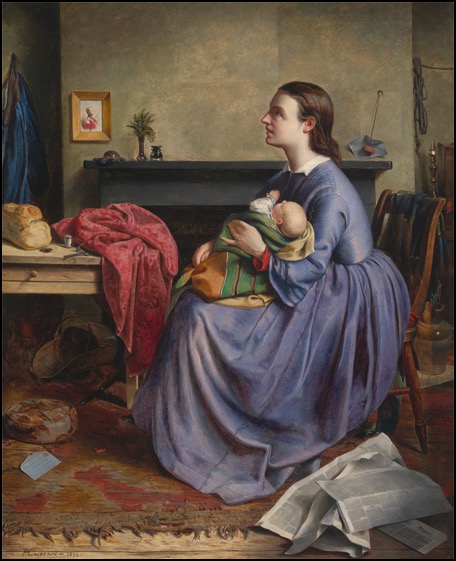
Above: Lord, Thy Will Be Done, 1855, by Philip Hermogenes Calderon (1833–98), oil on canvas, Yale Center for British Art, Paul Mellon Fund.
Lord, Thy Will be Done depicts a stricken-looking young mother holding her baby; a wedding ring is just visible on her ring finger. On the wall is a portrait of a soldier, no doubt her husband, and the baby’s father. On the table in front of her is a loaf of bread and some sewing; the room’s furnishings are shabby. A discarded envelope lies under the table. More pertinently, in terms of the painting’s significance, is the cast-aside copy of the Times newspaper at the forefront of the scene. These details, along with the painting’s date and title, may lead the viewer to surmise that the young mother has just found, in the Times, the name of her husband among the Crimean War’s latest list of military casualties. This infant army child has now been left fatherless, but the painting’s title implies that his or her mother’s faith will sustain her in their loss.
PICTURE: THE CRIMEA-WAR MEMORIAL ARCH, BROMPTON BARRACKS, CHATHAM, KENT
The black-and-white postcard below, which was posted in 1916, focuses on the Crimea War Memorial Arch at the ‘RE [Royal Engineers] Barracks’ in Chatham, Kent. Inscribed above the arch, which was designed by Sir Matthew Digby Wyatt, are the words ‘THE CORPS OF ROYAL ENGINEERS TO THEIR COMRADES WHO FELL IN THE WAR WITH RUSSIA MDCCCLIV–V–VI’, while the legend beneath it – the Royal Engineers’ motto – reads ‘QUO FAS ET GLORIA DUCUNT’ (Latin for ‘where right and glory lead’), flanked by the word ‘UBIQUE’ (‘everywhere’).
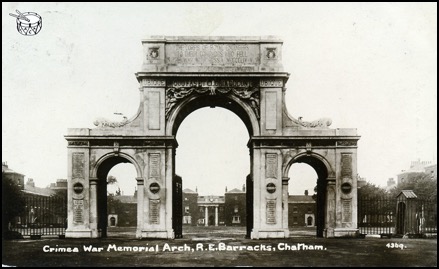
Chatham remains the headquarters of the Royal Engineers, and this memorial in Brompton Barracks will consequently have been seen by generations of army children over the past hundred and fifty years. It would, no doubt, have been viewed particularly poignantly by those whose fathers’ deaths it commemorated.
Click here for a brief history of Brompton Barracks; here for more information about the Crimea War memorial; and here for a Pathé film clip from 1936 featuring the memorial.
PICTURES: THE MEMORIAL WELL, CAWNPORE, INDIA
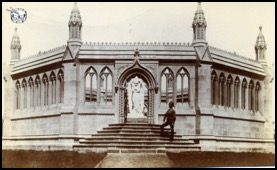
Click here for the list of those killed that is given on the Find A Grave website, and here for further information about Cawnpore courtesy of the Families in British India Society (FIBIS).
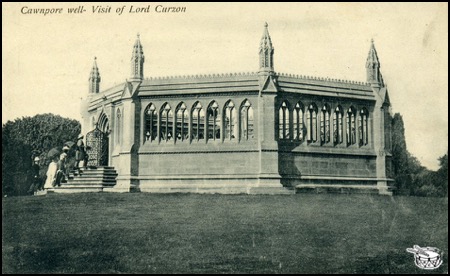
Above: Lord Curzon, then viceroy of India, visited the Cawnpore Memorial Well in 1899.
TACA CORRESPONDENCE: UNANSWERED QUESTIONS ABOUT THE ARMSTRONGS, A LATE-NINETEENTH-CENTURY ARMY FAMILY
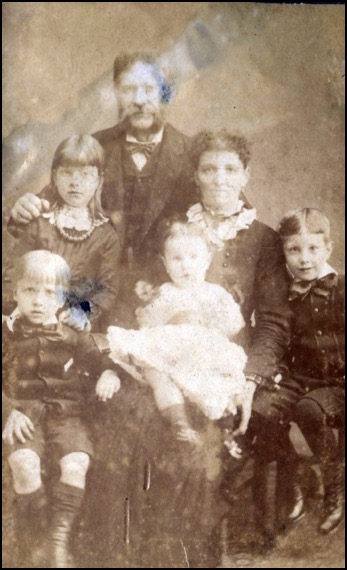
Along with sending a plea for help in researching her army family, Josephine Dunn contributed a selection of photographs of her great-grandfather, James Armstrong, his wife, Annie Elizabeth (née Clark), and their children (see below), at least some of whom qualify as army children. ‘I have a public family tree on www.ancestry.co.uk (search "Josephine Salt Family Tree June 2015" http://trees.ancestry.co.uk/tree/48129701/person/20071559537)’, Josephine explains, continuing, ‘What I’m trying to do is get documentary evidence of all, or any, of the possible documents and facts we have found through research online’.
This is what Josephine has discovered so far:
‘James Armstrong was born in Ireland in about 1838 (I would like confirmation of his village and county of birth). He died in Covent Garden, London, in the last quarter of 1899. James married Annie Elizabeth Clark in Old Street, London, in 1874; they both give their address at that time as being Featherstone Street, which is very close to the church in which they were married (I have their original marriage certificate). James gives his occupation as "gunner Royal Artillery". His father's name is stated as Hugh. By the time of the 1881 census, James was a “commissionaire mess” (i.e., he was apparently serving with the Commissariat and Transport Department), and was living with Anne and their children in Southwark. James and Annie’s children were:
• Amy Louisa, who was born in Southwark, London, in 1876, and died in 1918, probably of Spanish flu.
• James Philip, who was born Southwark in 1880, and died in 1939. (He married Henrietta Amy Gabriel, a Jewish woman, serving as a motorbike runner during World War I and working for the Post Office thereafter.)
• Annie Maude, who was born in Covent Garden in 1883, and died in 1947. (Annie was my grandmother. She worked as a lady’s maid to Mary, wife of Sir Charles Booth. She married Bernard Vincent McCarthy, a Catholic butcher (she didn’t convert to Roman Catholicism) and lived in Whitwick, Leicestershire.)
• Arthur Albert, who was born in Lambeth, London, in 1888, and died in 1943. (He got married late, to Beatrice Louisa, a widow, serving as a motorbike motorbike runner during World War I and subsequently working for the Post Office.)
• Percy William, who was born in Covent Garden in 1888, and died in 1890.
• Lillian Emma, who was born in Covent Garden in 1890, and died in 1956. (She married Tommy Harvey, a widower, and worked as a Post Office telegrapher and a music-hall performer.)’
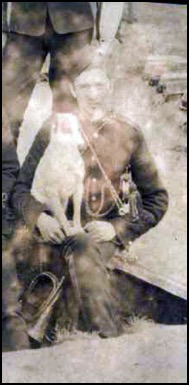
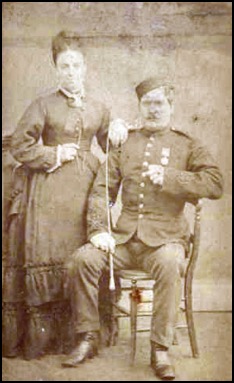
Above, left: A young James Armstrong in uniform, with dog and bugle. Above, right: James and Annie Armstrong photographed in Aldershot, Hampshire, in around 1877.
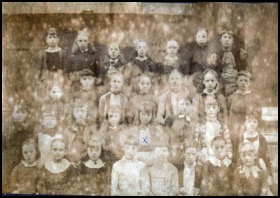
Below: Annie Maude Armstrong (‘X’) and fellow schoolgirls at St Martin’s School, Covent Garden.
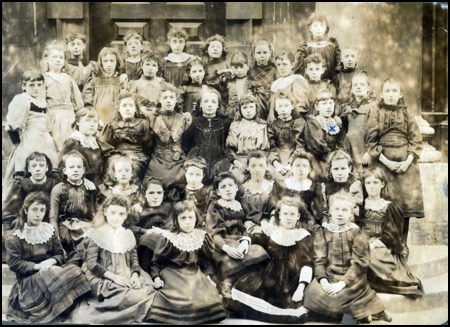
‘I have many loose ends to tie up,’ says Josephine, ‘for example: James may have been in Portsmouth provisioning ships; he was awarded a medal, which may have been a Zulu War medal; he may have been a corporal; and he may have got an army pension. And then how did James and his wife, Annie Elizabeth Clark, meet? She may have been a lady’s maid/companion in Paddington, but she was born in Netteswell, Essex, now part of Harlow, to a farm-labouring family. Finally, how did Annie Maude get a job as lady's maid to Mary, wife of Sir Charles Booth?’
If you think that you can tell Josephine more about this army family, please e-mail her at josephinedunn1957@btinternet.com.
TACA CORRESPONDENCE: HELP REQUESTED IN RESEARCHING THE CHILDREN OF CHARLES BRIGHTWELL, 35TH (ROYAL SUSSEX) REGIMENT
The sight of the photograph that Clement Chapman took of the grave, in Cyprus, of army child Violet Amelia Brightwell (‘PICTURE: THE GRAVE OF VIOLET AMELIA BRIGHTWELL (1874–80), AY NIKOLAOS GRAVEYARD, LIMASSOL, CYPRUS’) has prompted Christine Trehane to contact TACA with the following message.
‘Violet was the younger sister of my maternal great-grandmother, Edith Maud Mary Brightwell. Edith’s daughter – my grandmother – told the family before she died that two of Edith’s siblings had died in a forest fire in Cyprus, but we have no proof of this, or further information about this story. Edith and her younger sister Lydia lived to old age. The only other sibling that I am certain about is the youngest, Charles William Brightwell, who was born in Malta on 29.8.1880 and died at the barracks in Chichester on 9.11.1882 of tubercular meningitis. If the story about the fire is true, then there must have been another sibling. We were told that there was a girl called Millie, which we assumed was short for Millicent, but could also have been short for Amelia, Violet’s middle name. However, we have no information about a child called Millicent, so she may not have existed.
Do you know how we could find out how Violet died? Has anyone come across any definite information about a child called Millicent Brightwell? Do you know where Charles would have been buried if he died at the Chichester barracks?
We do not know where the children’s father, Charles Stephen John Brightwell, of the 35th (Royal Sussex) Regiment, served after his son was born, as I cannot find his service record at the National Archives, although I understand that part of the regiment went to India and part to the Sudan. I do not know whether the children’s parents returned from Cyprus to Chichester with their sick son as Charles junior’s death certificate says that the death was reported by someone who does not appear to have been a member of the family. We know that Charles senior had died by the time that Edith was married in August 1890, as her father is described as deceased on the marriage certificate (although his name is incorrectly given as Charles William, which was the name of his son).
Edith does not appear to have travelled abroad with her parents, but lived with her maternal grandparents in Colchester. I have not been able to find any of the family, except Edith, on the 1881 census, but have found Lydia on the 1891 census, as a fourteen-year-old inmate of the District Royal Victoria Patriotic Asylum, a “school” for orphans of soldiers from the Crimean War, or subsequent wars. On the building’s website, it says that girls were trained for domestic service there, and that is exactly what Lydia did for the rest of her working life. On the same census, her mother (also Lydia) was living back in Colchester. Interestingly, Lydia junior’s place of birth on the census record is given as India, although she was actually born in Barbados, so I am wondering whether she was actually “orphaned” in India i.e., whether her father had died there.
Thank you for such an interesting website, which has moved our family history forward by giving details of Violet’s death. I will explore the website further in the coming days. If you are able to point me in the right direction to fill any of the gaps in our knowledge, I would be grateful. I am just sorry that I did not find out more from my grandmother before she passed away in the 1980s.’
If you think that you can answer any of Christine’s questions, or otherwise add to her research, her e-mail address is christinetrehane@sky.com.
TACA CORRESPONDENCE: EDWARD JAMES BIRCH, BORN 1881, BERMUDA
Jack O'Brien has contacted TACA with the following request for assistance.
'I am doing genealogical research, seeking any relevant information on Edward James Birch, born December 17, 1881 at Ireland Island, Bermuda. He was the son of James Birch, who served at the Royal Naval Dockyard in Bermuda, and who retired from service in 1895 while stationed there, and Alice Corker (or Corber) Birch. I have also been trying to find any burial records for Alice Corker (or Corber) in Bermuda. My understanding is that James Birch retired from the British service in 1895, but then went on to India, where he died. He would have been with the Engineers in Bermuda or possibly with the infantry guarding the base.'
If you think that you can help, you can e-mail Jack either directly (jobrien@hireintegrity.com) or through TACA.
PICTURE: "TOMMY ATKINS" MARRIED – PAST AND PRESENT, 1884
The composite print shown below entitled "Tommy Atkins" Married – Past and Present first appeared in the 12 January 1884 issue of The Graphic.
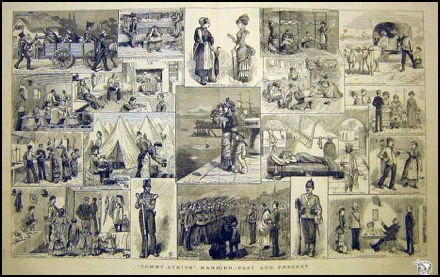
Moving from left to right, and from top to bottom, the nineteen scenes that make up the print illustrate various aspects of the Victorian army family's way of life, with the emphasis being on the improved conditions that were starting to prevail when 'on the march', at sea and in married quarters during the 1880s. They are labelled as follows: 'Soldiers' Wives on the March Before the Days of Railways (click here for a close-up); Quarters for Married Soldiers Going to India in the Old Days (click here for a close-up); The Soldier's Wife: Old and New Style; Women's and Children's Quarters on a Modern Troop-Ship (click here for a close-up); A Married Soldier on the March in India (click here for a close-up); Married Life on Board a Modern Troop-Ship (click here for a close-up); A Soldier and His Family in a Corner of a Barrack-Room in the Old Days (click here for a close-up); A Recruit in the Wash House; Medical Inspection Before Embarking for Foreign Service (click here for a close-up); Drawing Rations; In Camp at Cove Common, Aldershot (click here for a close-up); Married Without Leave: Left Behind on the Departure of the Regiment (click here for a close-up); Life of a Soldier's Wife in India; Dragging Her Husband out of the Canteen; Modern Married Quarters: "Haw! Are You Crowded Heeaw?" (click here for a close-up); The Old Uniform; A Soldier's Funeral (click here for a close-up); The New Uniform; An Admonition from the Colonel.'
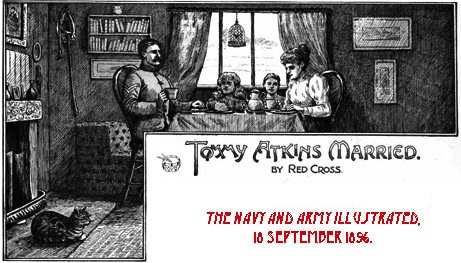
'CLEAN, STURDY, HEALTHY LITTLE URCHINS': CHILDREN OF THE REGIMENT IN 1896
The following glowing description of the 'children of the regiment', which makes special mention of celebrating the birthday of the 'daughter of the regiment', originally appeared within an article entitled 'Tommy Atkins Married', by 'Red Cross', which was published in the 18 September 1896 issue of The Navy and Army Illustrated. (Click here to read an outline of army children's schooling and their talent for music-making taken from the same article; here for an idea of how they were housed; and here for a description of how they were fed.)
'Married soldiers frequently have large families, and it is here, perhaps, that the wonderful management, which I have referred to as being characteristic of the soldier's wife, is brought into greater prominence. Clean, sturdy, healthy little urchins, soldiers' children are almost always well dressed and overflowing with happiness. And indeed they would be very ungrateful youngsters were it otherwise, for life is very pleasant for them. They are made much of, for everybody, from the Colonel downwards, takes a pride in the children of the regiment, and no sport or entertainment takes [place] without due provision being made for their share in it.
Regimental picnics and outings are of frequent occurrence, and I need hardly say, accompanied as they are by the regimental band, they are heartily enjoyed.
I may here refer to a pretty custom prevalent in many regiments, i.e., drinking the health of the daughter of the regiment.
The eldest girl present with the regiment and who was born in the regiment, has the honour of being toasted by the officers in their mess-room and the sergeants in theirs, on the anniversary of her birth.’
PICTURE: QUEEN VICTORIA WITH ARMY WIVES AND CHILDREN, 1899
The illustration below right, signed by S Begg, first appeared in a book entitled The Boers in Cape Colony, Oct.–Nov.1899, published in 1900. The caption beneath it reads as follows:
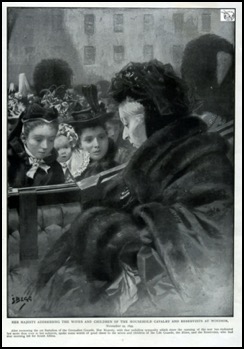
After reviewing the 1st Battalion of the Grenadier Guards, Her Majesty, with that unfailing sympathy which since the opening of the war has endeared her more than ever to her subjects, spoke some words of good cheer to the wives and children of the Life Guards, the Blues, and the Reservists, who had that morning left for South Africa.’
‘Her Majesty’ was, of course, Queen Victoria, who would die two years later, in 1901, while the reason for the Household Cavalry and Reservists’ departure for South Africa was to engage in the Second Boer War (1899–1902).
A CATCHPENNY VERSE TO HELP THE HOMES THAT TOMMY LEFT BEHIND
‘But we do not want his kiddies to remind him
That we sent ’em to the workhouse while their daddy hammered Paul,
So we’ll help the homes that Tommy left behind him!’
To read more, including the poem in its entirety, visit the TACA drum blog.
FAMILY-HISTORY RESEARCH: ROBERT AND SYDNEY COCKMAN, GORDON HIGHLANDERS (AND AN ARMY SCHOOLMASTER) DURING THE BOER WAR
'. . . The bulk of the fighting was now over for the two brothers. Sydney would have received bad news from home. His wife and children had moved to live with her mother in Glasgow while he was away, and on 18 May 1900, baby Sydney died there, from gastritis and convulsions. Nellie, notifying the death, betrayed her confusion about the names that she was supposed to be using: she gave the baby's name as Sydney Douglas Cockman, his father's name as Duncan Douglas Cockman, alias Douglas, and her name as Helen Dempster Cockman. By the time of the 1901 census, she had the story straight again . . .'
To read Virginia Silvester's absorbing article in which she presents the fruits of her research into the lives of two of her great-grandmother's soldier brothers – one of whom was an army schoolmaster – and their families, click here.
PICTURE: THE SOUTH AFRICA MEMORIAL ARCH, ROYAL ENGINEERS’ BARRACKS, GILLINGHAM, KENT
The memorial arch shown on this postcard was designed by Ingress Bell and unveiled in 1905 by King Edward VII, Colonel in Chief of the Royal Engineers, at Brompton Barracks, Gillingham (or Chatham), Kent, the corps’ headquarters. It commemorates the 420 officers and men of the Royal Engineers who died in the Boer Wars in South Africa between 1899 and 1902. Many of them were themselves ‘born into the army’, and, it’s safe to say, soldier–fathers when they died. The memorial will have been a familiar sight to many generations of army children.
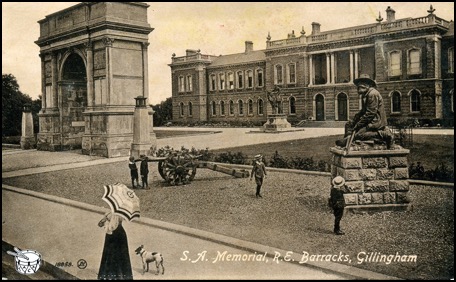
Click here for more information about the arch, as well as about the names of those listed on it.
PICTURES: CHURCH PARADES
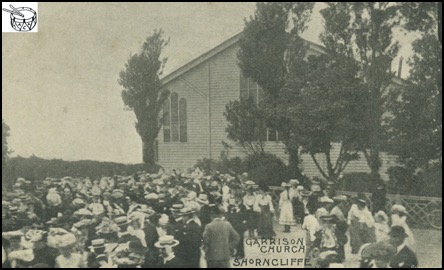
It was compulsory for soldiers to attend church parades on Sundays (that is, to march from their barracks to church to attend services there) until 1946. The standing orders of many regiments similarly required on-the-strength army wives and the children of the regiment to attend their place of worship every Sunday. If they belonged to the Church of England, Sundays (and important religious and regimental occasions) would therefore usually see army families converging on the garrison church, as seen in this black-and-white postcard of the garrison church at Shorncliffe, Kent, which dates from the early 1900s.
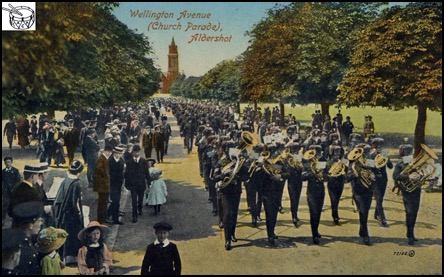
The vintage Valentine’s postcard below, which shows a military band at the head of a church parade marching along Wellington Avenue in Aldershot, Hampshire, conveys an impressive sense of occasion. The smartly turned out soldiers are being observed and accompanied by numerous fellow soldiers and civilians, among them children, most in their Sunday best.
‘WIVES AND SWEETHEARTS’ SPECIAL DISPLAY AT THE NATIONAL ARMY MUSEUM, AND TWO IMAGES FROM TACA’S ARCHIVE
To accompany the opening of the ‘Wives and Sweethearts: Love on the Front Line’ special display in the White Space Gallery at its premises in Chelsea, London (which can be viewed until 30 July 2011), the National Army Museum has launched an online exhibition to help visitors ‘uncover 200 years of soldiers’ lives and loves’. Divided into themes entitled ‘Courtship and engagement’, ‘Weddings’, ‘Women of the Regiment’, ‘Separation’ and ‘Reunion’, the actual and virtual exhibitions both focus primarily on the wives, fiancées and girlfriends of soldiers over the past two centuries. Army children also feature, however, such as in A caricature of soldiers of the 3rd (East Kent - The Buffs) Regiment of Foot on the march with their wives and families, 1811, for example, and in a heartrending letter written to Sergeant Louis Jones in Gibraltar by his wife, breaking the news of the death of their three-year-old son, Ted, in 1902.
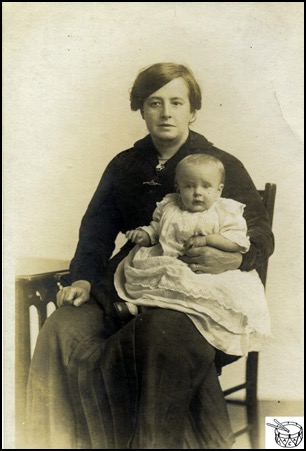
Two World War I-era images from our own archive vividly convey how the frequent absences of soldier husbands and fathers (and today increasingly also wives and mothers) on active service and tours of duty leave their families to cope on own, then as now. The first, below, is a studio portrait of a young mother (rifle-shaped military sweetheart brooch proudly pinned to her blouse in support of her husband) holding her baby; this was almost certainly taken, in Leeds, to send to her absent husband.

The second image, below, is a commercially produced postcard, whose visual and (error-ridden) written messages make it clear that it was intended for wives to send to their soldier husbands at the front; this one was posted in 1915.

To visit the ‘Wives and Sweethearts’ online exhibition, click on this link http://www.national-army-museum.ac.uk/exhibitions/online-exhibitions/ wives-sweethearts.
TACA CORRESPONDENCE: INFORMATION WELCOMED REGARDING AN EARLY-TWENTIETH-CENTURY ‘DAUGHTER OF THE REGIMENT’
Lloyd Harris has posted the following request for assistance in discovering more about an early-twentieth-century army child on TACA’s Facebook page:
‘Please add the following to The Army Children Archive: in memory of JESSIE ELLEN RYLAND, 1904–5. Jessie was the daughter of my great-granduncle Sergeant Walter William Ryland (3701), 13th Hussars, and his wife, Amy Elizabeth. Jessie was born in June 1904 in Elham, Kent, England, just before her family’s departure to India. She passed from this life on 21 June 1905 while residing at Bolarum, Madras, India. She is buried there. Her father joined the 13th Hussars regiment in about 1899 and served in the Boer War before being posted to India. Her siblings were Millicent Maude (born 1905 in Secunderabad, India); George; and Reginald William Ryland. By 1911, the family was residing in Hammersmith, London, England, and Walter no longer appears to have been in the army. Any information on this family, Jessie’s grave, or the cemetery where she might be buried would be appreciated.’
If you think that you can help Lloyd, please either comment on his post on TACA’s Facebook page or contact TACA, and we’ll pass on your message.
FAMILY-HISTORY RESEARCH: A JAMAICAN TRAGEDY, 1907
On investigating the ‘adventurous lives’ of his grandfather and great-uncle, who were both regular soldiers with the East Yorkshire Regiment, Paul Levitt, a keen amateur genealogist and himself once an army child, uncovered a sad family link with the earthquake that devastated Kingston, Jamaica, in 1907. Paul writes: ‘I saw from a service record that Jamaica had been a tour of duty of my great-uncle at the time of the earthquake. I also noted that the name and date of birth of a child (Beatrice Vera, 29.10.99) had been crossed out and “deceased 24-1-07” added. Her death at that young age, and just ten days after the earthquake, had to be more than a coincidence. I eventually found her name on the casualty list as having been killed outright by the earthquake. My relative, Margaret Levitt, had no knowledge about her deceased aunt Beatrice, but recalls that her father walked with a limp for his entire life. She presumed that it was because of a childhood accident or polio (he was a very strict man and she never dared to ask). Little did she know that he was actually the little boy who miraculously escaped with his life in Jamaica on 14 January 1907.’ Here, Paul explains what happened when the earthquake struck Kingston on that terrible day in January 1907.
‘When the door to No 5 Aughborough Street, Scarborough [North Yorkshire], closed behind them at the start of their journey to Bristol in July 1905, there could have been nothing but feelings of excitement and adventure among the three army children. Destined for the West Indies via West Africa, this was the start of an overseas posting with a difference. But despite the promise of a paradise far from any war zone, much more powerful and deadly forces were mustering.
It was a cloudless Monday afternoon in January, and eighteen months since they had left home for what was to be a two-year overseas tour. With temperatures well into the nineties, the oppressive heat may have conjured up thoughts of a much colder and wintry England. Around midday, a cooling and pleasant breeze began to pick up, until, by mid-afternoon, it had reached almost gale proportions. But at 3.30 pm, there was a sudden lull. Then, just two minutes later, all hell broke loose. Within another half a minute, the lives of nearly everyone in the garrison town of Kingston had changed forever, and many would perish in the fires that followed.
Newspaper reports noted the time exactly. “At 3:32 p.m. the city of Kingston was busy enough and all was alive and well. Suddenly there came the sound of a rushing, mighty wind, followed by the sound of a train roaring in a tunnel and the violent shaking of the earth so that men and buildings were tossed about like puppets. Screams split the air. Within 10-20 seconds a town of 46,000 had been rendered immobile. Hundreds lay dead, or dying buried beneath mounds of rubble and dust. By 3:33 p.m., three shocks had been felt and every building in Kingston sustained some damage; many in the lower part of the city were destroyed.”
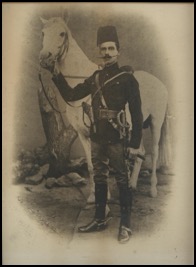
There was more shocking news. Also destroyed was Up Park Camp, north of Kingston. Among the casualties were about forty sick patients, all soldiers who were tragically burned to death before they could be saved from the wrecked and burning hospital. More reports described the horror. “Solid brick walls bulging and collapsing, carriages being lifted and flung through the air, telegraph poles swaying like leaves in the wind, and great structures whether made of iron, wood or stone, crumbling. People were simply picked up and tossed while struggling to maintain their balance. Those individuals who managed to escape out onto the streets were quickly enveloped in a thick yellow fog punctuated by the sound of crackling and tumbling walls. What many thought were heaps of dust were actually people trying to move in a city that had suddenly become foreign. Within twenty minutes fire blazed through the streets of Kingston and lasted for up to four days, in many cases finishing off what the earthquake had started.”
One eyewitness, having viewed the disaster from the deck of a ship, said, “The sky was a brilliant constellation of glorious lights, the waters over which we passed, dark and awesome, rendered all the more forbidding by the human flotsam and jetsam floating idly on its surface and from which I must shut my eyes.” Days later, Kingston resembled a ghost town.
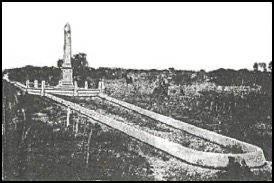
Paul Levitt.
TACA CORRESPONDENCE: SEARCHING FOR AN ARMY CHILD’S DEATH CERTIFICATE, CEYLON, 1911
Gavin Grant has contacted TACA with the following request for help: ‘I am looking for the death certificate of my uncle, Frederick George Fulcher, who was born on 17 October 1904 in Meiktila, Burma [Myanmar], and who died in Ceylon [Sri Lanka] in December 1911. His father was Ernest Thomas Fulcher, a colour sergeant in either the Middlesex Regiment or the Ceylon Defence Force.’ If you think that you can help Gavin, please contact TACA, and we’ll pass on your message.
TACA CORRESPONDENCE: CAN YOU HELP SOLVE THE MYSTERY OF WHAT HAPPENED TO AN ARMY WIFE AND HER DAUGHTER?
Catherine Capp has been in touch with TACA regarding a mystery in her family tree that she is longing to solve, as she explains:
‘My grandfather, William Thomas JAMES, who was then serving in the 1st King’s Dragoon Guards, married Cecilia Maud Lincoln MORRELL at the Holy Trinity Church, Bangalore [India], on Wednesday 1 August 1906. Their children were born at Ootacamund: Doris Elizabeth Emily JAMES, on Monday 14 December 1908, and Herbert Lionel JAMES, on Monday 7 August 1911.
I am looking for information on William Thomas’ wife, Cecilia, and his daughter, Doris. I believe that the family came out to Australia after February 1913 on the SS Maloja, but have not been able to check passenger lists. Later, William Thomas and Herbert Lionel appeared in South Australia at Booleroo Camp and went on to Tasmania with a Grace Ethel Margaret PORTER, who took on the surname of JAMES and claimed the marriage date of Cecilia with William when her daughter was born in South Australia. This family then moved to Tasmania, and William Thomas served with the 22nd Light Horse.
I am trying to find out what happened to Cecilia Maud Lincoln JAMES and Doris Elizabeth Emily JAMES. Did Cecilia and Doris come out to Australia and then return to India, OR did they remain in India after William Thomas JAMES left? I would appreciate any assistance in solving this mystery. Thank you.’
Catherine can be contacted through TACA should you have any information or advice for her.
PICTURES: MISS AND MASTER TOMMY ATKINS, c.1910
The two images below are playing cards drawn from a set called 'Funny Families', dating from approximately 1910. Identified as 'Miss Tommy Atkins the Soldier's Daughter' and 'Master Tommy Atkins the Soldier's Son', the family group is completed by two further cards representing their parents, 'Mr. Tommy Atkins the Soldier' and 'Mrs. Tommy Atkins the Soldier's Wife'. These imaginary army children are depicted stereotypically, playing soldiers: Miss Tommy Atkins, with her sword drawn, marches past a line of toy soldiers standing at attention, while Master Tommy Atkins prepares to fire a toy cannon.

FROM THE NAVAL AND MILITARY FAMILIES CARD GAME: EIGHT ARMY CHILDREN DEPICTED ACCORDING TO EARLY TWENTIETH-CENTURY STEREOTYPES
Pictured below are the offspring of soldiers of different ranks as portrayed in a card game designed by Prince and Princess Louis of Battenberg to be ‘sold for the benefit of the Soldiers’ Sailors’ and Airmen’s Families Association’ (today called SSAFA Forces Help).
Despite the mention of ‘SSAFA’ (as the Soldiers’ and Sailors’ Families Association became in 1919, following the creation of the RAF), the early twentieth-century fashions worn by the cards’ characters suggest that the set was designed well before 1917, when Prince Louis of Battenberg (1854–1921) and his wife, the former Princess Victoria of Hesse – grandparents of Prince Philip, the Duke of Edinburgh – changed their name from Battenberg to Mountbatten to dissociate themselves from Germany, Britain’s enemy during World War I.
Above, left and right: José Gatt and his sister, the sergeant’s children.

Above, left and right: Master Line, the major’s son, and his sister, little Miss Line.
Above, left and right: Miss and Mr Bief, the colonel’s offspring.
Above, left and right: Miss Fite, the general’s daughter, and her brother, Lieutenant Fite, who has followed in his father’s footsteps in joining the army.
TACA CORRESPONDENCE: CAN YOU HELP FLESH OUT THE DETAILS OF A SOLDIER–FATHER’S LIFE AND SERVICE?
Barbara Murphy-Bridge has already shared a photograph of Annie, John James and James Alexander Ward, army children photographed in Malta in around 1902, where their father, James Alexander Ward, was serving with the 79th (The Queen’s Own Cameron Highlanders)/the Royal Garrison Regiment (for the full story, see ‘TACA CORRESPONDENCE: HELP REQUESTED IN RESEARCHING THE DEATH AND BURIAL PLACES OF THREE ARMY CHILDREN’).
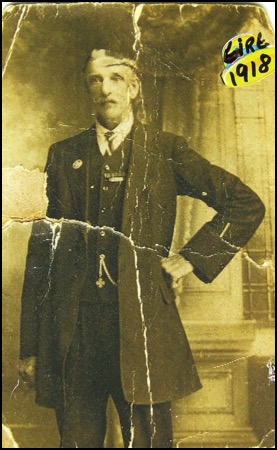
Barbara continues:
‘I’d give my eyeteeth to find out James’s actual birth year, and who his mother was. (I know from the birth certificate of his daughter, Margaret Josephine, who was born in 1902 in Valletta, Malta, that James’s father was a John Ward; family tradition has James’s grandfather as a Joseph Ward). (Margaret Josephine was one of the two infants who were born and died in Malta.) His mother was most likely a Margaret, as James named various children after family members, His brother, Robert Thomas Ward, died in France during World War I, and James named a son after him. He named another son, who was born in Gozo, Malta, in about 1904, John Joseph. His son John James Ward – one of the children pictured in the 1902 photograph – served with the Royal Garrison Artillery during World War I; he died of pneumonia aged 24 and is buried in Belgium.’
If you think that you can help Barbara by clarifying details in the photograph of James Alexander Ward, or by providing his birth year and mother’s name, please contact TACA, and we’ll pass on your message.
ONLINE RESOURCES: RECORDS OF ARMY CHILDREN’S BAPTISMS AT FERMOY AND BUTTEVANT GARRISON CHURCHES, IRELAND, C.1920
TACA is grateful to Dr Aoife Bhreatnach, of the Irish Garrison Towns website, for having alerted us (via Twitter’s @GarrisonTowns) to two online sources of army children’s baptismal records for garrison churches in Ireland, thanks to the work of the Anglican Record Project. Click here if you are interested in viewing the baptisms that took place at Fermoy Garrison Church, in the diocese of Cloyne, County of Cork, between 1920 and 1922, and here for the baptismal records of Buttevant Garrison Church, also in the diocese of Cloyne and County of Cork, between 1917 and 1922.
PICTURE: ‘FORMING FOURS’, A LINK BETWEEN SQUARE-BASHING SOLDIER–FATHERS AND QUADRUPLET ARMY CHILDREN?
‘Yus. First twas twins, now it’s triplets. Now me old man’ [sic] in the army. Say’s [sic] he’s learning to form fours.’ – so reads the caption to Reg Maurice’s illustration on the front of a postcard, below, published by the Regent Publishing Co, London, making a fanciful link between army children and soldier–fathers. The forming fours reference is to squad drill, as explained by Rudyard Kipling in Chapter XIV, ‘The Magic Square’, of A Book of Words (1928):
‘Here are two lines of men, one behind the other. Somebody utters a magic howl, or yelp, or bark – the sound of words of command hasn’t altered much since the beginning – and, behold, the lines become a compact, supple column capable of moving in any direction, and capable, if anyone says the magic word, of becoming two lines once more!’
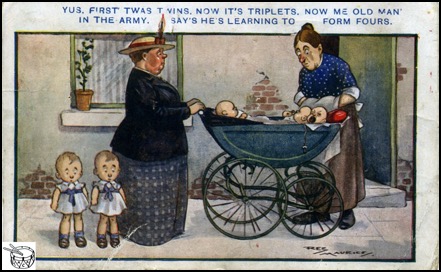
It is difficult to make out the postmark on this postcard, which was sent to an address in Whittington Moor, near Chesterfield, but it, in combination with a one-penny George V stamp, suggests that it was posted in 1919.
PICTURE: THE FAMILY OF SERGEANT LEWIS, STAFFORDSHIRE, 1920S
Kathleen Squires has contributed a photograph from her family album to TACA, along with a certificate of baptism. She explains that the photograph dates from the 1920s and is of ‘. . . my granddad and family when they lived in Whittington Barracks [in Whittington, Staffordshire]. In the picture is my granddad, nan and dad (on my nan’s lap), and my uncle Ted and aunt Nora. My granddad was, I think, a sergeant at the time. His name was Edwin Charles Lewis, and I think he was in the [North or South] Staffordshire Regiment.’
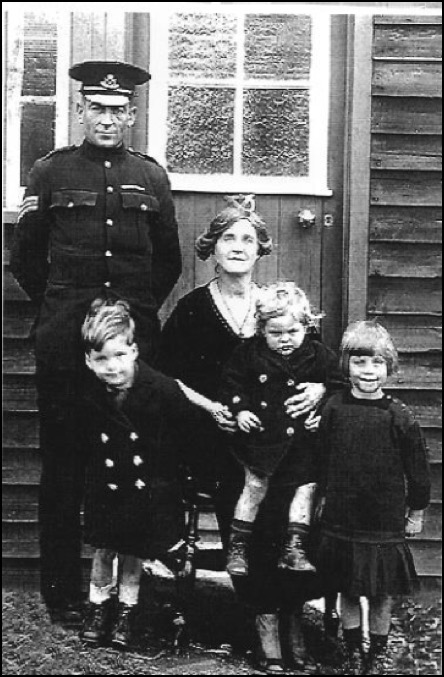
The certificate of baptism (below) is Ted’s. It states that he was the son of Edwin Charles Lewis and Teresa, née Brown; that he was born on 15 May 1920; and that he was baptised Edwin Charles Lewis at the Church of Our Lady of Victories [a Roman Catholic chapel in Whittington Barracks] on 21 May 1920 by John J Rowan; his godparents are also named.
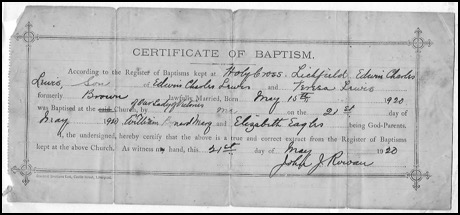
TACA is most grateful to Kathleen for her contribution – in view of the array of anonymous army families whose photographs appear on our ‘FORGOTTEN FACES’ page, it’s especially good to be able to put names to faces.
PICTURE: ‘GOODBYE, DADDY! GOD BLESS!’
Some army children may be too young to understand the full implications of a wartime farewell, but it must be a bittersweet moment for those soldiers who kiss their children goodbye before taking leave of their families and setting off on active service. The postcard below dates from World War II, and was produced by Bamforth & Co Ltd.
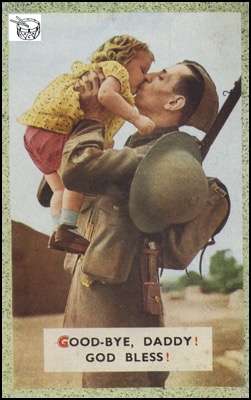
TACA CORRESPONDENCE: INFORMATION SOUGHT REGARDING AN EVACUATION FROM CAIRO, EGYPT, TO HAIFA, PALESTINE, 1941
After enlisting in the British Army in Cairo, Egypt, in 1941, Anne Keville’s father, Derek Hobson, served in the Royal Army Service Corps (RASC). That same year, Anne, her mother and brother travelled from Cairo to Haifa (today part of Israel, but then under the administration of the British Mandate of Palestine), as Anne explains:
‘In 1941, my father left Iran to join up in the British Army in Cairo. My mother, my brother (born 1941) and I (born 1939) were sent to a German hospice on Mount Carmel in Haifa because no wives or children of army personnel were allowed to stay in Cairo. I am writing a book about my parents' wartime experiences and would like to know the name of the hospice (convent) in which we stayed, what the conditions were like, the countryside, food, how we would have got there etc, and whether all the wives and children were well received by the nuns at that time.’
If you think that you can provide Anne with any relevant information, she can be contacted through TACA.
FROM THE HOME FRONT: THE NEWSLETTER OF THE 12TH ROYAL LANCERS FAMILIES’ ASSOCIATION, DECEMBER 1942
Reading the letter from Lydia Kidston dated Christmas 1942 (below), which appears on the front page of the fourth newsletter of the 12th Royal Lancers (Prince of Wales’s) Regiment (now the 9th/12th Royal Lancers (Prince of Wales’s) Regiment), it is striking how relevant it seems to those forces families whose loved ones are on active deployment in Afghanistan today: proud, yet constantly thinking of those who have been bereaved, and determined to remain positive and to do their bit ‘on the home front’. 

‘Ruth Street, aged ten years, has received the following from Mrs. Winston Churchill:–
Dear Ruth, Thank you very much for your gift which I have just received (£3 10s.) made out of making and selling lavender bags) I am most grateful to you for the trouble you have taken to help the brave Russians in their terrible struggle, and in the glorious Defence of their Country. Your sincere friend, CLEMENTINE CHURCHILL.
Ruth is a XII Lancer of the Fourth Generation.’
PICTURE: ARMY-CHILD DIANE BRADBURY, TRAFALGAR SQUARE, LONDON, 1942/43
We are delighted that Diane Kerwin (née Bradbury) decided to share the delightful photograph below with TACA.
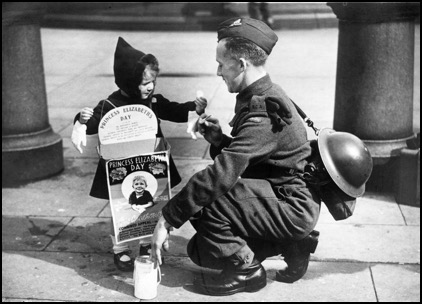
Diane writes:
‘I thought that this photo might be of interest. It was taken in Trafalgar Square in around late 1942/early 1943, and is of myself “selling” a pin or flag to a Canadian soldier. He is obviously dressed in World War II uniform, hence the helmet, but I know nothing more than that. I would have been about three years old. My dad was still in a PoW [prisoner-of-war] camp. After the war he stayed in the army until mid-1959. I was an army child all the way.’
She continues:
‘My dad, George Lewis Bradbury, joined the 1st Battalion, Royal Welch Fusiliers, at the age of fifteen, as a band boy. He stayed with that regiment through the war, being in Stalag VIIIB from mid-1940 (after Dunkirk) to October 1943, when he was repatriated home. He stayed in the army after the war, going to Kneller Hall to get his bandmastership, which he got in 1949. He was then bandmaster of the 10th Royal Hussars (Prince of Wales's Own), which were stationed in Germany. We joined Dad there on 19 December 1949’.
Diane was ‘selling’ her flags on behalf of Princess Elizabeth’s Day, the proceeds of which went to the London charities Barnardo’s, the Waifs and Strays, the NSPCC, the National Children's Home, the Crusade of Rescue, and the Council for Child Welfare.
TACA CORRESPONDENCE: TRYING TO TRACE AN ARMY CHILD BORN IN EGYPT IN 1946
Sue Attridge (née Rounsley) has contacted TACA with a request for assistance. As she explains, she is trying to trace an Egyptian-born army child and his mother:
‘I have been reading with great interest the entries on The Army Children Archive site and wondered whether there is any way anyone could assist me.
My late father was a member of the RASC [Royal Army Service Corps] who served throughout the Middle East during World War II, returning to England in 1948 after a stint in Palestine. I have a copy of his army records.
My father, Frederick Charles Rounsley, married Ginette Shama (born 1917 at Alexandria, Egypt) at St Mark's Church, Alexandria, in 1944. A copy of their marriage certificate states that Ginette was British by nationality and that her father, Ezra Shama, was deceased.
On 16 December 1946, Ginette gave birth to a son, Reginald Isaac Shama Rounsley, at the International Maternity Hospital, Alexandria. I have a GRO [General Register Office] copy of the birth certificate, and his birth is recorded by army records.
I only discovered these details about seven years ago, and since then I’ve been trying to discover what happened to Ginette and my half-brother (who would have been an army child). My late grandmother received some photographs and a letter, circa the late 1940s, explaining that Ginette would not leave Egypt to live in England whilst her mother was still alive.
I know this is a long shot, but wondered whether you had any suggestions or advice to offer me as any help would be so much appreciated.’
If you think that you can help Sue to learn more about her half-brother and his mother, please contact TACA, and we’ll put you in touch with her.
PERSONAL STORY: REFLECTIONS ON REMEMBRANCE DAY
Terry Friend, whose father was in the Royal Horse Artillery, was born in Kiel, (West) Germany, in 1947. Here, he reflects on Remembrance Days past, and on the significance that 11 November holds for him and his family. (For Terry's recollections of the camp at Hohne, (West) Germany, click here; for a description of his family's married quarters in Hohne, click here; for his memories of going to school in Hohne and Wilhelmshaven, click here; for the knock-on effects that the Hungarian uprising had on the Friend family, click here; for his account of Christmases in Germany, click here; and for more about Terry himself, visit his website: http:// www.anothercountrysong.com.)
'For a military family such as mine, Remembrance Day became as significant for us as Easter or Christmas – another important day in our yearly calendar. I have never in my life experienced anything so hauntingly beautiful in its melancholy as the sound of a lone bugler playing the Last Post, followed always by the cathedral-like hush of the minute's silence. It brought a lump to my throat then, and it brings a lump to my throat now. Conjuring up images of Grandad Lavers covered in mud on the Western Front. Of Father in the desert, or struggling up the Normandy beachhead. Of my brother Chris enduring dive bombers in the Falkland Sound. Or of myself trekking through those dingy, hate-filled, dirty little back streets of Belfast.
I first heard that lonely bugle lament in the Globe Cinema at Hohne in 1951 or 1952. Married families would be seated in the "gods" upstairs, and the regiments of the garrison would be marched to the cinema to file in downstairs. There gathered, we would all take part in the traditional church service for Remembrance Sunday conducted by the padre. There, in that building normally associated with the pleasurable pursuits of the silver screen, I became acquainted with the Remembrance service and its melancholy ceremony. I, who had not lived with the grim reality of war, often wondered what was running through the minds of Mother and Pop. One had been under bombardment from the enemy force. The family home was nearly destroyed in one raid, when a bomb landed in the street and destroyed three houses opposite number thirteen, a mere 15 yards away! The other had campaigned for six years, going from the heat of the desert to the freezing conditions of the winter of 1944 in Holland. He was wounded twice, both times in Africa, the first time being a bullet in the knee, and the second time, a shell splinter in the face.
After the service, the units would march back to their own area of the camp. There would be a march past and a salute. I was always struck by the fact that most of the soldiers had "naked chests". It was the era of national service, so most of them were no doubt unwilling conscripts. In contrast, at the rear of the squad marched the senior ranks, sergeants and warrant officers, all weighed down with medals, these jangling and shining proudly in the feeble autumn sun. Pop himself wore the 1939–45 Star, the Africa Star and the France and Germany Star, plus the Defence and War medals. These were to have another medal added to them in 1958, when he was presented with the army Long Service and Good Conduct Medal awarded after twenty-two years' service.
I always remember my father best, the evening before Remembrance Sunday, at home, seated at the table in the living room. The table was covered in newspaper, and he was armed to the teeth with button stick, button brush, yellow duster and the familiar tin of Brasso. Before him lay the task of cleaning his medals, which had probably lain neglected in a drawer for some months. To me, as I watched, it all looked a very fiddly and awkward job. Great care had to be maintained not to get any Brasso stains on the ribbons. I admired the old soldier as he sat there, whistling as he worked. Weren't the stars awkward to clean? The button brush was very handy for this. I had a secret ambition: I, too, wanted to be like Pop and have a chestful of medals one day.'
Terry Friend (b.1947).
TACA CORRESPONDENCE: INFORMATION SOUGHT ON BEECH-HANGER COURT, CATERHAM, SURREY
Jane O'Connor has contacted TACA with a request for information.
'Some time around 1945, my great aunt was principal matron at Beech-hanger Court, Caterham, in Surrey, which I believe was then a school for the daughters of Scots Guardsmen. However, my mother always believed it was an orphanage. She used to spend a month at a time with her aunt, spending a lot of time playing the piano with her and singing.
My great aunt's name was Elsie Shaw, and in 1931 she would have been 38. She was from Great Marlow, in Buckinghamshire, and her father was a boat builder. She had worked as a Red Cross nurse at the military hospital based at Marsh Court at Kings Somborne, Hampshire, during the First World War. (I have a few photos if anyone is interested.) I have no idea how long she stayed at Beech-hanger Court, or when she started and finished her job as principal matron there, though. She got married late in life (in 1945), at the age of 52.
I wonder if you can confirm whether Beech-hanger Court was indeed simply a girls' school; whether there are any records in existence of the staff who worked there during the war period; and whether it was built near, or on, the Guards Depot. Thank you for any information you can give me.'
If you think that you can help Jane, do get in touch: she can be contacted through TACA.
VIDEO: ARMY FAMILIES’ EVACUATION FROM TRIESTE, 1953
TACA is grateful to John Rayner for letting us know about a short, but telling video on the British Pathé website that shows army families being evacuated from Trieste in 1953. Click here to view it.
BRITISH ARMY OF THE RHINE NBC GUIDE, OCTOBER 1981
A revised leaflet published in October 1981 entitled British Army of the Rhine NBC Guide (above) makes chilling reading, setting out as it does crucial information and instructions in the event of an outbreak of nuclear or chemical warfare. In the case of chemical warfare (see below left), nerve and blister agents are described, as is how to take care of respirators, how to detect a chemical agent, and, in the event of an attack, the required immediate action drill, immediate first aid and immediate decontamination drill. Also listed are the different German civil and British military siren-note warnings; the advice given for sounding a chemical alarm, by contrast, is to ‘Bang together metal objects, or repeated bursts on vehicle horns’ (see below right).
While the guide additionally includes what should be worn in accordance with the different NBC states of green, amber 1, amber 2, amber 3, and red, it seems that the instructions given for nuclear and chemical reporting, and for the marking of contaminated areas, thankfully never had to be followed for real.
THE ELIZABETH CROSS: NATIONAL RECOGNITION FOR SERVICE FAMILIES FOR THEIR LOSS
The creation of a new emblem 'demonstrating tangible national recognition for Service families for their loss', in the words of the Ministry of Defence (MoD), was announced on 1 July 2009. From 1 August 2009, the Elizabeth Cross, a sterling-silver emblem whose reverse will be engraved with the name of the person in whose memory it is awarded, accompanied by a miniature version and also by a memorial scroll signed by Her Majesty the Queen, will be granted to the next of kin of UK armed forces personnel 'who have died on operations or as a result of an act of terrorism' between 1 January 1948 to date (including in the Korean War and the Falklands Conflict, and in operations in Northern Ireland, Iraq and Afghanistan). The MoD states that 'the Elizabeth Cross was instituted specifically to recognise the unique challenges that service personnel face on operations and from terrorism, and the particular burden this places on Service families'. Commenting on the announcement, Air Chief Marshal Sir Jock Stirrup, Chief of the Defence Staff, added: 'I hope that the families of those who have given their lives will wear the Elizabeth Cross with pride and pass it on to future generations so that they too might know the price that has been paid for their freedom and way of life'. Further details, including information on how to apply for the Elizabeth Cross, are given on the MoD’s website (see http://www.mod.uk/DefenceInternet/DefenceNews/ HistoryAndHonour/ ElizabethCrossHonoursFamiliesOfFallenTroops.htm and http://www.mod.uk/DefenceInternet/DefenceFor/Veterans/Medals/The ElizabethCrossDiedOnOperationsRecognitionAward.htm).
IN THE NEWS: THE BIRTH OF ‘BABY BASTION’, A UNIQUE ARMY CHILD, SEPTEMBER 2012
A first in the history of British army children took place during September 2012: the birth, at Camp Bastion, Afghanistan, to a British army soldier. Army children have been born in war zones to army wives and partners for centuries, but what made this birth so unusual was that it was the baby boy’s mother who was the serving British soldier deployed on active duty. For further details, see the ‘Army children’s war-zone births’ post on the TACA drum blog.
LINKS
The following links provide historical background information that explains much about many army children's lives and times.
- The National Army Museum: http://www.national-army-museum.ac.uk
- The Imperial War Museum, which encompasses all aspects of war in the twentieth and twenty-first centuries: http://www.iwm.org.uk
- The Army Museums Ogilby Trust's (AMOT's) website is approved by the Ministry of Defence as being the definitive guide to the regimental and corps museums of the British Army throughout the United Kingdom. It also provides details of specialist books and gives advice on researching army ancestors. Visit it at: http://www.armymuseums.org.uk
- The Royal Norfolk Regimental Museum's website includes a 'Children of the Regiment' web trail that comprises pages entitled 'Travelling with the Regiment'; 'On the Strength'; 'Off the Strength'; 'Army Children at School'; and 'Order of 1812': To set off on the trail, visit: http://www.rnrm.org.uk/web_trail/web_children_01.html
- The British Empire website is a rich resource for those interested in imperial British history, including as it does biographies, timelines, a map room, a glossary, a discussion forum, articles and information on many aspects of, for example, the armed forces, art and culture and science and technology during this period, as well as research tools. Visit it at: http://www.britishempire.co.uk.
- The RevWar'75 website (http://www.revwar75.com) focuses on the Revolutionary War (or, as it is also called, the American Revolution or the American War of Independence, 1775-83). Don N Hagist's article 'The Women of the British Army in America' includes statistics and information relating to the children of British Army soldiers who found themselves in North America during the American Revolution; to read it, click on: http://www.revwar75.com/library/hagist/britwomen.htm.
- The War of 1812 Website (http://www.warof1812.ca) is dedicated to the conflict between Britain and the United States of America that prevailed between 1812 and 1814. Included among the articles on this informative website are pieces that touch on the experiences of army children during the War of 1812, including: 'Extracts from the Journal of a Subaltern's Wife written in Canada during the years 1812, 1813, and 1814', edited by Don Graves (http://www.warof1812.ca/wife.htm); 'A Soldier's Family in the British Army during the War of 1812', by Robert Henderson (http://www.warof1812.ca/family.htm); and 'Soldiers' Families under Fire: Ambush at Toussaint Island, 1812', edited by Robert Henderson (http://www.warof1812.ca/ambush.htm).
- To read about the history of the British Army in Bermuda from 1776 to 1977, including the regiments and units stationed there, visit: http://www.bermuda-online.org/britarmy.htm. And to learn more about the cemeteries where British soldiers and sailors and their families who died in Bermuda were buried, visit http://bermuda-online.org/britishmilitarygravesbda.htm.
- The lively HistoryNet.com website (http://www.historynet.com) is the portal to ten history magazines published by the US Weider History Group. A number of archived articles can be accessed through the website, including 'Napoleonic Wars: Women at Waterloo' (http://www.historynet.com/ napoleonic-wars-women-at-waterloo.htm#high_1), which first appeared in Military History magazine, and which gives an indication of the conditions that army children endured and the sights that they witnessed at the Battle of Waterloo (1815).
- Hidden Lives Revealed (http://www.hiddenlives.org.uk) is a virtual archive dedicated to the stories of the children in the care of The Waifs and Strays' Society (today, The Children's Society) between 1881 and 1981. This absorbing website presents contemporaneous photographs; details of the homes operated by The Waifs and Strays' Society; a list of relevant publications and articles; and a selection of case studies. Army children feature among these, including Case 9308, or 'J', a boy born in 1896 whose mother had died in childbirth in 1900 while his soldier father was fighting in the Boer War (for more details of J's case, see http://www.hiddenlives.org.uk/cgi-bin/displayrec.pl?searchtext=soldier& record=/cases/case9308.html).
- The Serving Soldier website provides online access to original documents and photographs held by King's College London's (KCL's) Liddell Hart Centre for Military Archives. Jointly funded by KCL and the Joint Information Systems Committee (JISC), the stated aim is that: 'The Serving Soldier will eventually provide access to thousands of nationally significant historical archives revealing the broad interests, talents and accomplishments of servicemen and their families at the turn of the nineteenth and twentieth centuries. Their role as peacekeepers, technical innovators, explorers, colonial administrators and veterans is revealed through diaries and first hand accounts, scrapbooks, reports and photographs.' Click on this link http://kingscollections.org/servingsoldier/ to visit and explore the website, to which new material will regularly be added.
- The Second World War Experience Centre's mission is to 'collect and encourage access to the surviving testimony of men and women who lived through the years of the Second World War and to ensure that different audiences share and learn from the personal recollections preserved in the collection'. Explore it at: http://www.war-experience.org
- Children (& Families) of the Far East Prisoners of War (COFEPOW) is a registered charity dedicated to perpetuating the memory of Far East prisoners of war and advancing knowledge of the suffering endured and sacrifices made by them during their years of captivity in World War II. Several of its members are former army children, and the stories and memories of some can be read on COFEPOW's sobering, information-filled, reminiscence-rich website. Access it by clicking on http://www.cofepow.org.uk.
- The huge British Armed Forces and National Service website (http://www.britisharmedforces.org) is home to reminiscences and information on many aspects of the British armed forces and national service.
- The Britain's Small Wars website (http://britains-smallwars.com/) homes in on the history of British military conflicts since 1945. Here you'll find articles, reminiscences and anecdotes, as well as a forum, an online museum and memorial, recommended reading and much more.
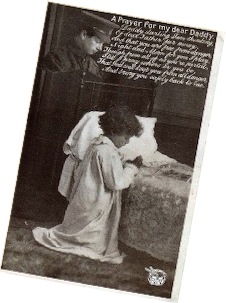
TO READ VIRGINIA SILVESTER'S ARTICLE, 'FAMILY-HISTORY RESEARCH: ROBERT AND SYDNEY COCKMAN, GORDON HIGHLANDERS (AND AN ARMY SCHOOLMASTER) DURING THE BOER WAR', CLICK HERE.


