Many old photographs featuring anonymous army children from times past have found their way to TACA. It seems a shame that these forgotten faces should continue to be disregarded, which is why we will be posting the photographs on TACA. (See also ‘The Army Children of the First World War: Faces and Families’, a set of photographic portraits of army children and their families photographed between 1914 and 1918 that are being posted on Flickr as part of TACA’s ‘The Army Children of the First World War’ project.) And if there is anything about any of images in this gallery of forgotten faces that you recognise, or would like to comment on, or if you have any such photographs of your own that you'd like to share, please contact TACA.
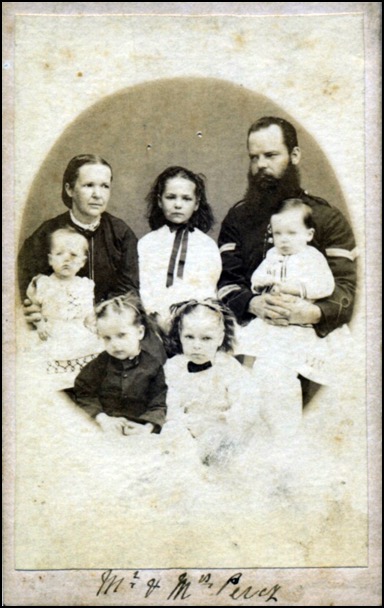
THE PEREZ FAMILY, 1860S
At least we have a family name for the five army children in the photograph below, thanks to the annotation written beneath it, which identifies their parents as being ‘Mr & Mrs Perez’ (a Spanish name). The two stripes on his upper sleeves tell us that Mr Perez is actually a corporal; it also seems that he has two good conduct stripes on his lower right sleeve, suggesting six years’ service of good conduct prior to 1881. The single loop decorating his cuffs indicates that he may have been serving in the Royal Engineers. The style of Mrs Perez’s clothes and hair suggests that this photograph may date from the 1860s.
A VICTORIAN ARMY FAMILY PHOTOGRAPHED IN CHATHAM, KENT
This small photograph of a Victorian army family, which has been pasted on to a carte de visite mount, has the following details emblazoned on the back: ‘Napoleon Syru’s Full Length Cartes de Visite / 3/6 Per Doz. / 16, Military Road, Chatham [in Kent] / J. G. Baker & Co. London’.
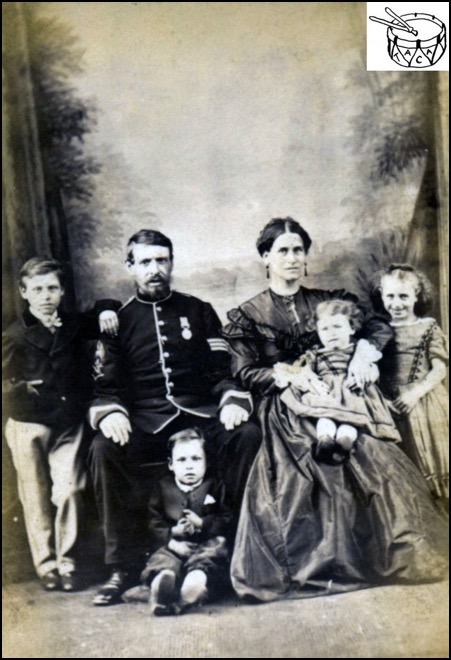
Four small army children are pictured with their parents against a studio backdrop. The three chevrons on their father’s left upper sleeve tell us that he is a sergeant; sadly, it is impossible to make out the badges on his left sleeve, or details of his medal.
Cartes de visite were particularly popular during the 1860s, and the style of clothes worn by the children and their mother indicate that the family may have been photographed during the later part of this decade.
A SERGEANT’S FAMILY PHOTOGRAPHED IN WOOLWICH, LONDON, MID-1860S OR 1870S
This age-damaged photograph of a Victorian British Army sergeant and his wife and three children has been printed on a carte de visite mount, a format popular from the 1860s until the early years of the twentieth century. The information printed on the front and the back of the mount tells us that the family visited the photographic studio of S Long, at 82 Wellington Street, Woolwich, in London, in order to be photographed. (An order number of 12377 has also been handwritten on the reverse.) The three stripes on his sleeves and the sash across his chest proclaim the sergeant’s rank. The style of his uniform, and those of his wife’s hairstyle and dress, suggest a date from the mid-1860s or 1870s. (You can view another photograph produced by the studio of Long & Faulkner at the same address below: ‘A TOY GUN FOR AN ARTILLERY SERGEANT’S SON, WOOLWICH, LONDON, 1880S’.)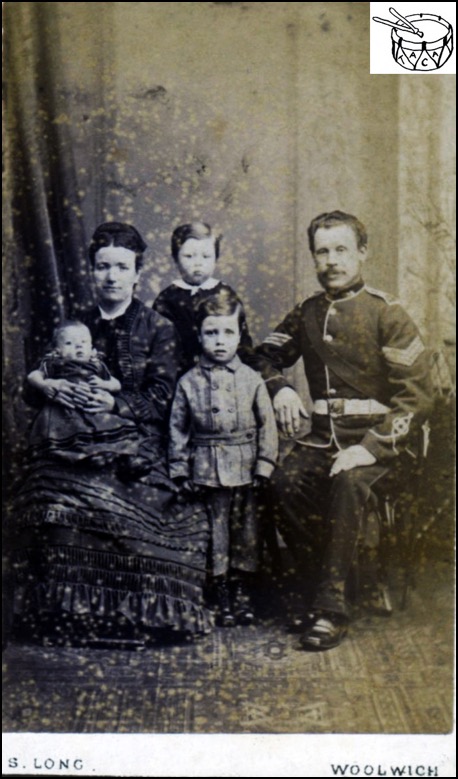
A FARRIER SERGEANT’S FAMILY PHOTOGRAPHED IN YORK, C.1870
This photograph of an army family has not aged well, but then it is around 150 years old. Despite its condition, we can still make out details of the children’s soldier–father’s uniform, including three sergeant’s stripes (the horseshoe above indicates that he is a farrier sergeant), a swagger stick and a splendid moustache. In a notable family pose, both of the children and their father have placed their hands on their seated mother, whose clothing and hairstyle suggest a date of around 1870. Pasted on a carte de visite mount, the name and address of the photographer that produced the photograph is printed on the back: ‘H. Bramham’, of ’16 Colliergate, York’. According to one source, Henry Bramham’s business premises were based at 16 Colliergate from 1867 to 1905.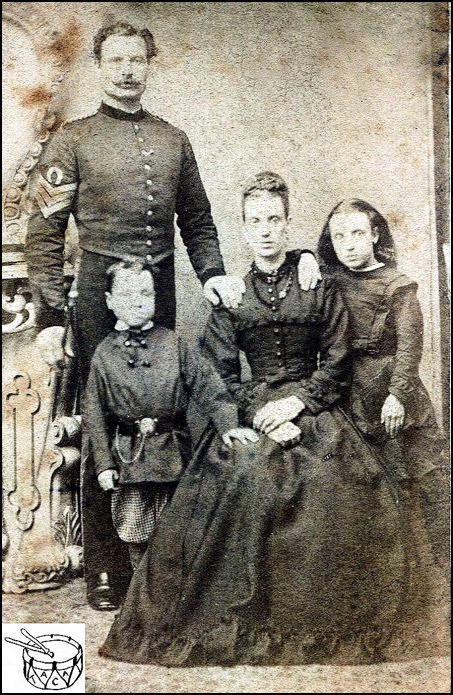
A CORPORAL AND HIS FAMILY, SOUTH AFRICA, 1870S
We do not know the names of the members of the large army family pictured below, but a stamp on the back tells us that the photographic studio that produced this photograph was Ashley & Son, and a business of that name was operating in South Africa from the 1860s. The father of the seven army children is a corporal, and the four stripes on his lower sleeve are good-conduct chevrons indicating at least eighteen years of service. The white helmet in front of him indicates service overseas. His wife’s hairstyle and dress, as well as the children’s outfits, suggest that the photograph dates from the 1870s.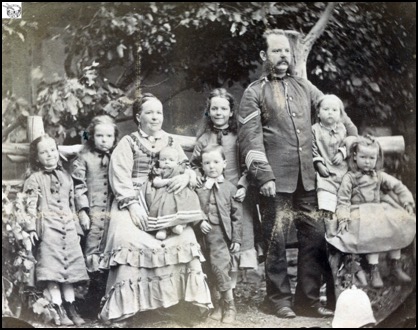
AN ARMY CHILD AND HER PARENTS, C.1880S
The black-and-white photograph below was pasted on to a blank carte de visite mount, with no photographer’s information printed on the back to tell us where it was taken. The subjects are an army child and her parents. Her soldier–father wears a Glengarry cap (worn from 1868 to 1897 by British soldiers) and rests a swagger cane on his knee. The two upward-pointing stripes on his right arm indicate six years’ good conduct, and it looks as though he has a marksman’s badge above them. The style of her mother’s clothes suggests a date of the early to mid-1880s.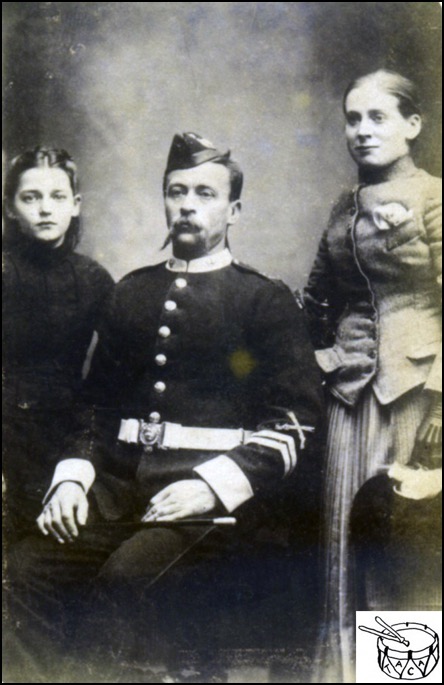
A VICTORIAN ARMY FAMILY WITH AN ARRAY OF HEADGEAR
Various clues suggest a likely date for the studio photograph below, which shows a British Army sergeant seated next to his wife, flanked by their son and daughter; he holds a swagger cane, while his wife balances an umbrella on her knee. The photograph forms the central part of a cabinet print (not shown), a type particularly popular during the 1880s and 1890s. The father’s uniform and pillbox cap, which was worn before 1903, dates the photograph to the late nineteenth century. This evidence, combined with the styles of clothing, hairstyles and accessories worn by the army children and their mother, together suggest a date of around the late 1880s.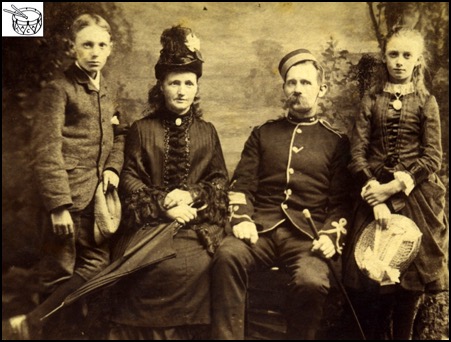
A VICTORIAN ARMY FAMILY PHOTOGRAPHED ABROAD, 1880S
This photograph of a Victorian army family has been mounted on card (cropped out here). The faces of the sergeant, his wife and their two children are frustratingly blurred. Details in the lower half of the photograph are clearer, however, such as the toy on the floor; the adults’ well-worn shoes; and the white sun helmet on the right. This style of sun helmet, which was introduced in 1877, indicates that the children’s soldier–father was serving overseas, possibly in India, while the style of his wife and children’s clothes suggests that they posed for their family portrait during the 1880s.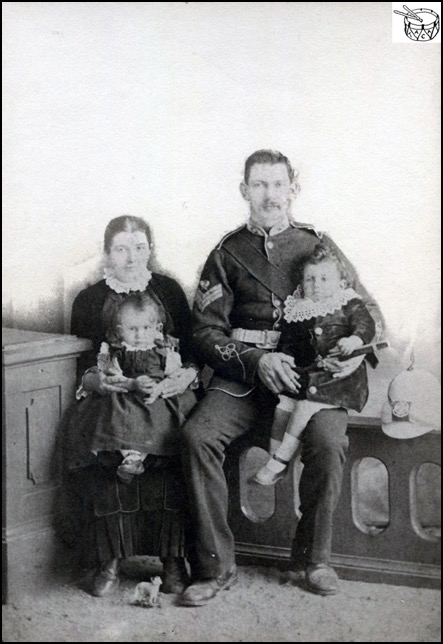
A TOY GUN FOR AN ARTILLERY SERGEANT’S SON, WOOLWICH, LONDON, 1880S
The cabinet portrait below was produced by Long & Faulkner, 82 Wellington Street, Woolwich, London, and shows a young army child (clutching a toy gun), his parents and an older man, most likely his grandfather. The three stripes on the boy’s father’s right sleeve indicate that he is a sergeant, as does his sash, while the crossed muskets on his left sleeve are the badge of a marksman. His mother’s outfit and hairstyle suggest a date during the 1880s, when the Royal Artillery was based at Woolwich.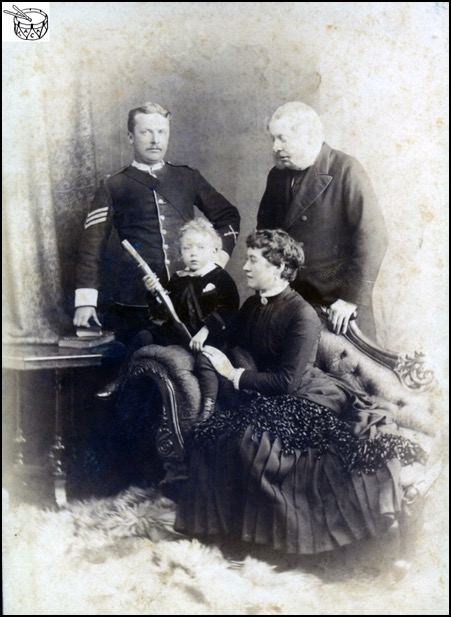
AN ARMY FAMILY PHOTOGRAPHED AT SOUTHSEA, PORTSMOUTH, HAMPSHIRE
The photograph below was taken at W V Amey's photographic studio in Southsea, Portsmouth, Hampshire.
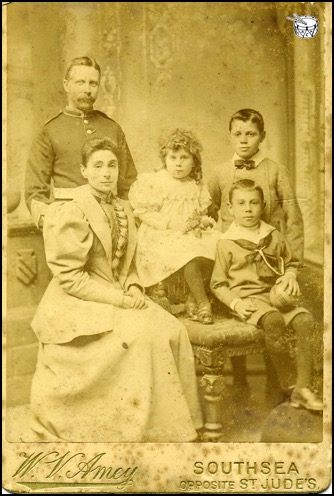
A SAILOR-SUITED ARMY CHILD AND HIS FAMILY, C.1895
An army family posed in an unknown photographer’s studio for this cabinet print, which is mounted on card. The boy at the front is wearing a sailor suit. His soldier–father is wearing a cavalryman’s pillbox cap and a patrol jacket. The four upward-pointing chevrons on his lower right sleeve indicate a quartermaster sergeant’s or quartermaster corporal major’s rank; a medal ribbon is visible on the left-hand side of his chest. The style of his wife’s clothing suggests a date of the mid-1890s.
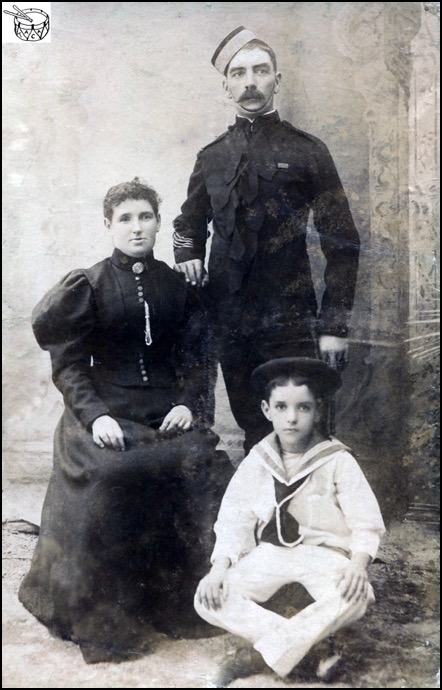
A SERGEANT’S FAMILY PHOTOGRAPHED IN PRESTON, LANCASHIRE, LATE 1890S
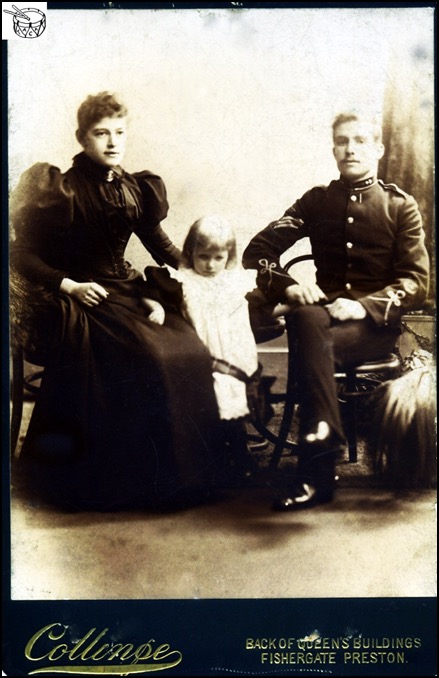
The cabinet-print mount on which this photograph of a solemn-looking army child and her parents has been pasted tells us the name and address of the photographer’s studio in which they were pictured: Collinge, which was located at the back of Queen’s Buildings, Fishergate, Preston, in Lancashire. The three stripes on her soldier–father’s upper arm tell us that he was a sergeant (there seems to be a cannon above the chevrons, suggesting that he was an artillery sergeant), and the one visible collar badge appears to be a grenade, indicating that he was a fusilier. Her mother’s hairstyle and outfit point to a date of the late 1890s.
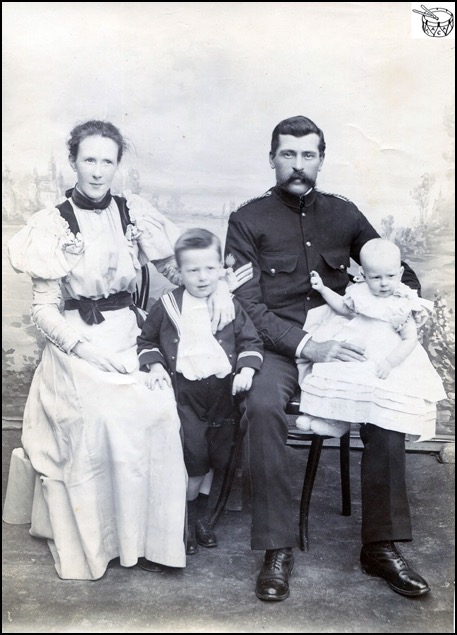
A SERGEANT IN THE ROYAL ENGINEERS AND HIS FAMILY, C.1895–98
This studio portrait of an army family measures 6½ x 4½ inches. Pictured are two army children and their parents. The three stripes and flaming grenade visible on their father’s upper arm indicate that he is a sergeant in the Royal Engineers. Their mother’s hairstyle and outfit suggest that the photograph was taken between 1895 and 1898.
POSING FOR THE PHOTOGRAPHER IN ROCHESTER, KENT
The small army family pictured in the studio portrait below most likely posed for the photographer at James J Eastmead’s establishment in Eastgate, Rochester, Kent, during the 1890s. The three chevrons and badge on his right arm suggest that the father of the family is an engineer sergeant.

AN ARMY FAMILY PHOTOGRAPHED IN NORTHAMPTON, 1890S
The photograph below of an army family that was taken at the studio of W H Parkinson, 27a Abington Street, Northampton, was presented as a cabinet print. The three stripes on his right sleeve tell us that the soldier–father is a sergeant; above them may be a flaming grenade topped by a crown (if this is the case, then he is probably an engineer sergeant). His wife’s hairstyle and clothing suggest a date from the mid- to late-1890s.

A LANCE CORPORAL’S FAMILY
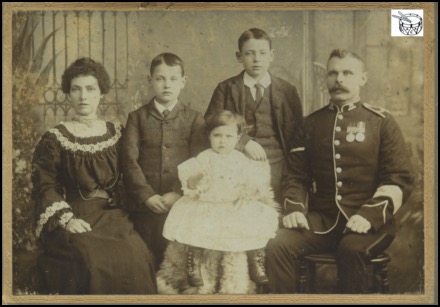
The army family pictured in the formal photograph below probably presented themselves at the photographer’s studio during the 1890s. The father of the two boys and their small sister displays two medals on his chest, while the single chevron on his left sleeve indicates that he is a lance corporal.
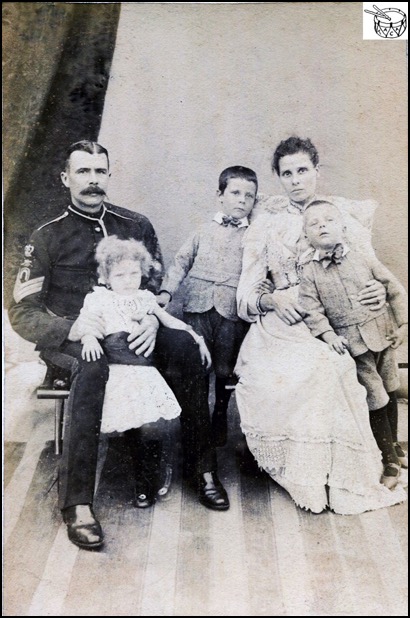
AN ARTILLERY SERGEANT’S FAMILY, 1890S
An army family looks out at us from the age-spotted photograph below, which probably dates from the 1890s. The badges on the children’s soldier–father’s right arm tell us that he is an artillery sergeant with proficiency as a farrier.
A SERGEANT’S FAMILY PHOTOGRAPHED IN ROCHESTER, KENT, 1890S
The mount on which this group portrait has been pasted (cropped out here) tells us that this army family was photographed in the studio of J J Eastmead in Rochester, Kent. The badge above the sergeant’s stripes may be a flaming grenade, indicating that he was in the Royal Engineers or an engineer sergeant. His wife’s dress and hairstyle suggest that this photograph dates from the 1890s.
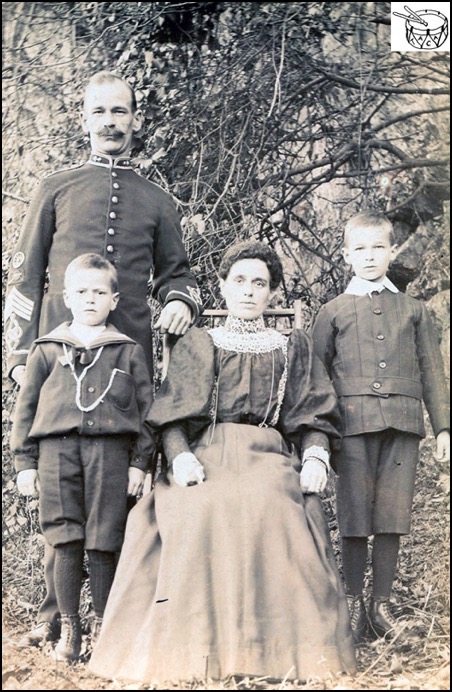
A QUARTERMASTER-SERGEANT AND HIS FAMILY, C.1895
This photograph of an army family pictured outside shows two boys, one dressed in a sailor suit, the other wearing a Norfolk jacket, and their parents. The badges on their father’s right-hand sleeve indicate that he is a quartermaster-sergeant in the Royal Artillery and had qualified as a wheelwright. The style of the boys’ mother’s clothes and hair suggest a date of 1895 or 1896.
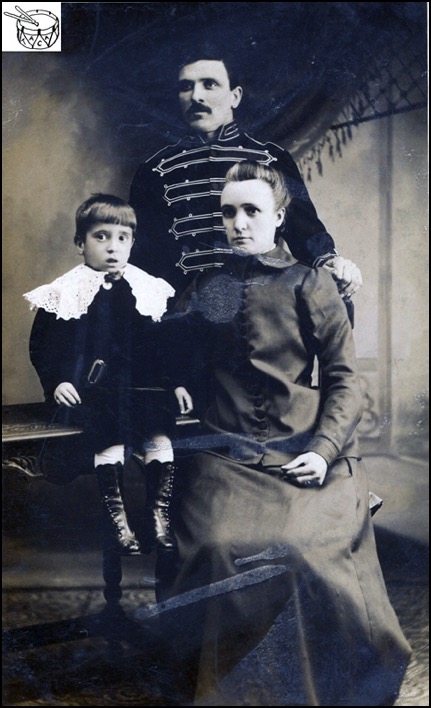
A MYSTERY ARMY FAMILY, C. EARLY 1900S
Much about this photograph of an unknown army family is a mystery. We know neither their names nor the studio in which they were photographed. The photograph itself has been printed on a postcard mount, the back of which has a central vertical dividing line, indicating a date no earlier than 1902. The little boy’s ornate white collar also suggests the early 1900s. The boy’s soldier–father’s tunic is distinctive, but no identifying badges are visible.
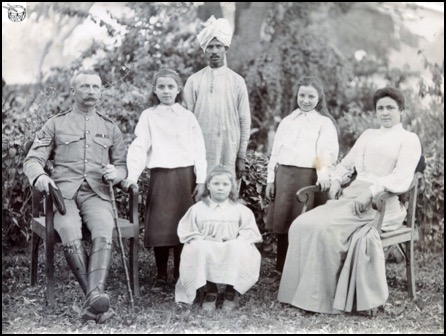
A RAJ-ERA 5TH DRAGOON GUARDS’ ARMY FAMILY, C.1900
This photograph of an army family and a male servant was no doubt taken in Raj-era India. The girls’ father’s arm badges tell us that he is a staff sergeant in the 5th Dragoon Guards; other details of note are his medal ribbons, riding boots and waxed moustache. The style of their mother’s hair and clothes suggests that the photograph was taken during the first decade of the twentieth century.
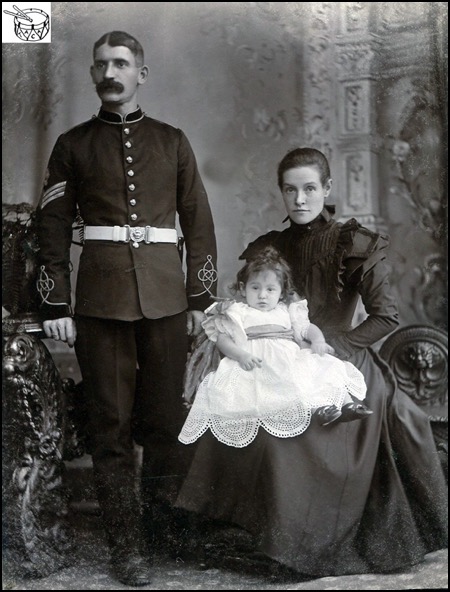
THE CONFIDENT CORPORAL’S FAMILY, C.1900
With his bristling moustache and confident pose, the corporal seen with his wife and baby in the photograph below looks every inch the proud soldier–father. Two downward-pointing chevrons are just visible on his right sleeve, proclaiming that he is a corporal, while the three upward-pointing chevrons on his left sleeve are good-conduct chevrons, or long-service stripes, indicating that he has served for at least twelve years. No regimental insignia are visible, but he is wearing undress uniform of the type worn by the Royal Artillery of the period.
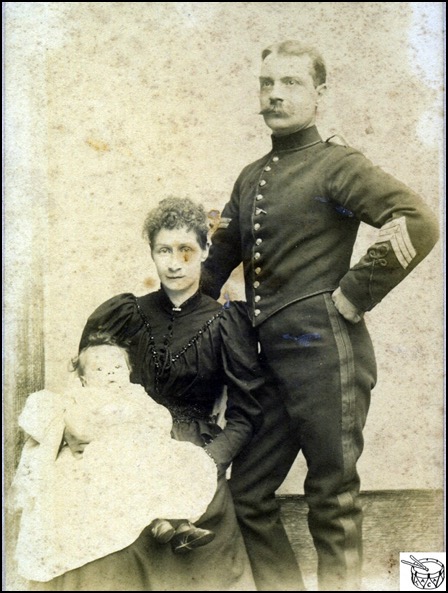
The photograph is a studio portrait, stamped with the name and address of the photographer, namely Warwick Brookes, of Clifton Street, Old Trafford, Manchester. The style of the army wife’s clothing (she appears to be in mourning), and her hairstyle, suggest a date of the late 1890s or early 1900s.
A SERGEANT AND HIS FAMILY, C.1900
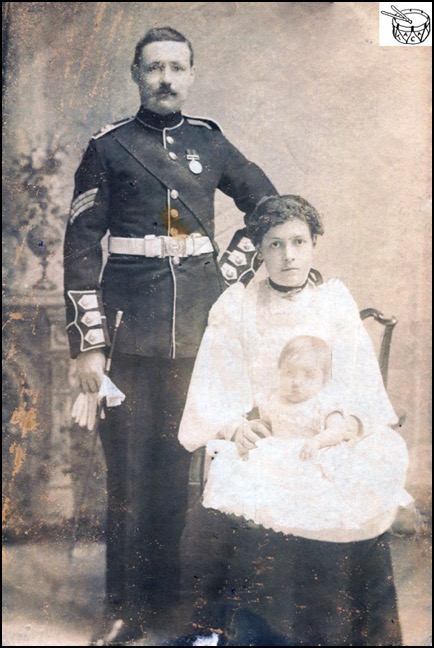
This old photograph of a sergeant and his family has not aged well. No doubt taken to commemorate the ghostly-looking baby’s christening, the style of the mother’s hair and clothes suggest a date of around 1900.
A LANCE-CORPORAL’S FAMILY PHOTOGRAPHED IN SHEERNESS-ON-SEA, KENT
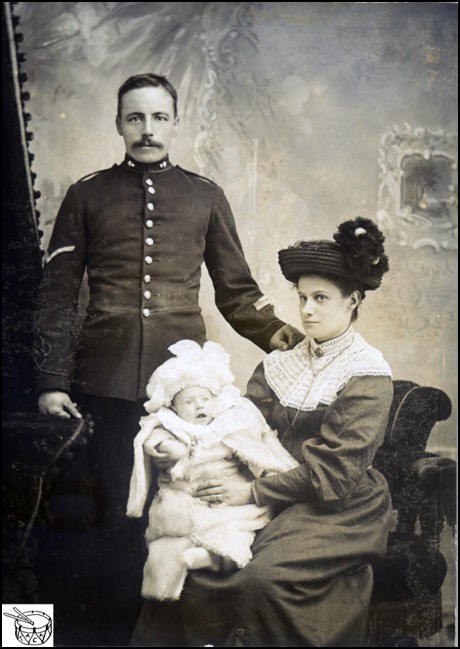
Although it has been cropped out here, the photograph below was mounted as a cabinet print, emblazoned with the name of the photographic studio that produced it: ‘C. H. Lucas, Sheerness-on-Sea.’, Sheerness being in Kent. The family depicted comprises an elaborately dressed baby, its mother (her wedding ring prominently displayed) and its soldier–father. The single stripe on his right-hand sleeve tells us that he is a lance-corporal; he seems to have two good-conduct stripes on his left sleeve; while his collar badges appear to take the form of grenades. Put together, the visual clues in the photograph suggest that it dates from the first years of the twentieth century.
A PRE-WORLD WAR I ARMY FAMILY OF SEVEN
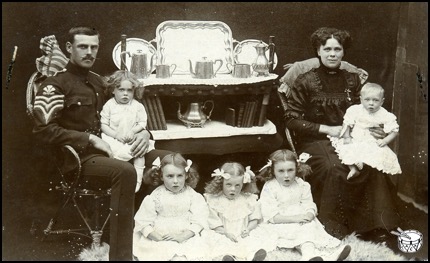
Books and metalware take centre stage in this postcard-backed black-and-white photograph of an army family dating from around a century ago. Prominent on the children's soldier father's right sleeve is an arm badge apparently showing the Prince of Wales' feathers above three point-down chevrons. If you can throw any further light on this photograph, please contact TACA.
A RAJ-ERA ARMY FAMILY IN INDIA
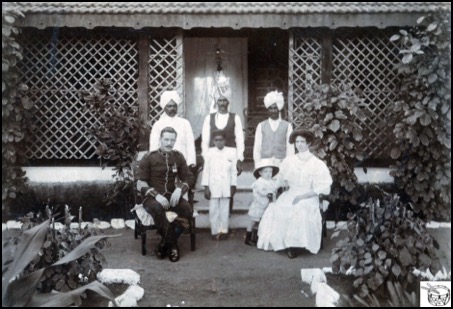
Although we do not know the names of the subjects of this photograph, it was clearly taken in India, during the Raj period, probably during the 1890s or early 1900s. Three Indian men and a boy stand behind an army child and his parents, no doubt in front of their married quarters. The boy’s bemedalled soldier–father is either a quartermaster sergeant or a squadron corporal major.
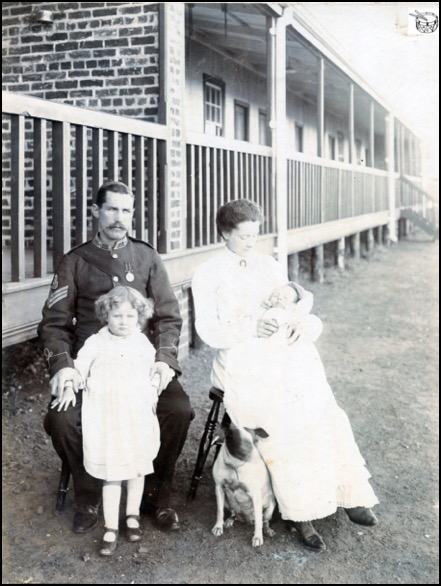
AN ARMY FAMILY PICTURED IN FRONT OF MARRIED QUARTERS, C.1900
This photograph is displayed on a cardboard mount (cropped out here), with ‘Aunt Fanny’ written on the back. It shows an army family, and their dog, in front of a building that probably comprises married quarters. The children’s father is a sergeant, and although the details of the badge above his chevrons are indistinct, it may be a bandmaster’s badge. His medal may be the India Medal, awarded between 1895 and 1902. The style of his wife’s hair and clothes suggests a date of around 1900.
A DRUM MAJOR’S FAMILY PHOTOGRAPHED IN KENT
The photograph below was taken at the studio of Stuart Lancaster & Son, of ‘Chatham Intra Rochester’ (and ‘High Street Blue Town Sheerness’). A legend on the back describes Stuart Lancaster & Son as ‘Photographers to Her Late Majesty Queen Victoria’, which dates the image to some time after Victoria’s death on 22 January 1901.
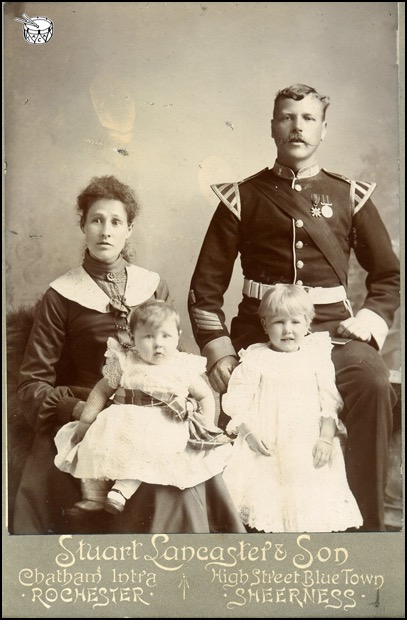
The two army children whose faces were captured in the studio portrait are clearly dressed in their best, whitest clothes. The insignia on their father’s lower right arm consists of four point-up chevrons, with a drum positioned above them, indicating that he is a drum major. His medals are most likely the Ashanti Star, 1896, awarded for participation in the Gold Coast campaign, 1896, and the Ashanti Medal, 1901, awarded for action on the Gold Coast, 1900 (thanks to Paul McCormick, of http://www. britishwarmedals.co.uk, for his help in identifying them). It is difficult to make out his collar badges (they may show a Royal Engineers’ grenade), but at the time that this photograph was taken, Chatham, in the Medway district of Kent, was home to a number of military barracks, as well as the depot and headquarters of the Corps of Royal Engineers (RE), and it may be that he was a member of the RE depot band. (For more information on the history of the Royal Engineers, visit the website of the Royal Engineers Museum and Library: http://www.remuseum.org.uk.)
If you have anything more to add about this photograph, please contact TACA.
AN ARMY FAMILY PHOTOGRAPHED WITH EXOTIC PROPS, 1900S
Various clues suggest that the photograph reproduced below could have been taken abroad, namely the outdoor setting and lush vegetation; the army wife’s lightweight summer outfit; and what appears to be an animal skin or two on the ground. Judging by the style of the soldier–father’s uniform, and of his wife’s clothes, the army family who posed for the photographer most likely did so during the first decade of the twentieth century. The two chevrons on the soldier’s left-hand sleeve, visible to the right of the army child, are good conduct stripes (with a pair usually signifying six years’ service), while the crossed flags of a signaller are discernible above them.
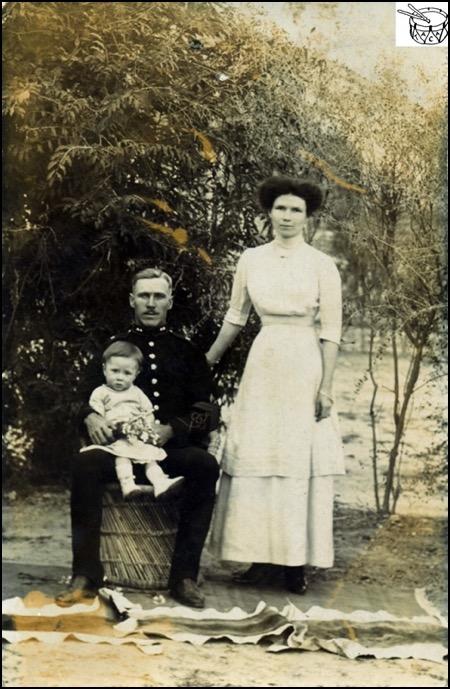
THE FRILLED AND BERIBBONED SERGEANT’S GIRLS
Although the army family shown in the photograph below was captured on film outside, rather than confined within a photographer’s studio, the placement and poses of the army children and their parents remain formal. The style of the clothing and hairstyles of the mother and her daughters suggest that the photograph was taken during the first decade of the twentieth century. Their soldier-husband and -father’s uniform, sash, trio of ‘stripes’, medals and badges indicate that he is a sergeant who has qualified as a musketry instructor and was awarded the Queen’s South Africa and King’s South Africa medals.
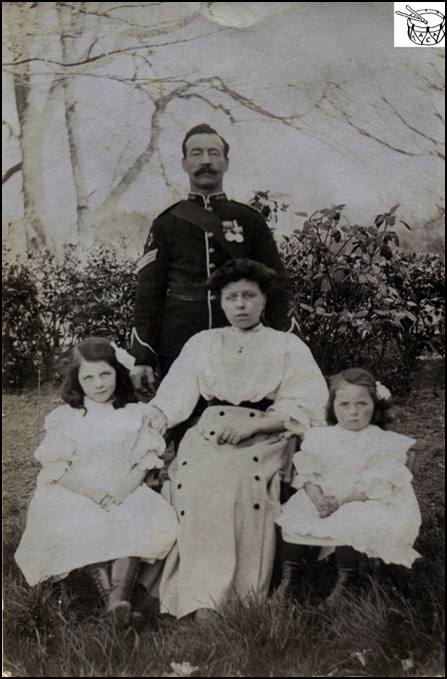
AN EXTENDED ARMY FAMILY PHOTOGRAPHED IN GREAT YARMOUTH, NORFOLK, C.1905
The mount on which this photograph has been pasted (cropped out here), tells us that it was taken in the studio of Frank H Sayers at 26 King Street, Great Yarmouth, in Norfolk. A bemedalled army sergeant is depicted with his wife and child, as well as either his parents or his parents-in-law. The style of his tunic identifies him as a hussar. The style of the women’s clothes indicates a date of around 1905.
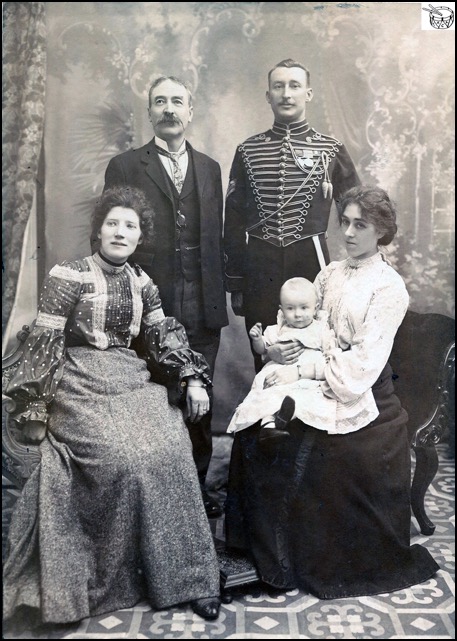
ARMY CHILD FREDDIE HAYHURST AND HIS PARENTS, C.1905
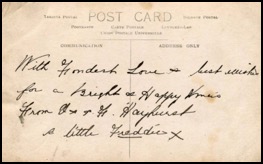
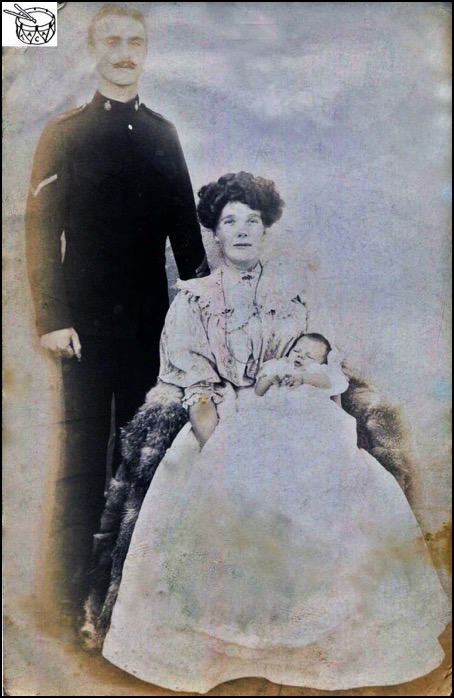
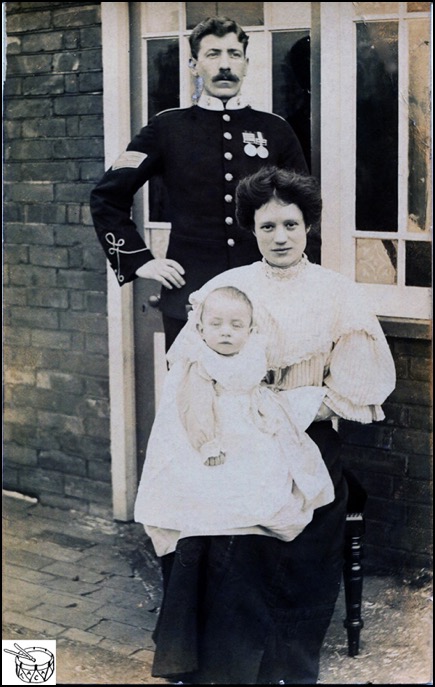
‘THE DAUNTLESS THREE’, 1907
Gazing out at us from the front of this real photographic postcard is an army family photographed in front of a house. The elaborately dressed army child is perched on his or her seated mother’s lap. The three stripes on the child's soldier–father's sleeve tell us that he is a sergeant; his two medals bear many clasps. A message has been pencilled on the reverse. It reads: ‘February 1907 / With love from the dauntless three’.
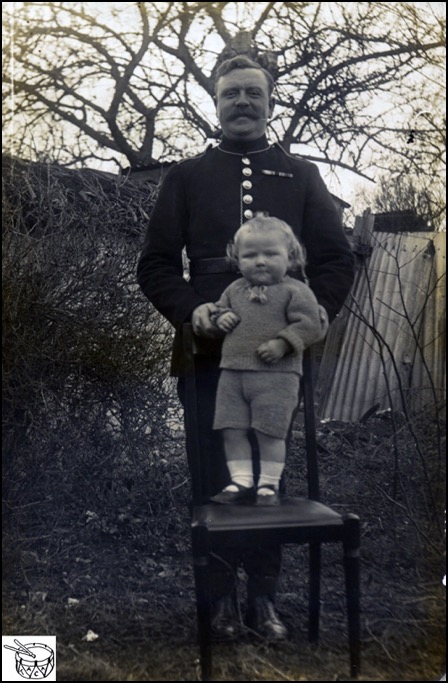
FREDERICK JOSEPH AND HIS SOLDIER–FATHER, AN EARLY TWENTIETH-CENTURY PHOTOGRAPH
The reverse, message side, of this charming real photographic postcard is divided into two, which tells us that its earliest possible date is 1902. ‘Frederick Joseph’, the name of the small boy pictured on the front, is written in black ink on the back, along with his age: ‘1 year 8 months’. Sadly, his family name is not given, nor is the name of his soldier–father, whose uniform predates World War I, and which features a row of medal ribbons on the left breast.
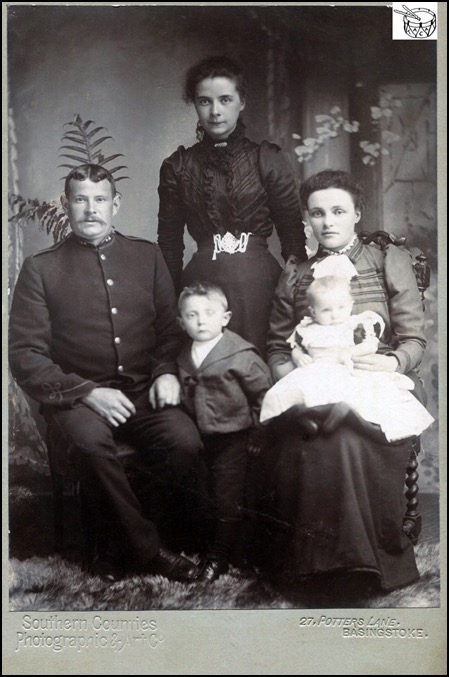
AN ARMY FAMILY PHOTOGRAPHED IN BASINGSTOKE, HAMPSHIRE, C.1900–10
The army family pictured on the cabinet print below visited the ‘Southern Counties Photographic & Art Co’ studio at ’27, Potters Lane, Basingstoke’ in order to be photographed. The family comprises a British soldier, his wife and three children. The style of the outfits worn by his wife and elder daughter suggests that the photograph dates from the first decade of the twentieth century.
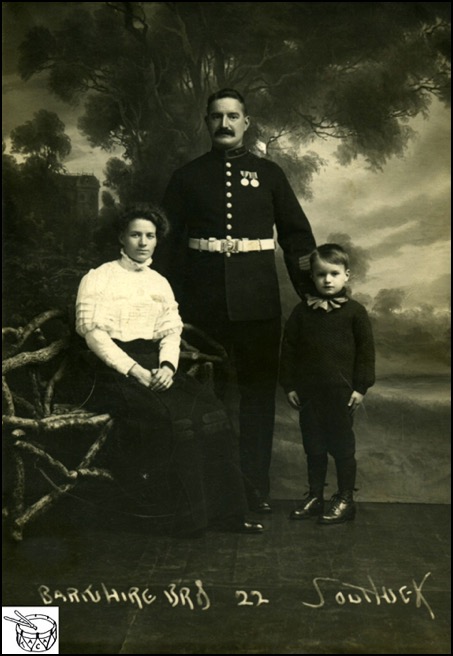
AN EDWARDIAN ARMY FAMILY POSED AGAINST A ROMANTIC BACKDROP
The small army family that once posed stiffly in front of a photographic studio’s romantic backdrop are clearly dressed in their best: the soldier–father is wearing his medals; his wife, a frilly white blouse and tailored skirt; while their small son sports shiny shoes, an elaborate collar and neatly brushed hair. The address of the studio, written on the front of this photographic postcard, should have made it easy to trace – had the writing been more legible (and if anyone can decipher it, please let us know). They are difficult to make out, but there may be four good-conduct chevrons on the soldier’s lower left arm, denoting eighteen years’ service; his white belt suggests a date before 1908, while the postcard mount on which the photograph is printed indicates a date no earlier than 1902.
AN ARGYLL AND SUTHERLAND HIGHLANDER'S FAMILY, 1907–11
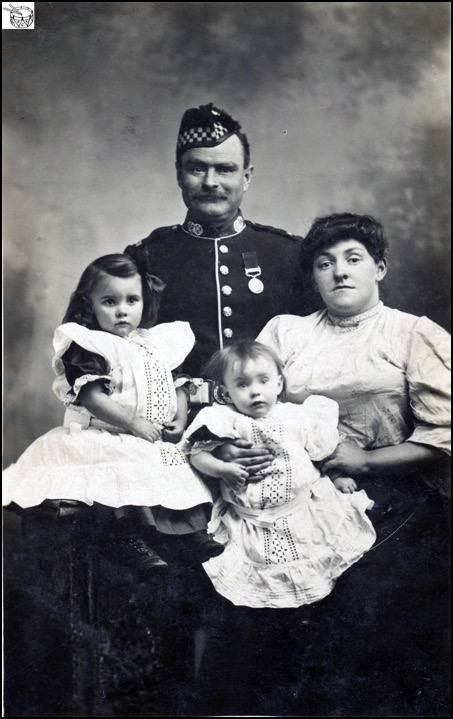
This family photograph was taken by a USA Studios’ photographer. Printed as a postcard, the shield design in the stamp box on the reverse dates it to between 1907 and 1911. The children’s bemedalled soldier–father is wearing a Scottish regiment’s Glengarry cap with a chequered band. His distinctive collar badges are those of the Argyll and Sutherland Highlanders.
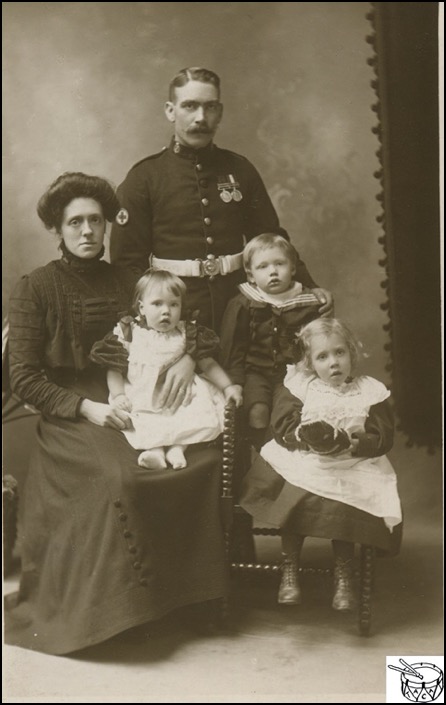
THE FAMILY OF A BOER WAR VETERAN, 1900S
A number of clues indicate that this army family of five was photographed at the start of the twentieth century. The soldier’s luxuriant moustache suggests that it was within the first decade of the 1900s, his white-leather belt further narrowing down the date to before 1908. In addition, he appears to be wearing the Queen’s South Africa medal and the King’s South Africa medal, both of which were awarded for service in the Boer War, between 11 October 1899 and 31 May 1902 and after 1 January 1902 respectively. The details of the badges on his collar and belt buckle are too indistinct to make out, but the circular badge containing a red cross on his right arm tells us that he was a medic, that is, that he was serving in the Royal Army Medical Corps (RAMC); he also wears the blue dress tunic that signifies a corps. The style of the children and their mother’s clothes – notably the boy’s sailor suit and the older girl’s laced-up boots, along with their mother’s hairstyle – also point to a date of between 1900 and 1910. His wife’s black dress, and the black button that punctuates the line of shiny brass buttons on the soldier’s tunic, together tell us that the adults are in mourning. The photograph is printed on a postcard, the back of which states that it was produced by the Curzon Studios, an East London photographic enterprise then based at 115 and 168, The Grove, Stratford, and 656 Romford Road, Manor Park.
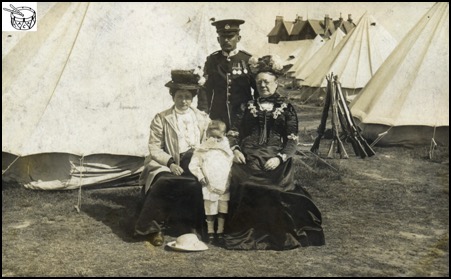
VISITING AN ARMY CAMP BETWEEN THE BOER WAR AND WORLD WAR I
A gust of wind has caused an army child’s collar to blow up and obscure his face as he is snapped with three adults who are likely to be his parents and grandmother at an army camp somewhere in England (possibly Salisbury Plain) at the start of the twentieth century. An arrangement of rifles can be seen behind the family group, which is posed in front of a veritable village of tents, these being temporary accommodation for the soldier pictured here and his brothers-in-arms; the women and small boy are clearly visitors. The style of their soldier–relative’s uniform, with its white facings, predates World War I, while his service-dress cap dates from 1905. Three chevrons indicating a sergeant’s rank are just visible on his right sleeve, and he wears an NCO’s sash. His medals and cap and collar badges are indistinct (the cap badge may be that of the Hampshire Regiment), but the medals appear to include the Queen’s and King’s South Africa medals for service in the Boer War, and maybe also a long service and good conduct medal. As you might expect, the older woman wears a more old-fashioned (and more elaborate) outfit than the boy’s mother, whose hat and blouse suggest a date between 1905 and 1910. This photograph was printed as a postcard.
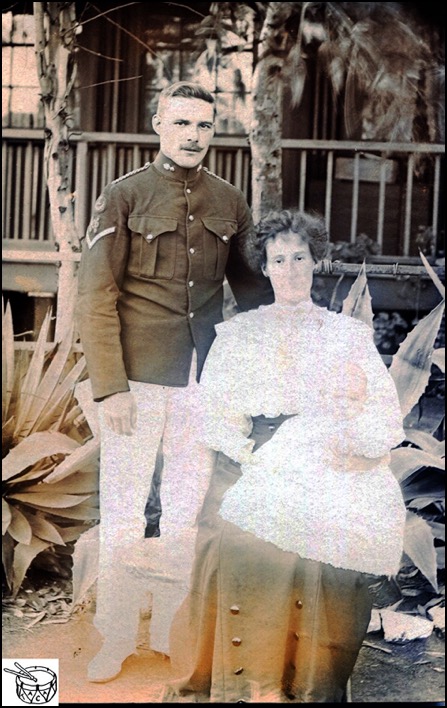
A LANCE CORPORAL’S FAMILY PHOTOGRAPHED IN A FOREIGN SETTING, C.1905
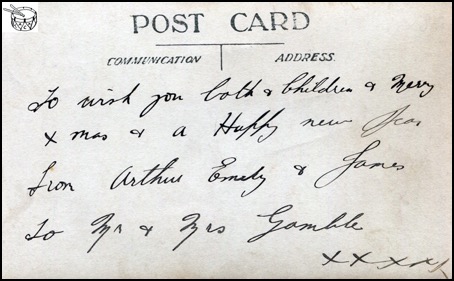
The photograph of a lance corporal and his family shown below has been overexposed, so that his wife’s features are not easily to discern, and that of their baby even less so. Judging by the plants behind them and what appears to be a verandah, the trio – Arthur, Emily and baby James – were photographed in a foreign setting. The postcard was printed on a postcard mount, its central division indicating a date after 1902. Identifiable details of Arthur’s uniform include grenade collar badges, suggesting that he is a fusilier; a saddler’s trade badge (above his lance corporal’s stripe); the white trousers that were worn in hot climates; and braided shoulder straps, which were prevalent between around 1904 and 1907.
The message written on the back (below) reads, ‘To wish you both & Children a Merry Xmas & a Happy new Year. From Arthur Emily & James to Mr & Mrs Gamble xxxxx’.
AN ARMY FAMILY PHOTOGRAPHED IN 1906

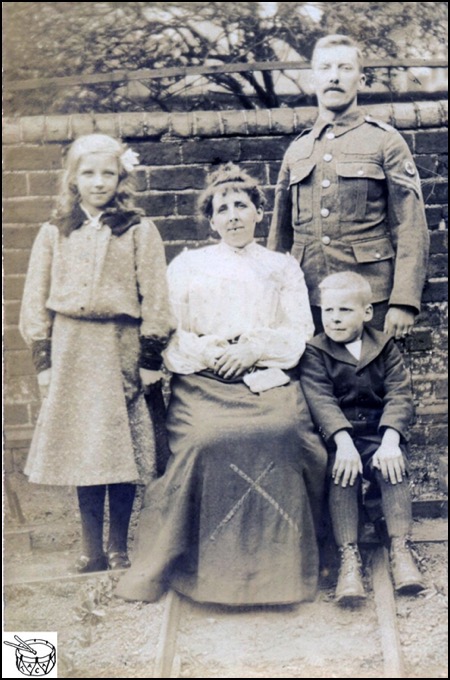
AN EDWARDIAN LANCE CORPORAL AND HIS FAMILY PHOTOGRAPHED IN KENT, C.1906
Printed on a postcard mount, this photograph of a lance corporal, his wife, daughters and dog was franked in Ashford, Kent, on 24 May 1906. The handwritten message from the army wife pictured here, to her sister in Tunbridge Wells, Kent, reads, ‘Dear Isobel, I shall be so glad if you will send me the fashion books as I cannot get them here. I am not very well this week I’ve got neuralgia but Tom is going into Ashford to get me something this evening. Love to all from us all your loving sister Lall’.
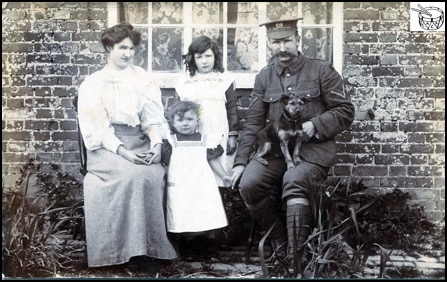
SUITED AND BOOTED
The black stockings and boots worn by the two boys in this photograph of an army family, which probably dates from the first decade of the twentieth century, are in striking contrast to their light-coloured suits. The three chevrons beneath a crown that are visible on their father’s right-hand sleeve indicate that he is a quartermaster sergeant.

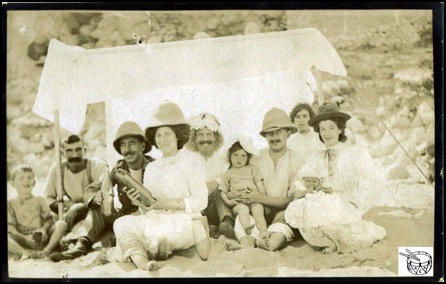
A SUNNY DAY ON A FOREIGN BEACH A CENTURY AGO
The photographic postcard below dates from the early decades of the twentieth century and shows a group of British soldiers with two army wives and four children enjoying a sunny day at the beach, probably in India. The men, in shirtsleeve order, wear Wolseley helmets, as does the lady at the front, who has swapped her hat with the man who is grinning broadly behind her.
A SUNNY DAY AT WHITTING BARRACKS, LICHFIELD, STAFFORDSHIRE, c.1900-10
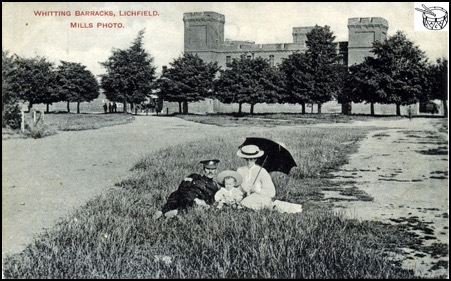
The black-and-white postcard below was produced by Mills Studios in Brownhills, in the West Midlands, and shows a sergeant posing with his wife and their small son on Whittington Heath against the backdrop of Whitting (or Whittington) Barracks, Lichfield, Staffordshire, then home to the South Staffordshire and Prince of Wales’s (North Staffordshire) regiments (click here for more information about the barracks). The lady’s boater-style hat, along with her outfit, suggest a date of between 1900 and 1910; she has opened her umbrella to protect herself from the sun.
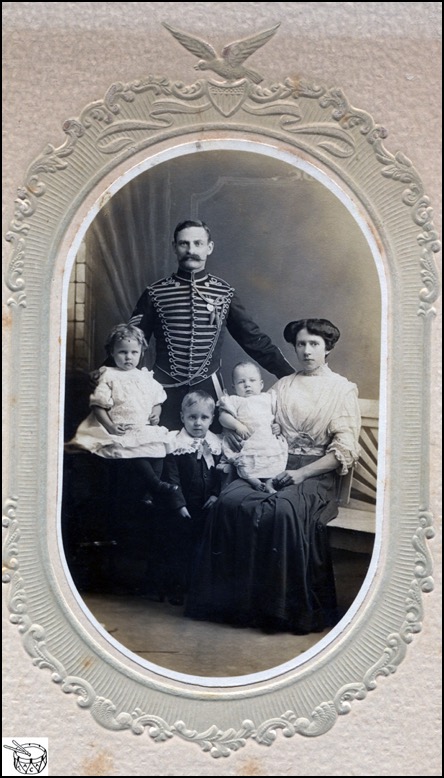
THE SAYERS FAMILY, WOOLWICH, LATE 1900S
This photograph of a Victorian army family has been inserted into an ornate mount produced by USA Studios, which had branches in London and the provinces, according to the typeset details on the reverse. ‘Woolwich’, in south-east London, has also been stamped on the back, and a handwritten note identifies the family as ‘Grandma & Grandpa Sayers / Mütti / U. Freddie / U. Jim’. (Presumably the little girl grew up to become a mother, and her brothers, uncles.) The children’s bemedalled soldier–father is wearing a hussar’s tunic. The three stripes on his left sleeve tell us that he is a sergeant, but details of the badge above are not discernible. Their mother’s hairstyle and outfit suggests a date of around 1908.
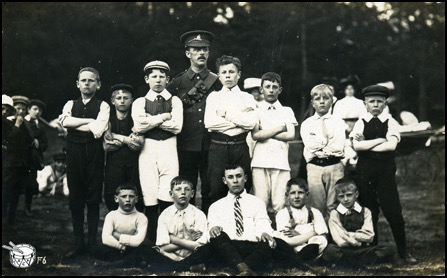
A TUG-OF-WAR TEAM, DEEPCUT, SURREY, 1909
A neatly penned note on the back of the postcard below tells us that we are looking at a proudly posed boys’ tug-of-war team photographed at Deepcut in May 1909. Deepcut Barracks was established in Surrey in 1903, when it became home to the Royal Field Artillery (RFA), and the presence of the soldier at the centre of the photograph (whom the writer seems to identify as Bombardier Barnard) suggests that the boys are likely to have been army children.
A PRE-1918 VISIT TO AN ARMY CAMP
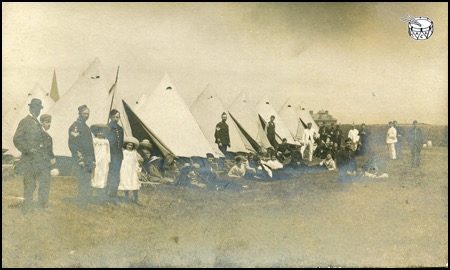
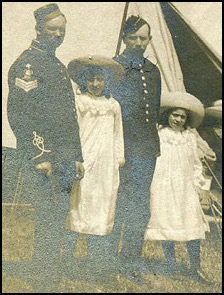
Perhaps pictured on a family visit to a temporary army camp, the enlarged detail at right reveals that the girls are standing alongside a sergeant wearing a pillbox cap and another soldier who is wearing a forage cap.
AN ARMY CHILD’S CHRISTENING, C.1910
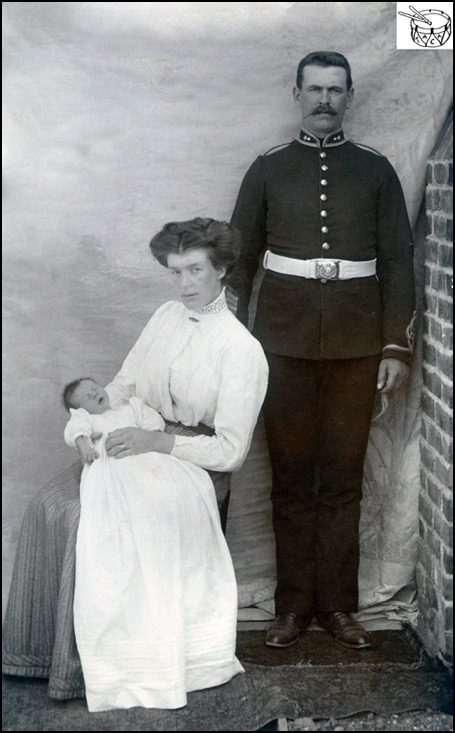
This photograph of an army family, who posed in front of a makeshift backdrop, was printed on a postcard mount with a divided back, meaning that it dates from after 1902. The style of the soldier’s uniform, together with those of his wife’s hair and clothes, suggest a date of around 1910. Their sleeping baby is wearing a christening gown, indicating that this photograph was taken to mark his or her baptism.
A PRE-1914 WEST-COUNTRY ARMY FAMILY
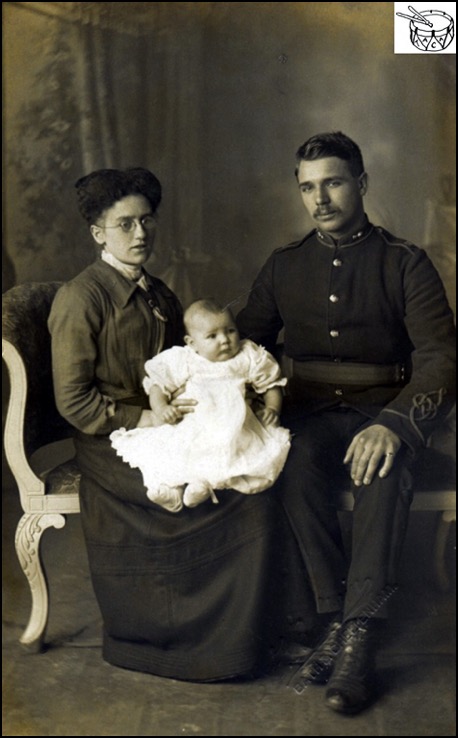
This photograph of an army family was printed on a postcard with a divided back, which means that it dates from 1902. The name of the photographic studio that produced it is embossed across the bottom right-hand corner: ‘E. & F. Baldwin / BATH & CHELTENHAM.’ [respectively in Somerset and Gloucestershire]. The baby’s soldier–father appears to be wearing a blue tunic of the type usual before 1914, suggesting that he belongs to a corps, while his collar badges appear to have the outline of a fired grenade, suggesting that the corps in question is either the Royal Engineers or the Royal Artillery. The army child appears to be wearing a christening gown.
A BOMBARDIER’S FAMILY PHOTOGRAPHED IN WALMER, KENT, 1910S
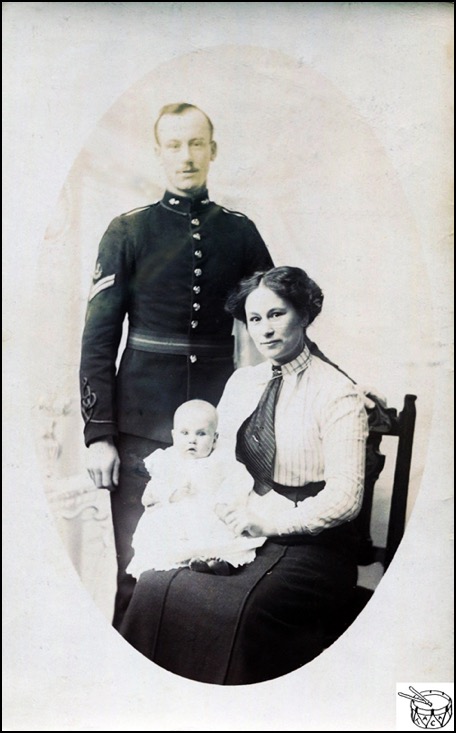
This photograph of a corporal and his wife and child was printed on a divided postcard back, which means that it dates from some time after 1902. Details of the photographic studio that printed it are given on the reverse: ‘E Neame Roff, 66, The Strand, Walmer [in Kent]’. The baby’s mother’s hairstyle and outfit suggest a date of between 1910 and 1914. His flaming-grenade collar badges and the two chevrons on his sleeve, along with other details of his uniform, indicate that the soldier is a bombardier in the Royal Artillery.
AN INFORMAL SNAPSHOT OF AN EARLY-TWENTIETH-CENTURY ARMY FAMILY
Most of the World War I-era photographs that have survived are studio portraits, so this charming informal snapshot of a relaxed-looking soldier and his family makes a striking contrast. Although no rank or unit badges are visible on the soldier-father’s uniform, his puttees and tunic, as well as his family’s hairstyles and clothes, suggest that this photograph (which was intended to be used as a postcard) was taken some time after 1907.
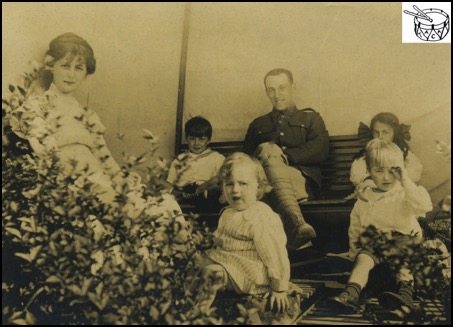
THREE ARMY FAMILIES PHOTOGRAPHED SHORTLY BEFORE WORLD WAR I
Judging by the women’s hairstyles and clothes, the black-and-white postcard below dates from between around 1910 and 1914. It appears to show three army families: three soldiers, their wives, their sons and daughters and a dog. Their collar badges indicate that the soldiers (wearing ‘blues’) belong to the same unit (probably a regiment of fusiliers), with the chevron and crossed flags on the central soldier’s right sleeve suggesting that he is a signalling lance corporal. The rugged backdrop and the rugs on which the army children are arranged suggest that the families were snapped on an outing.
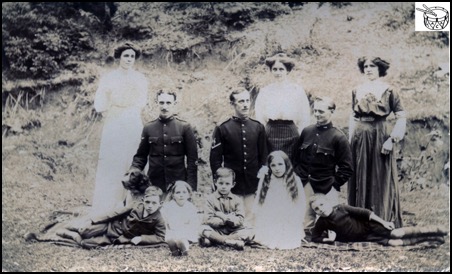
COMMEMORATING A CHRISTENING
The style of the mother and older children’s clothes, and of the soldier father’s uniform (the bandolier is its only distinctive visible feature), dates this photograph to around World War I. Looking at the baby’s long, white gown, the photograph may have been taken to commemorate its christening; none of the family looks particularly happy, however.
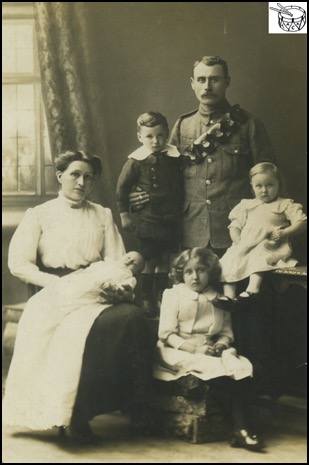
A WORLD WAR I ‘TEMPORARY’ ARMY FAMILY
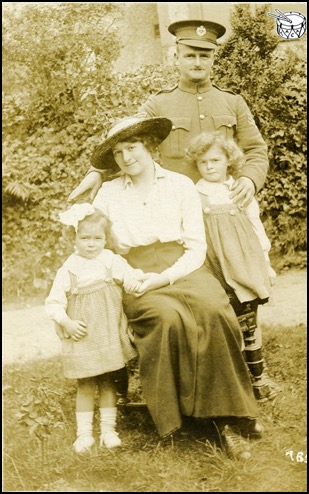
The soldier standing behind them being almost certainly a World War I volunteer rather than a regular soldier, the three youngsters captured on film between 1914 and 1918 in the photograph below were therefore probably only temporarily army children. This suggests that they were no doubt spared frequent house moves, but not the difficulty and anxiety of having an absentee father who was in very real danger of being killed or injured. The ‘S’-shaped buckle of the belt that their father is wearing was a feature of the 1914 Pattern uniform. His cap badge is that of the South Staffordshire Regiment.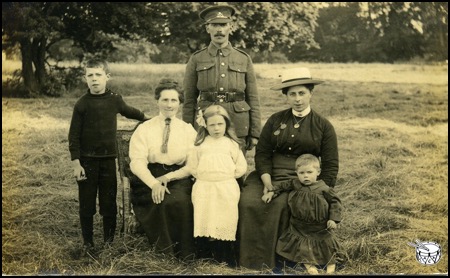
SUMMERTIME SMILES
This charming summertime photographic portrait of an army family dates from World War I. All that we know for certain about the father of the two girls, thanks to the three stripes on his sleeves, is that he is a sergeant. Its details are little indistinct, but his cap badge may be that of the Royal Engineers.
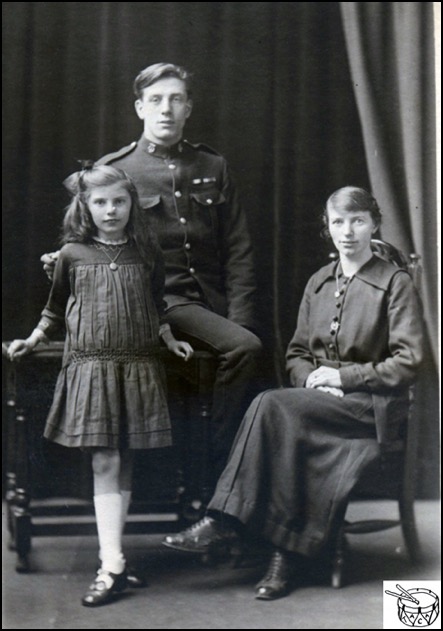
The three members of the army family who posed for the black-and-white photograph below did so at Simnett’s, a photographic studio that is still based at 2 Guild Street, Burton on Trent, Staffordshire. A handwritten note on the back of the photographic postcard states that the photograph was taken on 18 April 1920. Judging by his medal ribbons, the soldier–father of the smartly dressed army child in the foreground served in World War I; the collar badges that would have identified his regiment or corps are indistinct.
‘DADDY MARCHING WITH HIS SOLDIERS’
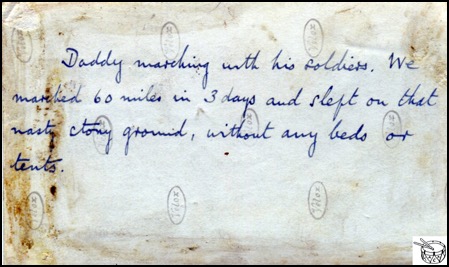
The photograph below, printed on Velox photographic paper, shows a British soldier at the head of a column of turban-wearing troops. The location is unknown, but the message on the back (bottom), written by the British soldier to his child, provides some context: ‘Daddy marching with his soldiers. We marched 60 miles in 3 days and slept on that nasty stony ground without any beds or tents.’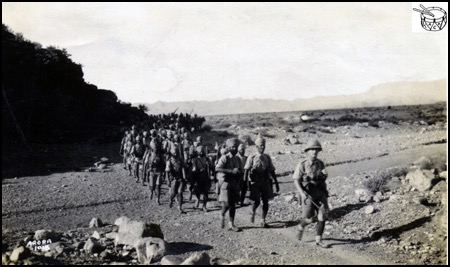
A PIONEER SERGEANT'S FAMILY
Shown below is a studio portrait of an army family probably photographed during the early years of the twentieth century. Judging by the crossed axes above the three chevrons on his left sleeve, and by the visible lion collar badge, the father of the family was a pioneer sergeant in the King's Own Royal Regiment (Lancaster). (See the King's Own Royal Regiment Museum's website for an overview of the regiment's history: http://www. kingsownmuseum.plus.com.)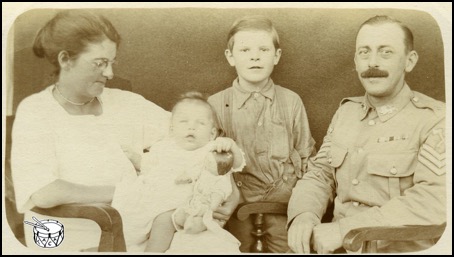
Peter Donnelly, curator of the King's Own Royal Regiment Museum in Lancaster, has kindly confirmed that the soldier father is wearing the uniform of a pioneer sergeant in the King's Own Royal Regiment (Lancaster). As he explains, Peter has, in addition, dated the photograph to the early 1920s:
'I can confirm that the pioneer sergeant in the photograph is serving with the King's Own Royal Regiment after the First World War. The medal ribbons are for the 1914 or 1914/15 Star, British War and Allied Victory Medal, which means the soldier served through the First World War. There were a good number of men who joined during the war and continued to serve after the war, being required to re-enlist. I am pretty sure that the photograph is taken in Burma or India in the early 1920s, from the style of jacket, which means the sergeant is with the 2nd Battalion.'
Many thanks to Peter for throwing further light on these forgotten faces.
A SNUGLY DRESSED 1920S’ ARMY CHILD AND HER FAMILY
While her mother’s coat has a fur collar and cuffs, the small army child in this back-garden snapshot wears a woolly top and side-buttoning leggings to combat the cold. It is difficult to make out the details of her soldier-father’s collar and sleeve badges, or the row of medal ribbons above his left-hand breast pocket, but the three chevrons on his sleeve clearly proclaim his rank: sergeant. In fact, the indistinct badges look suspiciously like flaming grenades, so it is likely that he is an engineer sergeant. His wife’s cloche hat dates this photograph to the 1920s.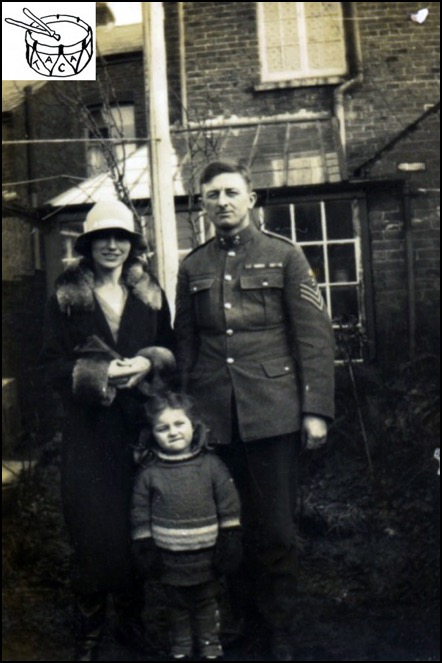
AN ARMY FAMILY SNAPPED DURING THE 1920S
Judging by the style of the hats worn by the two girls, and also that of their mother, the snapshot of this army family (below) was taken during the 1920s. A handwritten note on the back tells us that the beaming soldier was an ‘Uncle Frank’ to someone, and the two stripes on his right arm indicate that he was a corporal when he posed with his wife and daughters for the photographer; his collar badges are indistinct, however.

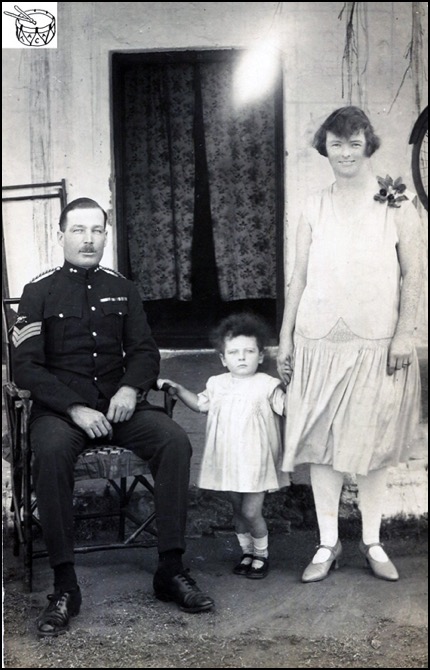
AN ARMY FAMILY PHOTOGRAPHED IN BANGALORE, INDIA, C.1920S
A stamp on the back of this real photographic postcard tells us that the pictured army family was photographed by ‘A. P. S. Pane, Regtl. [Regimental] Photographer. Bangalore. [or Bengaluru, in India]’. A handwritten note ‘To Cyril & Rose and Little one’ from ‘Beat Doll & Doug’ also gives the family’s first names. Guessing that Doll is the little girl, the clothes worn by her mother, Beat, suggest that the photograph dates from the 1920s. Doug, Doll’s soldier–father, has a row of medal ribbons above his left-hand jacket pocket and flaming grenades for collar badges. The three stripes on his sleeve and badge above tell us that he is a quartermaster sergeant in the Royal Artillery.
AN ARMY CORPORAL AND HIS FAMILY, 1920S
Pictured here are a corporal with his wife and daughter. We know neither the family’s names nor the studio in which they were photographed, but the style of the little girl’s mother’s clothes and hair suggest a date of the 1920s.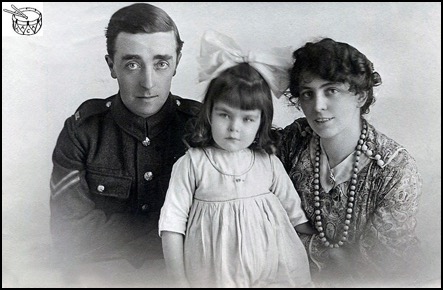
A FANCILY-DRESSED ARMY FAMILY OF FOUR, MID-1920S
The studio portrait below portrays an army family of four photographed in around the mid-1920s, judging by the style of the mother’s outfit, with the two army children clearly being dressed in their best clothes, with freshly brushed hair. Although his collar and shoulder badges can’t be made out, his open-necked jacket, shirt, tie and Sam Browne belt indicate that the soldier is an officer.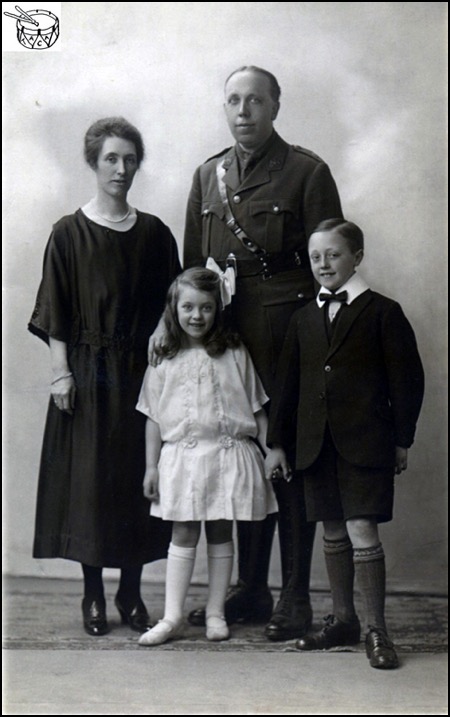
A WEDDING IN GIBRALTAR, 1926
This photographic postcard shows a wedding that took place eight years after World War I ended. A note written on the back gives the time as Saturday 27 November 1926, and the place as South Barracks Church, Gibraltar, but does not name the bride and groom. Zooming in, the three stripes on the groom’s sleeves tell us that he is a sergeant, as is the bemedalled soldier on the right, who is smiling, unlike the small flower girl (most likely an army child) standing on the steps next to the bride. The badge on the sleeve of the soldier on the left features a harp, indicating that he is a bandmaster. On the far right, a woman readies herself to throw confetti.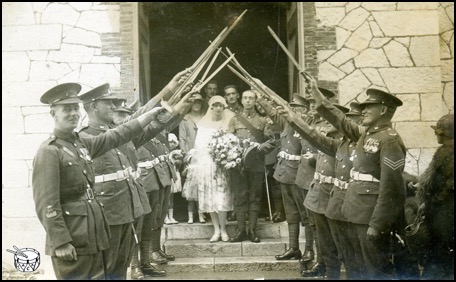
AN ARMY FAMILY PHOTOGRAPHED ABROAD BETWEEN THE WARS
The pictured army family was photographed alongside exotic-looking props, suggesting a foreign location, perhaps India. Also notable is the stone-flagged floor and large arched window behind a diaphanous curtain. The small boy is obviously dressed in his best, while his mother’s hairstyle and clothes suggest the 1920s or 1930s. His soldier–father has a long row of medal ribbons on his chest. The three chevrons on his left arm tell us that he is a sergeant, what appears to be a crown above indicating a senior sergeant’s rank. The photograph has been printed on a postcard mount. A handwritten note on the back reads ‘C.M.S. Riddle’.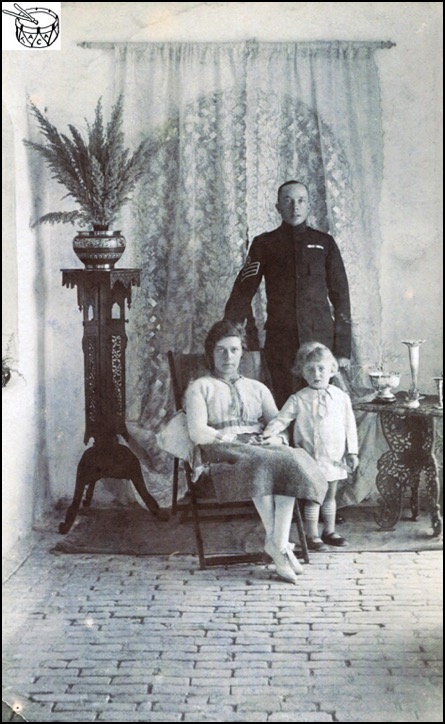
AN ARMY FAMILY PHOTOGRAPHED BETWEEN THE WARS IN MULTAN, INDIA
There is a handwritten message on the back of the real photographic postcard shown below. It reads: ‘To Aunt Lucy and all at Commonside with best wishes from all at Multan’; there is a signature, but it is illegible. Pictured on the front are two young boys, their baby sibling and their parents. Their soldier–father is wearing British Army tropical uniform, including shorts, puttees and hosetops. Judging by the style of the clothes worn by the boys and their mother, the photograph is likely to date from between the wars. Multan, now in Pakistan, was then part of India.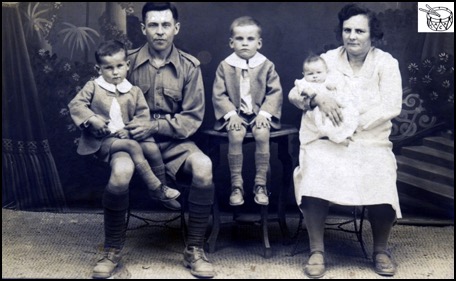
A ROYAL ARTILLERY FAMILY OF THE 1930S
No rank insignia is visible on the uniform worn by the father of the two army children in the studio portrait below right, but certain visual clues tell us more about when he served in the British Army, and in which regiment.
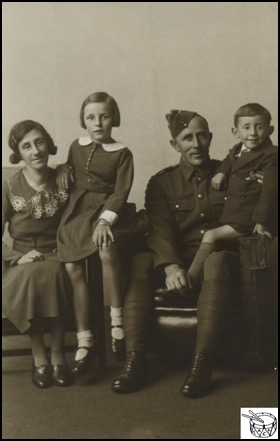

A BETWEEN-THE-WARS ARMY FAMILY PHOTOGRAPHED IN ALEXANDRIA, EGYPT
An identifying stamp in the bottom-right-hand corner of this photographic postcard tells us that it was produced by Shahen & Co, Alexandria. Alexandria was one of the main bases for British troops in Egypt between World War I and World War II, most likely the time when this army child was photographed with her parents. Her soldier–father’s medal-ribbon bar suggests that he served in World War I; his shoulder title is too indistinct to tell us his unit, however.
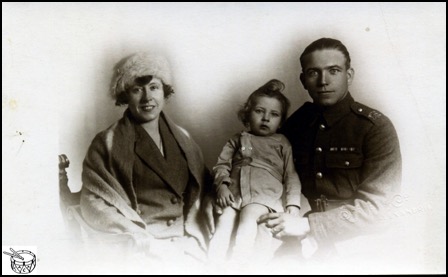
A 1930S’ ROYAL ARTILLERY FAMILY
Presented as a postcard, the black-and-white photograph below shows a Royal Artillery soldier and his family. Clearly dressed in their best clothes, the two army children seem to be standing apprehensively to attention as they face the photographer. Their other-rank father wears two good-conduct stripes on his lower-left sleeve, awarded after six years of service.
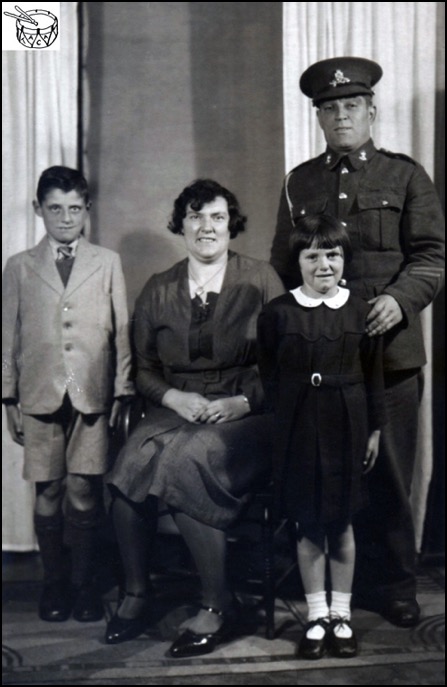
A TWENTIETH-CENTURY ARMY FAMILY PHOTOGRAPHED IN BATH, SOMERSET
Gazing out at us from the black-and-white photograph below is an army family of five. The position of the three children’s hands is notable: the older children’s are touching their parents’ shoulders, while their younger sister’s rest on their father’s hand and their mother’s arm. The grenade badge and three stripes on their soldier–father’s upper arm indicate that he is an engineer sergeant; he also wears grenade collar badges, and medal ribbons are visible above his left-hand tunic pocket. The details of his cap badge are difficult to make out. Printed information on the reverse informs us that the family was photographed at Mower’s Studios, on Westgate Street, Bath, in Somerset, probably between the wars.
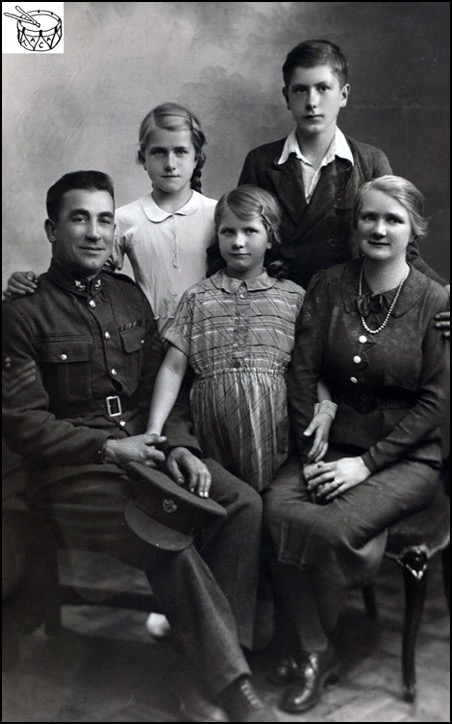
A MID-TWENTIETH-CENTURY LANCASHIRE FUSILIER FAMILY
The photograph shown below, of two young parents and their baby, was taken at the Oxford Studio, 133 Oxford Road, All Saints, Manchester, during the 1930s or 1940s. The soldier–father’s cap badge identifies his regiment as the Lancashire Fusiliers.
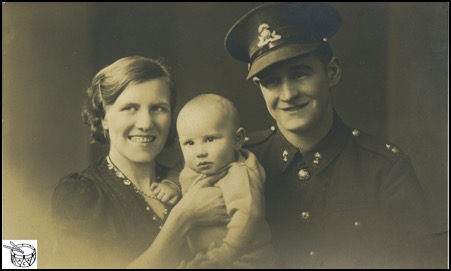
AN ARMY FAMILY SNAPPED DURING WORLD WAR II
We don’t know the names of the army child and her parents who are pictured below, or where they were photographed. The style of their clothing, and of the girl’s soldier–father’s uniform, suggests that they were snapped during the late 1930s or early 1940s.
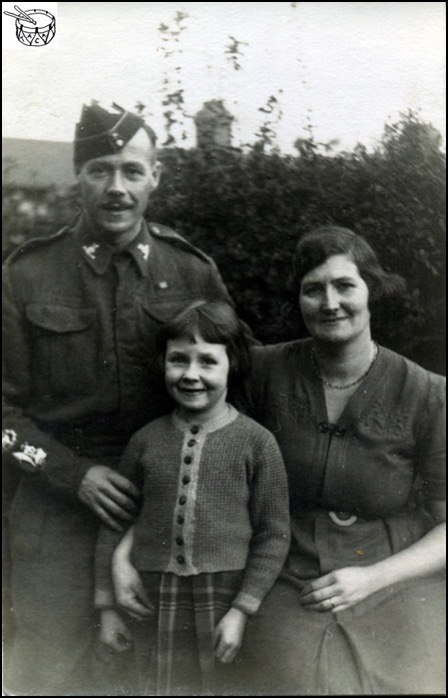
A SERGEANT-MAJOR’S FAMILY PHOTOGRAPHED IN DORCHESTER, DORSET, C.1937–41
This black-and-white photograph of a sergeant major and his family is printed on a postcard mount; the name and address of the studio in which the family is pictured is stamped on the bottom right-hand corner: H P Webber, Cornhill, Dorchester. The style of the sergeant major’s tunic and side cap suggests a date of between 1937 and 1941; the most notable feature of his uniform are his medal ribbons and sergeant-major's crowns. His wife and daughter’s clothes and hairstyles suggest the same period.
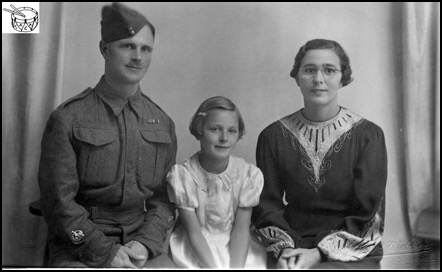
A SEPARATED ARMY FAMILY, 1940S
The composite postcard of a separated army family reproduced below was produced as a real photographic postcard by Studio Aram, as is stamped on the back.
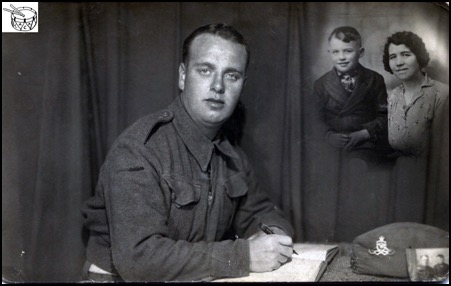
A British soldier is pictured gazing at the camera, apparently writing in the book in front of him. His field service cap lies on the table, and the cap badge tells us that he is serving in the Royal Artillery. Together, his battle dress, field service cap and arm-of-service stripe suggest that this photograph dates from World War II.
Inset in the top right-hand corner is a photograph of the soldier’s son and wife. Look closely at the bottom right-hand corner, and it is clear that the photograph above was copied from the one that you can see there: the boy’s posture is the same, although in this image, his soldier–father is sitting on his right, while his mother, on his left, has been cropped out. The soldier must have given Studio Aram the photograph of the three of them to enable the production of the main, composite image.
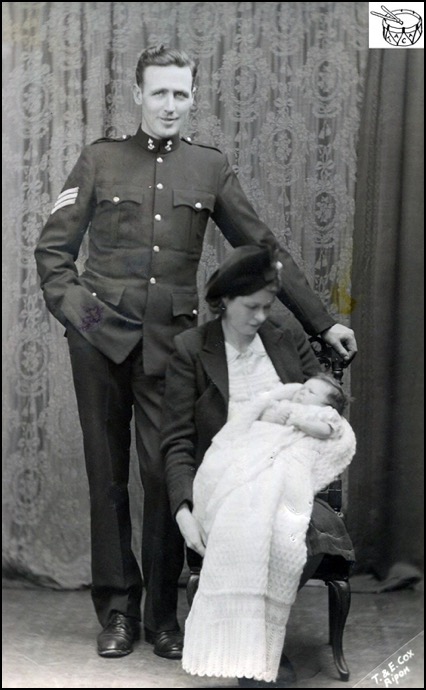
A SERGEANT’S FAMILY PHOTOGRAPHED IN RIPON, WEST RIDING OF YORKSHIRE, 1940S
The photograph below, which was printed on a postcard mount, was taken in the studio of T & E Cox in Ripon (which was then in the West Riding of Yorkshire), no doubt to commemorate the baby’s christening. The baby’s father, a sergeant, is pictured without his belt; his grenade collar badges indicate that he was serving in the Royal Artillery. The style of his wife’s clothes suggests that this family portrait dates from the 1940s.
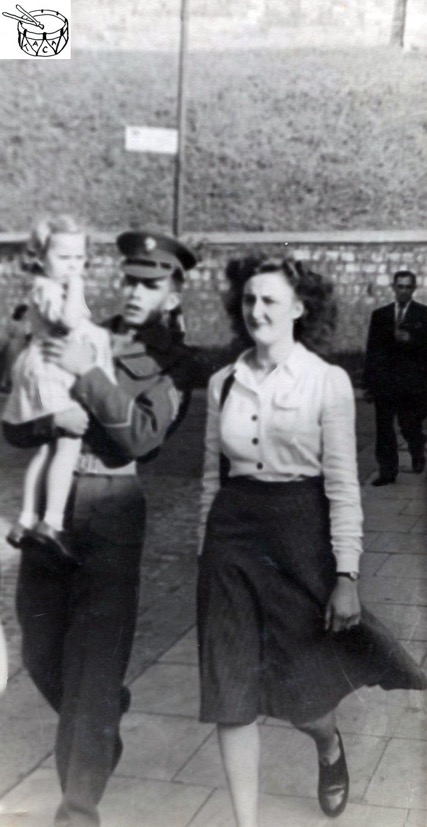
AN ARMY FAMILY PHOTOGRAPHED BY A CHALFONT-ST-PETER PHOTOGRAPHER, 1940S
According to a stamp on the reverse, the snapshot below of an army family was produced by Charles Hearne & Son, a photographic studio based at 21 Market Place, Chalfont St Peter (in Buckinghamshire), probably during the 1940s. A handwritten note on the back names the family: ‘Bill, Pat & Sheila (aged 3 yrs) walking down from the Castle’. The stripes on his upper left leeve suggest that the little girl’s father is a corporal; the chevron on his lower left sleeve is a good-conduct stripe.
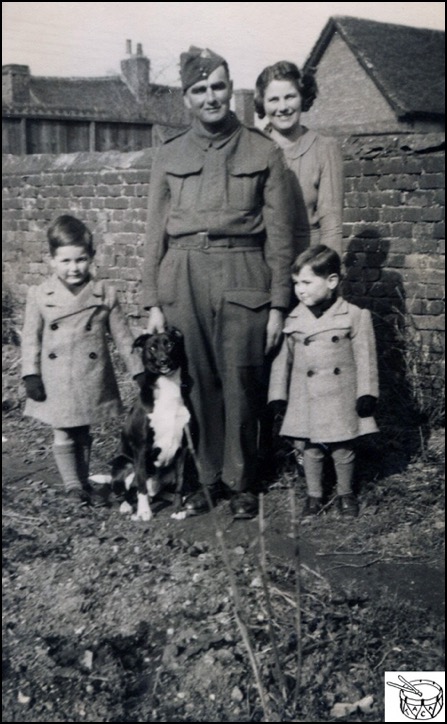
AN ARMY FAMILY, AND THEIR DOG, PICTURED DURING WORLD WAR II
The snapshot below shows a soldier with his wife and sons, as well as the family dog. Although the names of the family are unknown, as is the location, the style of the soldier’s uniform – battle dress and field service cap – dates the photograph to the early years of World War II.